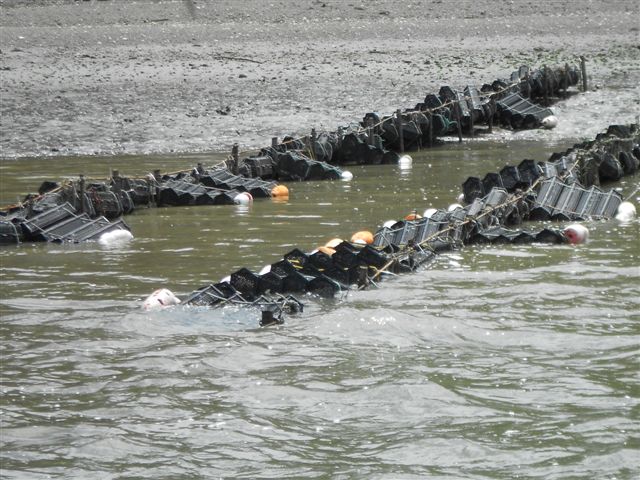
Our mission is to protect the habitat of Puget Sound tidelands from the underregulated expansion of new and intensive shellfish aquaculture methods. These methods were never anticipated when the Shoreline Management Act was passed. They are transforming the natural tideland ecosystems in Puget Sound and are resulting in a fractured shoreline habitat. In South Puget Sound much of this has been done with few if any meaningful shoreline permits and with limited public input. It is exactly what the Shoreline Management Act was intended to prevent.

Get involved and contact your elected officials to let them you do not support aquaculture's industrial transformation of Puget Sound's tidelands.

Governor Inslee:
Showing posts with label taylor shellfish mussel farm. Show all posts

Saturday, December 20, 2014

Taylor Shellfish Mussel Farm Monitoring: Thurston County Passes Responsibility to DNR

Where is Thurston County lacking expertise?
 
Is this a good hand?
Thurston County's not sure, folds, 
and will let DNR play its hand.

Cumulative impacts analysis not required but you will have to monitor specific parameters (Shorelines Hearings Board reversal of permit denial for Taylor Shellfish 58 raft mussel farm)
In June of 2013 the Shorelines Hearings Board reversed Thurston County's denial of a Shoreline Substantial Development Permit for a 58 raft mussel farm to be operated by Taylor Shellfish. The county's hearing examiner had denied that permit application based on a lack of information, thereby requiring a cumulative impacts analysis.

Taylor Shellfish appealed that decision to the Shorelines Hearings Board which reversed the denial, approving the SSDP but adding a condition which required the development of a plan to monitor very specific items (e.g., dissolved oxygen and mussel fall-off below the rafts) and what Taylor Shellfish would be required to do if problems were found (see below for the specific condition, or click here for the decision which has Condition 2 on pages 33/34).

Taylor Shellfish agrees they will monitor, what they want to monitor and when
Taylor Shellfish took issue with what it was supposed to monitor and provided alternatives which it felt better represented impacts (see Taylor's draft alternative here). The County and Taylor Shellfish were unable to come to terms with the differences between what the SHB had in its condition and what Taylor Shellfish felt was more appropriate, resulting in a letter to the SHB stating future negotiations would be "fruitless" (see letter here).

Those threats of litigation by Taylor Shellfish cause Thurston County to admit they do not have the expertise, believing DNR does
After that letter and the threat of further litigation the County chose instead to turn over the monitoring to the Department of Natural Resources. It would be made part of the lease between Taylor Shellfish and DNR, something none of the other mussel farms Taylor Shellfish has in waters leased from DNR are required to do and which in large part caused the hearing examiner to originally deny the permit and require a cumulative impacts analysis.

Does DNR have a better hand
to play against Taylor Shellfish?
Thurston County thinks so.

Thurston County relies on a draft Aquatic Lands Habitat Conservation Plan
The original "Condition 2" would be replaced in its entirety by one paragraph, seen below. The monitoring plan would be based on undefined "conservation measures" and  undefined monitoring requirements developed by DNR. Thurston County felt a draft of the Aquatic Lands Habitat Conservation Plan they reviewed was comforting enough to turn all over to DNR. This draft is something the U.S. Fish and Wildlife Services has just finished accepting comments on, December 4 (click here for the Public Notice from FWS). Why Thurston County felt something currently in its draft stage could be used as a framework by an agency already (DNR) dependent on revenues from similar current leases which do not require monitoring is somewhat of a mystery.

Expertise lacking - in what? Creating a monitoring plan, or pushing back on Taylor Shellfish being unwilling to monitor their mussel farm as the SHB required it to do?
In announcing the agreement, Thurston County stated they lacked the expertise to develop and monitor a plan which would ensure the waters of Thurston County are not adversely impacted by aquaculture. Nobody expects the county to have the expertise in everything. But in this case, to simply give up and replace a condition from the SHB which required specific parameters to be measured and replace that condition with a single vague paragraph, hoping a draft Habitat Conservation Plan would result in an equivalent plan, suggests expertise is lacking in other areas. It also puts in question whether they should be issuing SSDP permits at all.

One paragraph replacement, followed by the original SHB condition

Newer and better?
2. An additional condition shall be added to the approved SSDP as follows:

Prior to operation of the NTI Farm, the permittee shall submit to Thurston County Resource Stewardship Department (TCRSD) a copy of (1) conservation measures, and (2) monitoring requirements approved by Department of Natural Resources in relation to permittee’s lease application for use of state-owned aquatic lands, Authorization Number: 20-013608. The conservation measures, and monitoring requirements shall be incorporated into and attached to the permit. All reports submitted to DNR as a result of the approved conservation measures and monitoring requirements shall also be sent to TCRSD within 10 days of completion.


Original Shorelines Hearings Board Monitoring Condition
2. An additional condition shall be added to the approved SSDP as follows:

Prior to operation of the NTI Farm, the permittee shall submit to Thurston County for approval a monitoring plan consistent with the Taylor Shellfish Farms Environmental Code of Practice (which needs to be incorporated into and attached to the permit issuance). The plan, at a minimum, shall include:

A. Annual benthic sampling under the mussel farm rafts to determine whether any impacts to the benthic flora and fauna in excess of those anticipated in the EIS have occurred.

B. Annual vertical profiles of the water column adjacent to mussel farms to measure potential changes in dissolved oxygen concentrations for an extended period in excess of those anticipated in the EIS.

C. Provisions for the periodic inspection and removal of mussel fall-offs and all unnatural and non-biodegradable materials that accidently fall from rafts and work areas onto the seafloor, as well as periodic inspection and immediate removal of any Beggiatoa that forms around any of the mussel rafts.

D. The plan shall also include specific measures designed to remediate unanticipated impacts to the benthic community identified through the implementation of the monitoring plan.
E. Monitoring shall include surveys that measure at a minimum the following parameters: sulfides, REDOX potential, total volatile solids, sediment grain size, presence or absence of gas bubbles, Beggiatoa, pseudofeces, feces, farm litter, and benthic and infaunal biotic samples.

F. The monitoring plan shall address what actions TSF will be required to take to minimize risks to aquatic life and habitat in excess of those anticipated in the EIS.
All required monitoring shall be conducted by TSF or its consultants consistently with accepted scientific standards and at a scientifically appropriate number of sites to be determined in the approved monitoring plan that are located directly underneath, adjacent to NTI Farms, and at least 1 km away from the actual NTI site.

TSF shall provide the results from the annual monitoring and surveys to Thurston County Resource Stewardship Department (TCRSD) within 10 days of completion. Thurston County shall review the information, and if it determines that the aquatic habitat of Totten Inlet may be at substantial risk of adverse impacts on the benthic community in the vicinity of the mussel farm or with respect to changes in dissolved oxygen concentrations in excess of those anticipated in the EIS, based on the surveys or other reports and analysis, Thurston County may impose additional conditions on the operation of the NTI Farm. If the County determines that the annual reports indicate no adverse impacts with respect to the monitored parameters and conditions for five or more consecutive monitoring years, it may allow TSF to modify the plan to allow for monitoring once every five years, rather than annually.

Thursday, March 27, 2014

Mussel Farm Permit: APHETI and Taylor Shellfish in Court on Friday, March 28th, at 1:30PM

APHETI and Taylor Shellfish will be in Superior Court Friday, March 28 at 1:30PM. Listen to each explain their differing opinions on whether Taylor Shellfish's proposed 58 raft mussel farm at the mouth of Totten Inlet is or is not consistent with the state's Shoreline Management Act and Thurston County's Shoreline Master Program.
 
From APHETI:
 
Association for the Protection of Hammersley, Eld, & Totten Inlets
-APHETI-
PO BOX 11523, Olympia WA 98508-1523 
(360) 866 - 8245  
March 24, 2013

Reminder:  APHETI Superior Court Hearing Date / 1:30 PM, Friday, March 28, 2014
Greetings APHETI Members and Supporters -  

If you can possibly do so, please attend the Superior Court hearing of APHETI's and Thurton County's joint appeal the State Shoreline Hearing Board decision to overturn Thurston County's denial of Taylor's permit application for expanded mussel raft aquaculture operations in Totten Inlet.   
 
Your personal presence of support to uphold Thurston County's denial of Taylor's permit application is very important! Bring your family. Bring your friends. 

The hearing will begin promptly at 1:30 PM, this coming Friday, March 28, 2014.  The location is Courtroom 202, Building #2 of the Thurston County administrative complex, 2000 Lakeridge Drive SW, Olympia, WA 98512.  Please spread the word.

Plan to arrive by 1:00 PM to get parked and walk to Courts Building #2.  Upon entry, go through security and then check the Court Scheduleing board to confirm the hearing is still to be in  Courtroom 202.  This is on the second floor of Building #2.  An elevator is available.  

Feel welcome to call Superior Court at (360) 786-5560, Ext. -0- or APHETI at (360/866-8245) with any questions you may have.  

In advance, Thank You!
APHETI Board of Directors

Sunday, March 16, 2014

Taylor Shellfish Mussel Farm Permit Appeal: Court Date Set - March 28, 1:30

"Taylor has spent almost 18 years funding* the development
of a voluminous body of scientific evidence..."
(* - see end note)
 
The appeal of the Shorelines Hearings Board (SHB) decision which reversed the Thurston County Hearing Examiner's denial of a shoreline permit will be heard in the Thurston County Superior Court, March 28 at 1:30. The Superior Court is located here:
2000 LAKERIDGE DRIVE SW, BLDG 2
OLYMPIA WA 98502
Tel:  360.786.5560

In court, APHETI (the Association for the Protection of Hammersly, Eld and Totten Inlet) and Thurston County will argue that Taylor Shellfish has failed to show its proposed 58 raft mussel farm is consistent with the Washington's Shoreline Management Act and Thurston County's Shoreline Master Program. Taylor Shellfish will argue they have spent a lot of money to hire contract scientists to show it is.

The outcome of the court decision will determine whether future expansion of high density shellfish farming in south Puget Sound will occur without consideration of the cumulative impacts which  individual projects, considered as a whole, are having on Puget Sound's ecosystem and habitat.

If you support APHETI's position that shellfish aquaculture in south Puget Sound has evolved to a point where it needs to be looked at in its entirety instead of "one permit at a time" you can contribute to APHETI (a non-profit 501c3) here:
http://www.apheti.com/contactus.htm

To the north, CISA (Case Inlet Shoreline Association) is also involved in forcing the cumulative impacts issue to be considered by Pierce County. There, Pierce County has appealed a SHB reversal of their approval for the first subtidal commercial "farm". There the SHB said a cumulative impacts analysis was needed. The shellfish industry does not agree and has appealed. Contact/donation information is found here: http://www.caseinlet.org/Join_Us.php

End Note: *There may be some question of just how much money Taylor Shellfish itself has spent.
Clicking on this link - (https://grantsonline.rdc.noaa.gov/flows/publicSearch/begin.do) - and entering
NA16RG1591 into the "grant award" box will show a $384,000 grant awarded to the Pacific Shellfish Institute to study impacts from mussel farms in Totten Inlet. Clicking on this link - (http://www.co.thurston.wa.us/permitting/devactivity/totten/itrc-process/3C%20PSI_CarryingCapacityStudyProposal_Jul01.pdf) - will take you to a letter posted on Thurston County's web site stating that Taylor Shellfish and Thurston County will be using the information to develop the EIS and want to meet to discuss how to develop this study. Apparently for their benefit and at taxpayer expense.


Wednesday, December 18, 2013

APHETI Year End Update on Taylor Shellfish Mussel Farm Permit Appeal

The following is an update from APHETI (The Association for the Protection of Hammersley, Eld and Totten Inlet) on the status of the Superior Court case appealing Taylor Shellfish's permit approval for a 58 raft mussel farm near the mouth of Totten Inlet.

Note: APHETI is a 501c3 non-profit corporation. All donations are tax deductible. Their efforts help to ensure the waters and tidelands of Puget Sound are protected through the Shoreline Management Act and local county programs as intended - for everyone.
---------------------------------
Contact information:
Association for the Protection of Hammersley, Eld, & Totten Inlets
-APHETI- (a 501c3 non-profit organization)
PO BOX 11523,

Olympia WA 98508-1523
(360) 866 - 0218 www.apheti.com 
 
December 17, 2013
 
UPDATE: Superior Court appeal status / State Shoreline Hearings Board (SHB) decision
Greetings APHETI Members and Supporters -

It has been some time since our last letter to you so we thought this update would be helpful. Here is what has been happening since late June 2013.

We last reported that on June 17, 2013 the SHB overturned Thurston County's denial of Taylor's permit application for expanded mussel raft aquaculture in Totten Inlet (APHETI website www.apheti.com).

APHETI attorney, David Mann, said this of the SHB decision -
“I continue to believe the SHB got it wrong on Benthic impacts, dissolved oxygen, Gallo mussels and cumulative impacts. The only way they (SHB) could get to their answer was to ignore entirely our legal arguments, our cross examination, and the multiple holes in the analysis.”

“Frankly I believe all of the issues the Examiner raised and we defended before the SHB are worthy of appeal. It will be an uphill fight, but it is by no means a slam-dunk against us.”

It was unclear at that time what Thurston County might do in response to the SHB decision. Regardless, the APHETI Board decided to immediately move forward with our own appeal of the SHB decision to Superior Court. APHETI attorney, David Mann, filed APHETI's timely appeal which effectively prohibits any further action by Taylor until the matter is resolved by the Court.

Then, after conversations with Thurston County staff by APHETI Board members, the Thurston Co. Commissioners agreed to join with APHETI and also filed a timely appeal with the Superior Court.

Since then, the wheels of the justice system have moved slowly. Presently, the Superior Court has scheduled the hearing of the APHETI / Thurston Co. appeal for March 28, 2014. We will let you know the outcome when the decision is rendered and what our next action plans will be.

We also wish to THANK YOU! for your outstanding response to our request for financial contributions to help pay APHETI's legal expenses in advancing this Superior Court appeal. Without your support this appeal would not be possible. We are still in the fight thanks again to all your generosity!!

Continuing contributions are most welcome and will be put to good use. If you would care to, please mail your response to APHETI, PO Box 11523, Olympia, WA 98508-1523. APHETI is an IRS registered non-profit charitable organization. Contributions may be tax deductible and all are acknowledged in writing. The identity of all donors is kept strictly confidential.

As always, please feel welcome to contact APHETI (360/866-0218) with any questions you may have. We again, Thank You! for your continued support.

APHETI Board of Directors

Wednesday, October 16, 2013

Drakes Bay Oyster Company: Invasive Tunicate Didemnum Vexillum Found to be Colonizing Eelgrass in Drakes Estero

Updated 10/17
Drakes Bay Oyster Company harvesting
oysters covered with Didemnum  Vexillum
Colonies dislodge and are spread
throughout Drakes Estero.

During the hearing for Taylor Shellfish's proposed expansion of an additional 58 rafts the threat of further spreading Didemnum Vexillum from growing and harvesting mussels in Totten Inlets was glossed over. The new evidence found in Drakes Estero clearly shows an impact from shellfish farming which was previously not acknowledged.

Invasive Didemnum Vexillum
on Eelgrass in Drakes Estero.


From the Environmental Action Committee in West Marin:

Drakes Bay Oyster Company Causing “Alarming” Amounts of Invasive Marine Vomit
New Research States Marine Vomit Infestation Threatens Eelgrass, Must Be Removed
Point Reyes, California.  A new scientific report released today reveals that the controversial Drakes Bay Oyster Company’s production of millions of non-native Japanese oysters is perpetuating “alarming” amounts of the highly aggressive and invasive “marine vomit” that threatens the ecological health of Drakes Estero marine wilderness area.
The study, prepared by Jude Stalker, an experienced Bay Area invasive species removal specialist, documented that  Didemnum vexillum (Dvex or marine vomit) has infested the Drakes Bay Oyster Company's non-native oysters and oyster infrastructure. Alarmingly the marine vomit has invaded both dead and live eelgrass that exists on the floor of Drakes Estero. Dvex is considered to be a significant threat to the health of marine ecosystems because of its documented ability to spread rapidly, smother native flora and habitats, and thereby reduce the biodiversity of natural areas. Because eelgrass dominates the bottom habitat of Drakes Estero, the potential adverse impact from the existing Dvex infestation is substantial.
“The Drakes Bay Oyster Company’s operations and practices in Drakes Estero that are spreading marine vomit represent an undeniably dangerous threat to the native flora and fauna of Drakes Estero marine wilderness area and must stop immediately,” said Amy Trainer, executive director of the Environmental Action Committee of West Marin. “Despite awareness of the increasing Dvex infestation on its non-native oysters, the company has failed to take responsibility for or remediate this serious ecological disaster in the making,” Trainer said.
The report is based on a kayak survey of Drakes Estero and states that the amount of Dvex documented represents “a trend of increasing infestation” as well as a “new ability” of Dvex to spread onto eelgrass within Drakes Estero. Eelgrass is the critical base of the marine food chain that dominates the bottom habitat of Drakes Estero, and approximately 5-7% of California’s remaining coastal eelgrass is in Drakes Estero. Thus, the ongoing and future harm to numerous native flora and fauna that utilize eelgrass for food and habitat is cause for “serious concern” the report said.
The report notes that the “abundant population of Dvex observed on the DBOC infrastructure [oyster racks] provides a significant source of Dvex in both larval and fragmental form in Drakes Estero.” The Drakes Bay Oyster Company’s harvesting practices of pulling Dvex-infested hanging culture lines and tubes from the racks, transporting them on open barges, separating and cleaning the Dvex-ridden oyster shells on the dock and returning the fragmented Dvex colonies back into the water “are all likely facilitating the spread and persistence of this highly invasive species.”
Dvex colonies are aggressive and rapidly-spreading invasive marine organisms. In some cases, rapid expansions like the one going on in Drakes Estero cause significant changes in the natural community structure.
The report noted that Dvex research elsewhere concludes that the environmental and economic damage from an uncontrolled Dvex infestation is great. “This survey indicates an increasing potential for that outcome in Drake Estero.”  
 
Research has shown that a rapid response to a Dvex infestation is essential to successfully manage and ensure its removal from a natural area. The report recommended the immediate removal of Dvex from all infested sources in the Estero, including infested oysters, infested oyster cultivation infrastructure, infested live and dead eelgrass, and any other infested natural substrate.
 
The California Coastal Commission ordered the company to deal with its marine vomit problem in February, but the company instead sued and has done nothing to date to address the issue. The Drakes Bay Oyster Company was denied for the second time a preliminary injunction to keep operating by the 9th Circuit Court of Appeals on September 3rd. Drakes Bay Oyster Company was removed from the Monterey Bay Aquarium’s Seafood Watch Partner list more than 3 years ago and is being supported by the Koch brothers funded Pacific Legal Foundation and Americans For Prosperity in its quest to commercialize Drakes Estero Wilderness. Today’s report comes on the heels of the Sonoma County Democratic Central Committees overwhelming support for Interior Secretary Salazar’s decision to allow Drakes Estero to run wild.
 
 
# # #
Amy Trainer
Executive Director

Environmental Action Committee of West Marin
P.O. Box 609 Point Reyes, CA 94956
(415) 663-9312 office
(415) 306-6052 cell

Protecting West Marin for over 40 years!


Wednesday, September 11, 2013

Taylor Shellfish Files Petition for Review, Objecting to SHB Monitoring Condition

Update 3/16/14: Corrected instructions to grant details
1. Go here for the Grants online search page:
https://grantsonline.rdc.noaa.gov/flows/publicSearch/begin.do
2. Enter award number NA16RG1591 in the "award number box"
Developing this study to benefit Taylor Shellfish and the EIS is found in this letter to Thurston County from Vicki Morris:
http://www.co.thurston.wa.us/permitting/devactivity/totten/itrc-process/3C%20PSI_CarryingCapacityStudyProposal_Jul01.pdf

Taylor Shellfish Files Petition for Review with Superior Court
Taylor Shellfish has filed a Petition for Review with the Superior Court in Thurston County, objecting to the Shoreline Hearings Board (SHB) decision which reversed Thurston County's denial of its Shoreline Substantial Development Permit (SSDP). In that decision the SHB required Taylor Shellfish to develop and implement, with Thurston County, a monitoring plan to ensure dissolved oxygen in the water column, benthic organisms, and native species of mussel were not adversely impacted from the mussel operation.

Precedent for Monitoring Set by Seattle Shellfish and Mason County
The Shoreline Hearings Board has a precedent to rely on for its action in SHB No. 10-009. When Seattle Shellfish wished to install a 300 yard long geoduck nursery facility, as part of the settlement to an appeal by Case Inlet Shoreline Association, they agreed to allow a 3rd party (not a contract scientist) to develop a monitoring plan. Seattle Shellfish and Mason County became responsible for implementing that plan and providing reports as they became available. The first annual report has been posted on Mason County's site. The Shoreline Hearings Board noted in their letter: "Thank you for your efforts in settling this matter."

Petition to the Shoreline Hearing Board by Taylor Shellfish Requesting their Monitoring Plan Be Accepted
When the SHB reversed Thurston County's permit denial it also required Taylor Shellfish and Thurston County develop a monitoring plant to address areas the Examiner had concerns on. In an attempt to overstep Thurston County's role, Taylor Shellfish requested the SHB accept its monitoring plan which it developed without input from the County. The "plan" consisted of a 12 page Petition; their contract scientist's 12 page Declaration; their contract scientist's 3 page monitoring plan; and, American Gold Seafood's 30 page Waste Discharge Permit for their salmon net pen operation. The SHB denied the Petition.

Taylor Shellfish Rejects their Own Monitoring Plan?
Oddly similar to Taylor Shellfish telling the Thurston County Hearing Examiner to deny their permit, Taylor Shellfish's Petition for Review to the Superior Court has rejected its own monitoring plan. In their Petition they do not suggest the Court accept the monitoring plan developed by their contract scientist. Now they reject the SHB condition which required Taylor Shellfish and the County to develop a monitoring plan claiming this process has cost them "millions*" and the SHB has no authority to require the monitoring, despite the SHB accepting the monitoring resolution to the appeal of Seattle Shellfish's permit by Case Inlet Shoreline Association.
*Last year Taylor claimed to have only spent over a million dollars. It is unclear what has happened between then and now to balloon their perceived expense to multiple millions. Of interest would be whether a $368,000 NOAA grant to study carrying capacity in Totten Inlet is included as an expense. Or perhaps they only refer to lost revenues. Whatever the case, it is not the amount of money spent or pages produced which are important. It is whether studies adequately addressed the environmental impacts of a project. In this case, everyone agrees (excluding Taylor Shellfish) they did not.
Separately, APHETI and Thurston County File Petition for Review Requesting Reversal of SHB Decision
APHETI and Thurston County have joined in filing a separate Petition for Review to Superior Court asking them to reverse entirely the SHB decision and reinstate the decision of Thurston County's Hearing Examiner which denied Taylor Shellfish's permit. That denial was based on a lack of sufficient information. Taylor Shellfish, rather than providing the requested information, asked the permit be denied.


.


Wednesday, September 4, 2013

Thurston County Joins APHETI in Appealing SHB Decision

Thurston County has announced it will join APHETI in its appeal to Superior Court of the Shoreline Hearings Board (SHB) reversal of the County's denial of Taylor Shellfish's shoreline permit for a 58 raft mussel farm.

Thurston County's Hearing Examiner had denied the permit based on a lack of information addressing cumulative impacts. Taylor Shellfish appealed that decision to the County Commissioners who affirmed the denial. Taylor Shellfish then appealed that affirmation of the denial to the SHB who reversed the denial. Taylor Shellfish then attempted to circumvent the County's authority by petitioning the SHB to consider and accept a "monitoring plan" created by their contract scientist, based in large part on salmon net pens. The SHB denied that petition.

Help Support APHETI
More detailed information on the SHB reversal is found on APHETI's site as is information on how you can help support their goal of protecting Puget Sound's waters and shorelines for the benefit of everyone, as the Shoreline Management Act intended, not just a select few shellfish companies.

This is not good for Puget Sound.

Invasive tunicates growing on Taylor's mussels,
dislodged and spread through Puget Sound while harvesting.

Monday, August 12, 2013

Shorelines Hearings Board Denies Taylor Shellfish Petition for Reconsideration

SHB tells Thurston County to issue a permit to Taylor Shellfish with a condition of a monitoring plan developed between Thurston County and Taylor Shellfish. In a petition for reconsideration Taylor Shellfish asked for the SHB to accept their contract scientist's monitoring plan. The SHB rejected that petition, but still requires the County to issue the permit. APHETI intends to appeal that decision and ask the Superior Court to deny the permit, as the original examiner and the county commissioners did.
You can help protect Puget Sound by donating to APHETI here: http://www.apheti.org/donation.htm
Taylor's Petition
The Shorelines Hearings Board (SHB) has denied Taylor Shellfish's petition for reconsideration of its decision on its mussel farm in which the creation of a monitoring plan was added as a condition. That plan was to have been developed with the county. In the reconsideration Taylor Shellfish asked the SHB to instead accept a plan developed by its contract scientist. The SHB rejected that idea, telling them it presented new evidence which could have been presented at the hearing and the county was the proper party for developing the monitoring plan, not the SHB.

Impacts Confirmed
Ironic in the petition is that information submitted by their contract scientist clearly acknowledges what the original examiner determined: that cumulative impacts are not adequately dealt with.

One area of concern is the alteration of the sediments below the rafts from the shells and debris which accumulate from the operation. In the petition, it was suggested that instead of "curtains" surrounding only the sides of the individual rafts a bottom net be added and kept in place during the entire grow out period (currently the bottom net is removed a few weeks after mussels are hung). It was felt so doing would prevent shells and debris from falling to the sediments below the rafts. Not mentioned was the debris which these nets themselves accumulate in the form of species which find a convenient surface to begin growing on and in turn fall from.
Note: The contract scientist went so far as to say he believes that below the rafts the currents are so turbulent that the shells, among other things, would be simply carried away or turned into what he calls "shell hash." Perhaps that may be true in the near shore energy of waves rolling onto the shore, but there was nothing to support there being this level of energy below the rafts. Based on this assertion alone Taylor felt simply cleaning the nets would suffice, neglecting to detail how it intended on doing even that.
A further suggestion in the "plan" was related to monitoring periods. Here the scientist believes it would suffice if "...most parameters would be monitored every other year for a total of three of the first five years..." To support this position he compares salmon net pens to mussel farms. While it is true there are nets which enclose each operation, the similarities end there, whether they be the type of species grown or the methods used. It is something  Dr. Corey Goodman would enjoy critiquing in his spare time.
Note: One of the parameters required to be measured is dissolved oxygen, something clearly shown in the original EIS to create an adverse impact especially during the late summer when DO levels in Totten Inlet drop with DO levels dropping below 5mg/L. The contract scientist suggest monitoring every other year "during the summer", believing his "considerable experience" with salmon net farms is all that needs to be said to justify this plan.
One other example of clear impacts is revealed in the contract scientists' comment on Beggiatoa mats which appeared below the existing farms and were a concern to the original examiner. In the case of these mats, he believes they are simply a process due to "...excessive loading of total organic ("TOC") on the sea bottom." Removing it would create turbidity and be a disposal problem. The fact that this excessive "TOC" is a direct result of the mussel debris is seemingly not important or is lost to him.

Spreading Impacts Around Does Not Diminish Them
To drive home the concerns of the hearing examiner who felt that information provided was not adequate to determine if cumulative impacts were dealt with is what to do if "unanticipated impacts" occur. The contract scientist suggests a "reconfiguration of the mussel raft positions", or in other words, to simply spread the impact out over a larger area than that already being impacted.

APHETI To Appeal SHB Decision
The SHB was correct in rejecting Taylor Shellfish's petition. APHETI intends to appeal the reversal of the SHB decision which requires the county to issue a permit, even with the added condition, to Superior Court.

You can help ensure that Puget Sound remains a healthy body of water for future generations by donating to APHETI, at this site:
http://www.apheti.org/donation.htm

Tuesday, June 18, 2013

Taylor Shellfish Mussel Raft Permit: Shorelines Hearings Board Reverses Thurston County Requirement for Additional Information

The Shorelines Hearings Board reversed Thurston County's decision to require additional information before a permit for their 58 raft mussel farm at the mouth of Totten Inlet would be approved.

Concerns expressed by the Hearing Examiner over dissolved oxygen being lowered to levels at which marine species become stressed were dismissed. Concerns expressed by the Hearing Examiner over non-native species of mussels displacing native blue mussels were dismissed. Concerns over benthic impacts, while not dismissed, were dealt with by allowing Taylor Shellfish to develop and submit a monitoring plan to check on impacts which would be implemented after start of the farm.

There is now a 30 day period for Thurston County and/or APHETI (Association to Protect Hammersley, Eld and Totten Inlets) to file an appeal. Taylor may also appeal the decision's requirement for additional monitoring.

You may contact APHETI at: apheti@gmail.com
You may donate to APHETI at: http://apheti.org/donation.htm

Sunday, April 21, 2013

Shoreline Hearings Board to Hear Appeal of Taylor Mussel Farm Permit Denial

The Shoreline Hearings Board will hold a hearing on Thurston County's denial of Taylor Shellfish's permit for their proposed 58 raft mussel farm, located at the mouth of Totten Inlet. The public is invited to attend.


One of Taylor's current mussel farms
located in Totten Inlet.
(click lower right corner to enlarge)

Taylor Shellfish has proposed placing 58 rafts near the mouth of Totten Inlet to expand production of their non-native Mediterranean mussels sold. Thurston County required an environmental impact statement to be performed which the Hearing Examiner decided was lacking in its analysis of cumulative impacts. The Examiner gave Taylor the opportunity to provide additional information which they chose not to do, and instead asked that the permit be denied. [click here to read Taylor's request for denial] The Examiner complied. Over one year later, additional information the Examiner asked for is now being provided to the Shoreline Hearings Board.

After the permit was denied (as requested) Taylor then appealed that decision to the Thurston County Board of Commissioners. The Commissioners in turn agreed that the information provided was lacking in its analysis of cumulative impacts, supported the Examiner's permit denial, and denied the appeal.

After the Commissioners decision, Taylor then appealed the decision to the Shoreline Hearings Board where it will be heard, with additional information now being provided. Thurston County's Prosecuting Attorney's Office and APHETI's attorney David Mann (Gendler and Mann) will defend the decision to have denied the permit. [click here for APHETI site]

Taylor Shellfish could have easily provided the Hearing Examiner the additional information they are now providing to the Shoreline Hearings Board. Not having done so has resulted in a significant expense to Thurston County taxpayers.


Monday, November 19, 2012

Thurston County Commissioners Affirm Mussel Farm Permit Denial

"...the law requires an adequate analysis of cumulative impacts before a SSDP permit may be issued in this case."

Thurston County Commissioners have affirmed the Hearing Examiner's denial of Taylor Shellfish's Shoreline Substantial Development Permit application for a 58 raft mussel farm in Totten Inlet. They agreed that denial based on an inadequate analysis of cumulative impacts was correct[click here for decision].

It quotes from a recent Shoreline Hearing Board decision:
"...consideration of potential cumulative effects and precedential effects is warranted in any case where there is proof of impacts that risk harm to habitat." Coalition to Protect Puget Sound Habitat v. Pierce Co. and Longbranch Shellfish, LLC, SHB No. 11-019-2012

Cancel or Appeal?
Taylor Shellfish may appeal the decision to the Shoreline Hearing Board or they may simply cancel the permit application and wait for Mason County to update its Shoreline Master Program. Based on current policy in Mason County and industry's heavy involvement in their SMP update process, Taylor's 58 rafts will most likely be allowed on the Mason County side of Totten Inlet, with little to no permitting requirements.

Become Engaged
The public cannot appreciate the amount of money Taylor Shellfish, the Pacific Coast Shellfish Growers Association, and other "benefactors" put into minimizing regulatory oversight. The public cannot appreciate how much taxpayer money is spent to support the industry, whether it be the Department of Health's monthly monitoring of waters or funding for hatcheries.  The dairy, agriculture, and timber industries all incur expenses to help the shellfish industry, and pay a far greater percentage in taxes.

All the while, owners of Taylor Shellfish and Arcadia Point Seafood, among others, generate over $1 million/acre in profits from geoducks. That money in turn pays for attorneys, "scientists", and lobbyists to ensure they are able to continue generating wealth for themselves at the expense of Puget Sound's tidelands and waters, and at the expense of taxpayers.

Modern shellfish aquaculture is transforming Puget Sound's habitat. Once converted, that habitat does not recover. The public needs to become engaged in the current Shoreline Master Program updates.

Thursday, November 15, 2012

Taylor Mussel Farm Permit Appeal: Audio Recording of Appeal is Available

 
When is enough too much?
Current mussel farm in Totten Inlet

An audio recording of Taylor Shellfish's appeal on November 14 of their mussel farm permit being denied before the Thurston County Commissioners is available. [click here] Included is APHETI's attorney, David Mann with Gendler Mann, testifying why cumulative impacts should be considered and why the Hearing Examiner's denial of the permit was correct. A decision by the commissioners will be made by November 27.

Presented at the hearing was why cumulative impacts should, or should not, be considered under both the Shoreline Management Act and Thurston County's Shoreline Master Program. As noted in earlier posts, the legal interpretation of the SMA and counties SMP's allows for discretion in determining whether cumulative impacts should be considered. In the case of Taylor's proposed mussel farm, there is no question that cumulative impacts should be closely analyzed.

Structures for oysters

In the case of aquaculture, it is not "aquaculture" itself which is in question. What is in question are the current methods and intensity. While some forms of "aquaculture" may be considered a "preferred use" of the shorelines, it does not mean any and all methods should be permitted to operate at any time of the day. It most certainly does not mean cumulative impacts should be ignored.

Sunday morning, 7AM
Taylor's geoduck farm in Hammersley Inlet

Taylor would have us believe the intensity of today's operations have not changed from when the SMA and Thurston County's SMP were created, in 1971 and 1990, respectively. And, if they have, "filtering" provided by shellfish more than makes up for any fragmentation of habitat which may have occurred, is occurring, and will occur.

Oyster bags in Totten Inlet


In fact, "aquaculture" has changed dramatically in that time and there is intense pressure for it to be allowed to expand, with little oversight. Cumulative impacts to the aquatic habitat have taken place and will take place.

One of many "barges" used
to transport geoduck

In the case of Taylor's mussel rafts, the shellfish "production" found under one 30' X 34' raft is equivalent to what used to be produced on one acre of tidelands (25,000 pounds). In the case of geoduck, over 120,000 pounds are produced on one acre, where they never used to grow in that density, through the use of PVC pipes, rebar and netting. Currently, grow-out bags and "cages" for both oyster and clam have increased the density of shellfish produced. Willapa Bay has had native ghost shrimp eradicated through chemical application and now a permit for the application of the herbicide imazamox to eradicate eelgrass is being considered. In short, there has been a dramatic change in production methods and intensity which has occurred. Put together, the cumulative impact is beyond significant.

PVC pipes for geoduck farm


You cannot argue that because "aquaculture" was once considered a "preferred use" and is "water dependent" that it means "anything goes." In fact, Thurston County's current Shoreline Master Program is clear in its intent to protect water quality and aquatic habitat, not just for "aquaculture" and not just from upland development. Its primary goal is clearly defined in Section V's Regional Criteria, Part B:

Protection of water quality and aquatic habitat is recognized as a primary goal. All applications for development of shorelines and use of public waters shall be closely analyzed for their effect on the aquatic environment. Of particular concern will be the preservation of the larger ecological system when a change is proposed to a lesser part of the system, like a marshland or tideland.

The Shoreline Management Act was passed and approved by voters to prevent the fragmentation of shoreline habitat from piecemeal development. Corporate shellfish companies and current methods have become that process which is fragmenting the shoreline habitat and what needs to have far greater regulatory oversight applied. Thurston County should be where that process begins and where an analysis of cumulative effects begins.

If you want to help ensure cumulative impacts from corporate shellfish methods are analyzed, contact APHETI  (Association to Protect Hammersly, Eld and Totten Inlets).

Tuesday, October 2, 2012

Cumulative Impacts from Shellfish Farming Continue to Grow: What Ocean Acidification Means

Concerns over cumulative impacts from corporate shellfish farming continue to grow. Most recently the "Blue Ribbon Panel" on ocean acidification has spent a great deal of time analyzing how CO2 absorption in marine waters lowers pH levels ("acidification"). In turn, the entire food web is impacted, beginning at the fundamental level of phytoplankton upwards. Unlike other species of oyster, the Pacific oyster is apparently hyper-sensitive to these changes, to the point hatcheries are being shut down and natural "sets" are not occurring. But Puget Sound species are far more diverse than the non-native Pacific oyster.

Look a little deeper
than where the shellfish industry
wants you to.


At the core of ocean acidification is a reduction in "carbonate ions for calcifying biota" which 30% of Puget Sound's species are dependent on. This reduction, in turn, results in these species becoming physiologically stressed due to an increase in energy spent as they move through their life stages. Planktotrophic larvae are especially sensitive, becoming "energetically disadvantaged as they attempt metamorphosis, thereby suffering reduced survivorship and fitness." (Miller) [further details are included in Miller's study here and in Shalin Busch's presentation to the "Blue Ribbon Panel"]

From Shallin Busch Presentation - March 30, 2012                    
Why does this matter? The shellfish industry is pressing to greatly increase production in the tidelands and waters of Puget Sound. Densities far beyond those found in the natural environment are proposed. Geoduck are planted up to 3 per square foot in upper intertidal areas where they do not naturally occur. Mussel rafts grow larger, non-native mussels in densities of 25,000 pounds in a 1,020 square foot area which, per Bill Dewey with Taylor Shellfish, would require 1 acre, or 42,000 square feet of tidelands (a permit denied for 58 of these rafts in Totten Inlet is currently being appealed [click here for 12mb appeal]). Jim Gibbons with Seattle Shellfish has pointed out south Puget Sound is "only" harvesting an estimated 20 million pounds of shellfish in an area where Spain is harvesting 600 million pounds of mussels [click here for short video of Spain's mussel farms, preceded by short advertisement]. All these shellfish require diminishing calcifying agents to grow their shells.

If what has been presented to the "Blue Ribbon Panel" on ocean acidification is in fact true - that CO2 is causing a decrease in the ions needed for species to use for calcification - what will happen to those species if densities of shellfish increase to levels corporations want? This critical building block needed at the most fundamental levels of the food chain will not be there at the levels needed, having been instead used up by shellfish. As noted in the study by Miller [click here] there are oysters far less impacted by ocean acidification than the Pacific oyster.

Cumulative impacts from corporate shellfish farming do exist, they are increasing, and Taylor Shellfish with others are more than willing to spend immense sums of money to fight any consideration of cumulative impacts in permitting decisions.

Before agencies rush to satisfy the needs of a few corporate shellfish companies they should consider listening to the voices of what the shellfish industry would like to consider just a few "NIMBY's" (Not In My Back Yard). The continued increase in calls about aquaculture's tideland habitat transformation seen on Eld Inlet, Totten Inlet, Oakland Bay, Pickering Passage, Case Inlet, the Nisqually Reach, Henderson Bay and Burley Lagoon are from more than "just a few NIMBY's". They are eyewitnesses to an unsustainable transformation and can see down the road to what's coming.