Our mission is to protect the habitat of Puget Sound tidelands from the underregulated expansion of new and intensive shellfish aquaculture methods. These methods were never anticipated when the Shoreline Management Act was passed. They are transforming the natural tideland ecosystems in Puget Sound and are resulting in a fractured shoreline habitat. In South Puget Sound much of this has been done with few if any meaningful shoreline permits and with limited public input. It is exactly what the Shoreline Management Act was intended to prevent.

Get involved and contact your elected officials to let them you do not support aquaculture's industrial transformation of Puget Sound's tidelands.

Governor Inslee:
Showing posts with label cumulative impacts of shellfish farming. Show all posts

Thursday, March 31, 2016

Taylor Shellfish Proposes to More than Double Stratford/Meyer Geoduck Farm, Known Since 2013

Shorelines Hearings Board Needs to Ask the Right Questions
or
Who's Testimony is Really Reliable?

(One of 3 leases executed in April of 2013)

Background - Not Disclosed
In April of 2013, Taylor Shellfish executed 3 separate leases with private tideland owners in Pierce County which would more than double in size their Stratford-Meyer geoduck farm. The farm is located to the south of the recently approved "Haley/Seattle Shellfish/Taylor Shellfish" geoduck farm and north of Herron Island along the shoreline of Case Inlet. (The original farm has operated since the mid-2000's.)

Background - An appeal of Haley/Seattle Shellfish/Taylor Shellfish decisions and belief a cumulative impacts analysis should be required.
One year later, in May of 2014, the Coalition to Protect Puget Sound Habitat appealed a permit approved by Pierce County and an associated mitigated determination of non-significance (MDNS) decision. In the initial hearing before the Hearing Examiner, affidavits were submitted to Pierce County by representatives of Taylor Shellfish and Seattle Shellfish stating no additional farms "abutting the Haley Farm" were proposed. Pierce County's staff noted "no applications for nearby farms were pending before the County." No mention of plans for the Stratford-Meyer farm to more than double in size was made, a plan known in April of 2013 if not sooner. In October of 2014 the Hearing Examiner denied the appeal of the MDNS and approved the permit. The appeal to the Shorelines Hearings Board was denied and the permit, with conditions, was approved in May of 2015.

Why an analysis was not required.
The SHB noted "Pierce County has no pending aquaculture applications between the county line to the north and Herron island to the south." Taylor Shellfish's Diane Cooper submitted an email from the Corps stating it only had "...2 pending applications in all of Pierce County for geoduck farms." (They were not for the 3 leases signed in 2013). Disclosure of the 3 executed leases for tidelands north of Herron Island, south of the "Haley" farm, was not made.

Was Pierce County's testimony really that reliable?
In its decision, the SHB found Pierce County's "testimony" to be the "most reliable" which lead it to believe there was no need for a Cumulative Impacts Analysis and the Coalition had "...failed to prove that there will be adverse impacts from the Haley farm, along with other existing aquaculture and reasonably foreseeable aquaculture in the vicinity of the Haley Farm." (p. 32 SHB decision) 

Current permit application (at least what's known) March 23, Pierce County announced Taylor Shellfish intended to more than double in size its Haley/Stratford geoduck farm, using leases it had executed in 2013. It will accept comments through April 19, by 5PM (See permit application announcement here)

True, but not the complete story. What else is there?

 "Additionally, the Applicant provided affidavits by Cooper and Gibbons, speaking on behalf of Taylor and Seattle Shellfish, respectively, indicating “No plans to operate any additional shellfish aquaculture farms abutting the Haley Farm.” Further, the MDNS and staff report considered aquaculture activities adjacent to or abutting the proposed site, noting that no aquaculture activity occurs within 4,300 feet of the Haley site and no applications for nearby farms were pending before the County."
Size is a relative term - and like geoducks, it just keeps getting larger and larger, overwhelming south Puget Sound.
In the October 2014 decision, the Hearing Examiner noted the Haley/Seattle Shellfish/Taylor Shellfish geoduck farm was "in proportion" to the area proposed. Currently, Taylor Shellfish is also proposing an additional 25 acre geoduck operation in nearby Burley Lagoon, also in Pierce County. More importantly, the University of Washington recently released a study stating a mere increase of ~3 acres to ~7 acres of geoduck farming in the Central Basin of Puget Sound would cause significant adverse impacts. The UW wrote, "Gear...Impacts Ecosystem If Farming Increases." If only 7 acres in the Central Basin causes impacts, what will the current proposals in south Puget Sound do?
"The scale of aquaculture operations shall be in proportion with the surface area and configuration of the affected water body. The proposed site is not within a constricted waterway, but along the shore of Case Inlet. Case Inlet is long and wide and the proposed farm, even at 11 acres, is within an appropriate scale for such a water body, even considering other aquacultural activity in Case Inlet." (p. 28, Hearings Examiner Decision, October 2014)
Get involved. Pierce County is accepting comments now.


Monday, September 16, 2013

CO2 and Ocean Acidification : The Problem Explained and Why Proposed Intensive Commercial Shellfish Operations Add to the Problem

Expanding intensive commercial shellfish operations
will not solve the problems of Ocean Acidification,
only make them worse.
 
"We're scared to death," Jim Stone, co-owner
of the Bering Sea crab boat Arctic Hunter

September 12 the Seattle Times published two articles on Ocean Acidification. Part 1 presented an overview of the problem with Part 2 focusing on the impacts which lower levels of calcium carbonate will have on the crabbing industry. One animated video contained within Part 1 distilled down the science to show the core problem increased levels of CO2 in the marine waters creates: a lack of calcium carbonate. This fundamental building block is needed by many marine species for calcification. Plans in place to dramatically expand commercial shellfish farms will rob the water of this diminishing building block, resulting in an even bigger problem for native marine species already under stress. Impacts have not been considered in any proposals and only show again why cumulative impacts from intensive commercial shellfish farming matter, whether mussels, oysters or geoduck.

The Problem Explained in Words and Pictures


When CO2 mixes with water it takes on a corrosive power that erodes some animals’ shells or skeletons. It lowers the pH, making oceans more acidic and sour, and robs the water of ingredients animals use to grow shells in the first place.


Wednesday, February 6, 2013

Taylor Shellfish Appeals Denial of Mussel Farm Permit

Taylor Shellfish has appealed the denial of their Shoreline Substantial Development Permit (SSDP) application for a 58 raft mussel farm, near the entry of Totten Inlet, to the Shoreline Hearings Board. APHETI (Association for the Protection of Hammersley, Eld and Totten Inlets) has intervened in support of the denial, siding with the Thurston County Commissioners who denied Taylor's first appeal. [click here for APHETI web site]

In part, Taylor claims, the time and money spent on the Environmental Impact Statement (EIS) surely justifies approval. The logic is similar to the used car salesman basing the price of his used car on how much money has been "put into it."
[click here for Petition to the Shoreline Hearings Board]
[click here for SHB Prehearing Order]

"I'm selling it for $15,000
because that's what was put into it,
and that doesn't even include
my time spent detailing it!"

Time and money spent on something does not mean that's what it's worth, nor that it's right.
In the pleadings presented, Taylor Shellfish repeats that the amount of money spent, and the amount of time it has taken, to craft the final Environmental Impact Statement (FEIS) must mean it's right. Both the Hearing Examiner and the County Commissioners found that argument was only one of the many holes in their case. In fact, what both felt is the current analysis of cumulative impacts resulting from intensive commercial shellfish farming in Totten Inlet were not adequately considered. Despite the cost and the volumes of paper provided.

Pouring more money
into a leaking bucket
won't plug the holes.


Taylor's action (or inaction) and resulting permit denial.
Instead of choosing to plug the holes in their case by providing the additional information requested, Taylor instead chose to simply pour more water, in the form of legal fees, into the leaking bucket.

The Hearing Examiner, in his decision dated July 19, 2012, stated: "...the Applicant is given two options for proceeding. First, it may inform the Hearing Examiner that it wishes to challenge the determination that the present analysis of cumulative impacts is deficient and the requirement to perform an additional cumulative analysis. In that case, I will issue a supplemental decision denying the application on that basis, and the Applicant may appeal. Alternatively, the Applicant may inform the Examiner that it wishes to carry out the analysis of cumulative effects required by this decision. In that case, the Examiner and the parties will confer about the timing and nature of that analysis." [click here for initial decision
Taylor chose the former, responding on August 16, 2012, to "...request a final decision at the Hearing Examiner's earliest convenience...even if that decision must be a project denial."

September 14, 2012, the Hearing Examiner obligingly denied the permit which Taylor then appealed to the County Commissioners (who agreed with the Examiner) and is now appealing to the Shoreline Hearings Board. [click here for Hearing Examiner's supplemental decision]

What's one flat tire? There are 3 others aren't there?


Is a dissolved oxygen problem from one mussel farm really that important? Yes.
In the evidence presented at the initial hearing it was clearly shown the existing mussel operations in Totten Inlet resulted in lowering dissolved oxygen levels, approaching hypoxic levels, dropping well below the 7 mg/L level found throughout Totten Inlet (an "extraordinary" body of water). What was not discussed at the hearing was whether the intense densities of other shellfish farms in Totten Inlet also creates lower dissolved oxygen levels. All shellfish respire (consume oxygen) and concentrate feces/pseudo feces on which bacteria feed, also consuming oxygen. Washington's law is clear: When a water body's D[issoveld].O[ygen]. is lower than the criteria in Table 210 (1)(d) (or within 0.2 mg/L of the criteria) and that condition is due to natural conditions, then human actions considered cumulatively may not cause the D.O. of that water body to decrease more than 0.2 mg/L.

Water Quality Problem in Totten Inlet
Low Dissolved Oxygen Problem
Category 5 (worst)
(north of current mussel farm, south of proposed farm)

Added further to the significance intensive shellfish farming lowering dissolved oxygen levels was the recently EPA approved water quality report submitted by the Department Ecology. In that report, just north of the current mussel farm and south of the proposed farm, a significant area of low dissolved oxygen was found, with levels so low it is listed as "Category 5" (Polluted waters that require a TMDL). It was not attributable to natural conditions, leaving an unknown man made source as the probable cause. Little Skookum Inlet is one of the most intensively farmed areas in Totten Inlet, putting in question just what benefits shellfish filtering provide.

Also pointed out by one of the experts used:  The vertical stratification of Puget Sound, the seasonal input of low oxygen waters from the Pacific Ocean during the upwelling season, and the turbulence over sills that brings deep low oxygen waters to the surface make Totten Inlet and Puget Sound a unique area in which to assess if these activities will result in oxygen depression. What does current industrial/intensive shellfish farming add to an already known risk of low oxygen levels from upwelling?

"I can see you're a good negotiator.
For you, I'll throw in some fuzzy dice."
 

Nitrogen is removed. Isn't that a plus? Or, "Fuzzy math gives fuzzy conclusions."
Towards the end of the hearing, Dr. Rensel was asked to perform a calculation of how much nitrogen was removed from Totten Inlet when mussels were harvested, then to opine on whether that was "significant." An optimistic assumption that all 58 rafts would be in production, and a negative assumption that current efforts to lessen nitrogen inputs would fail, were made in his formula. Actual numbers from Dissolved Oxygen studies of nitrogen inputs into Totten Inlet from Ecology were used which cannot be found in those reports and the nitrogen inputs from air into Totten Inlet were incorrect. Perhaps of most significance is that Dr. Rensel's formula to determine whether nitrogen removal was "significant" did not consider the marine upwellings into Totten Inlet, mentioned above, at all. As he noted in his testimony, without consideration of the marine water input the numbers would "..not be as useful." Logic would dictate that much of his formula's assumptions would make it useless, especially in trying to back up the statement that mussel farming in Totten Inlet is now suddenly "significantly beneficial to South Puget Sound" as Taylor claims in their Petition for Review (page 6).

 "Not to worry. You won't see it if you don't look."
 

Shell deposition below the rafts? What's the worry?
Discussed at the hearing was shell deposition from mussel die-off and feces/pseudo feces accumulating below the rafts. Analysis of impacts on the benthic life below and near the mussel rafts was considered inadequate, let alone when considered in whole with the rest of Totten Inlet's shellfish farms, the most intensive found in Puget Sound. 

"How about we just
cover it up and call it good?"

This car is a lemon and should be left on the lot.
Taylor's claim of money spent and time invested will not make up for deficiencies found which caused the Thurston County's Hearing Examiner to deny their permit and the County Commissioner to deny Taylor's first appeal. Taylor wanting to spend money on legal fees instead of analyzing the cumulative impacts from industrial shellfish farming is understandable, if you don't want something to be found. But lurking under those mussel rafts; under those predator nets; and, inside of those grow-out bags being spread through south Puget Sound's inlets and beyond is a very real problem they do not want found: shellfish farming's cumulative impacts are significant and adverse, threatening the health of Puget Sound.

Look a little deeper.
Just because you can't see it
doesn't mean it's not there.

Lack of science...
As stated by the Federal Judge in the Drakes Bay Oyster Farm decision: "...lack of evidence of major adverse effects is not the same as proof of no adverse effects nor is it a guarantee that such effects will not manifest in the future."

Modified, and applicable here: "...lack of studies on multiple farms operating simultaneously within an enclosed estuary is not proof of no adverse effects nor is it a guarantee that such effects will not manifest in the future." The latter was clearly acknowledged in the most recent geoduck farm permits approved which require a new hearing after the first planting is harvested. Coalition to Protect Puget Sound Habitat does not agree and is appealing those permit decisions, saying it is time now for a cumulative impacts analysis, not after the damage has been done.

Contact information on how to help ensure the Shoreline Management Act is implemented as it was intended to be when passed by voters in 1972:
apheti@gmail.com
or
Laura Hendricks (253) 509-4987
Curt Puddicombe (206) 730-0288


Sunday, December 2, 2012

Drakes Bay Oyster Company: Castles Made of Sand

"Castles made of sand ..."
 

Shellfish growers from the East Coast Shellfish Growers Association and Pacific Coast Shellfish Growers Association lobbying groups are upset about Secretary Salazar's decision to allow a lease for a commercial shellfish farm in the Point Reyes wilderness area to expire. They claim "accepted environmental science" shows commercial shellfish farms, as operated today, benefit the environment and they are "going to sue." More importantly, they are at the same time lobbying for Governor Gregoire to replace Secretary Salazar. Unlike the Governor, Secretary Salazar placed the definition of "Wilderness" above the commercial needs of the shellfish industry.

Look a Little Deeper


Why are they bringing "forces to bear?" It is not over concern of the Lunny family who purchased the farm, knowing its lease was set to expire in 2012. The Lunny family is very well off and will continue to be well off from the profits made while operating the shellfish farm and from their upland dairy/cattle farm operated nearby. Nor are they concerned about their employees. Workers will be displaced, but if we are to believe Taylor Shellfish and the PCSGA, their skills are in high demand and will be easily absorbed by the shellfish industry. They lobbied in Washington D.C. this February for immigration reform, distributing an "issues paper" stating: "In a healthy economy, the domestic workforce does not provide sufficient numbers of qualified workers for the shellfish industry."

Why are they so upset they are going to spend the money to sue? It is because they are worried the Environmental Impact Statement (EIS), which clearly shows adverse impacts from current methods used in commercial shellfish farming, establishes a precedent which will be used to regulate the industry and constrict the growth and tideland development they have lobbied so hard for.

Existing and Proposed Geoduck Farms in Henderson Inlet
From a November 26 permit hearing, courtesy of Sierra Club

Commercial shellfish farms, as operated today, are transforming the aquatic habitat of all areas they operate in, and even those far from where they are located. Gone are the days when Justin Taylor, as a boy, used to spread shell on the tidelands for oyster clusters grow on, to be harvested three years later. Now, genetically modified non-native Pacific oysters are "hatched" in a waterside factory and placed into growout bags, smothering and scouring the tidelands they are placed on. Other growers tie "oyster cages" together with floats which rise off of and fall back onto the tidelands with each cycle of the tides, scouring the sediments. A natural habitat is completely altered.

Grow Out Bags

Shellfish growers justify this by saying bags create "structure" and oysters provide "filtering". Were oysters left in place, and natural reefs allowed to develop as they had in the past, this may have merit. But they are not. Every two years, or sooner, this "structure" and any filtering provided are removed, leaving in its place scoured tidelands, soon covered by new growout bags and oysters hatched from as far away as Hawaii. This is not "wilderness" nor is it even natural. Nor is it the only impact from commercial shellfish operations which is occurring.
 
Penn Cove Processing Barge
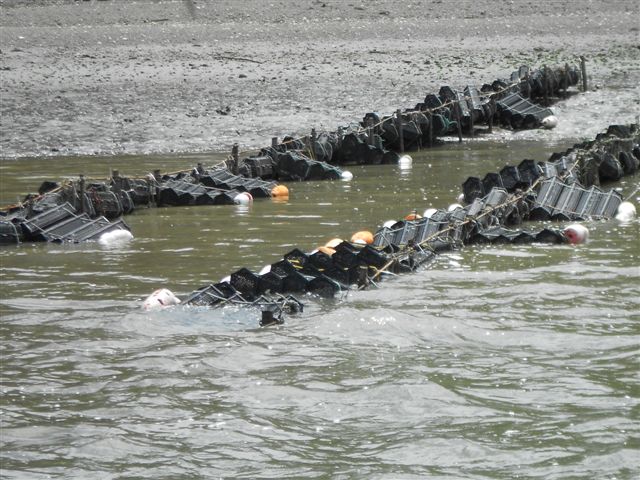
In addition to the adverse tideland impacts the shellfish industry is so concerned about are the in water facilities which exist. Totten Inlet and Penn Cove are two areas where large mussel farms are operated. In Penn Cove, an in-water processing facility is used to clean and process mussels harvested from the near 50 rafts located in Penn Cove.

A recent permit for 58 mussel rafts in Thurston County was denied due to the EIS not adequately considering cumulative impacts. Among other things, dissolved oxygen levels below the rafts were significantly decreased. Shells dropping off from mussel die-off smothered the sediments below the rafts. Deposition of feces and pseudo-feces concentrated nutrients below the rafts. Spreading of non-native Gallo mussels into habitat of native mussels was occurring. All were issues not adequately addressed in the EIS and, in part, why the Hearing Examiner denied the permit.

CO2 and Ocean Acidification

Most recently, the Blue Ribbon Panel on Ocean Acidification described how CO2 is lowering the pH level in ocean waters and lessening the molecules necessary for calcification, resulting in hatcheries being unable to produce adequate amounts of seed. It also results in native species having fewer molecules to use for calcifying. The recommendation? Expand shellfish farming. The problem? The increase in densities of shellfish grown will use up even more of the diminished supply of molecules necessary for life by native species.

Their recommendation on limiting the primary source of CO2 exported to China, coal? "We are silent on that issue." Involvement of the farming/dairy/cattle industries on recommendations? Nothing because, as Bill Dewey reported to the PCSGA in January: "Ocean Acidification – Sustainable Fisheries Partnership will help identify participants for the Governor’s Blue Ribbon Panel." (January 2012 minutes of PCSGA meeting.) It seems Mr. Warren forgot to include them when he helped create the panel, even knowing they would be one of the primary targets of recommended actions.

Castles built of sand slip into the sea. The shellfish industry is finding their own "scientific" foundation slipping into the sea.

Get involved. Let President Obama and your congressional representatives know Governor Gregoire is not the best choice to replace Secretary Salazar, should he decide to leave.
http://www.usa.gov/Contact/Elected.shtml

Thursday, November 15, 2012

Taylor Mussel Farm Permit Appeal: Audio Recording of Appeal is Available

 
When is enough too much?
Current mussel farm in Totten Inlet

An audio recording of Taylor Shellfish's appeal on November 14 of their mussel farm permit being denied before the Thurston County Commissioners is available. [click here] Included is APHETI's attorney, David Mann with Gendler Mann, testifying why cumulative impacts should be considered and why the Hearing Examiner's denial of the permit was correct. A decision by the commissioners will be made by November 27.

Presented at the hearing was why cumulative impacts should, or should not, be considered under both the Shoreline Management Act and Thurston County's Shoreline Master Program. As noted in earlier posts, the legal interpretation of the SMA and counties SMP's allows for discretion in determining whether cumulative impacts should be considered. In the case of Taylor's proposed mussel farm, there is no question that cumulative impacts should be closely analyzed.

Structures for oysters

In the case of aquaculture, it is not "aquaculture" itself which is in question. What is in question are the current methods and intensity. While some forms of "aquaculture" may be considered a "preferred use" of the shorelines, it does not mean any and all methods should be permitted to operate at any time of the day. It most certainly does not mean cumulative impacts should be ignored.

Sunday morning, 7AM
Taylor's geoduck farm in Hammersley Inlet

Taylor would have us believe the intensity of today's operations have not changed from when the SMA and Thurston County's SMP were created, in 1971 and 1990, respectively. And, if they have, "filtering" provided by shellfish more than makes up for any fragmentation of habitat which may have occurred, is occurring, and will occur.

Oyster bags in Totten Inlet


In fact, "aquaculture" has changed dramatically in that time and there is intense pressure for it to be allowed to expand, with little oversight. Cumulative impacts to the aquatic habitat have taken place and will take place.

One of many "barges" used
to transport geoduck

In the case of Taylor's mussel rafts, the shellfish "production" found under one 30' X 34' raft is equivalent to what used to be produced on one acre of tidelands (25,000 pounds). In the case of geoduck, over 120,000 pounds are produced on one acre, where they never used to grow in that density, through the use of PVC pipes, rebar and netting. Currently, grow-out bags and "cages" for both oyster and clam have increased the density of shellfish produced. Willapa Bay has had native ghost shrimp eradicated through chemical application and now a permit for the application of the herbicide imazamox to eradicate eelgrass is being considered. In short, there has been a dramatic change in production methods and intensity which has occurred. Put together, the cumulative impact is beyond significant.

PVC pipes for geoduck farm


You cannot argue that because "aquaculture" was once considered a "preferred use" and is "water dependent" that it means "anything goes." In fact, Thurston County's current Shoreline Master Program is clear in its intent to protect water quality and aquatic habitat, not just for "aquaculture" and not just from upland development. Its primary goal is clearly defined in Section V's Regional Criteria, Part B:

Protection of water quality and aquatic habitat is recognized as a primary goal. All applications for development of shorelines and use of public waters shall be closely analyzed for their effect on the aquatic environment. Of particular concern will be the preservation of the larger ecological system when a change is proposed to a lesser part of the system, like a marshland or tideland.

The Shoreline Management Act was passed and approved by voters to prevent the fragmentation of shoreline habitat from piecemeal development. Corporate shellfish companies and current methods have become that process which is fragmenting the shoreline habitat and what needs to have far greater regulatory oversight applied. Thurston County should be where that process begins and where an analysis of cumulative effects begins.

If you want to help ensure cumulative impacts from corporate shellfish methods are analyzed, contact APHETI  (Association to Protect Hammersly, Eld and Totten Inlets).

Wednesday, November 14, 2012

Thurston County Geoduck Farms, Permit Hearing November 26

Shoreline Substantial Development Permit Hearing for 3 proposed geoduck farms 
November 26, 10AM
Expo Center, Thurston County Fairgrounds
3054 Carpenter Road
Lacey
Comments by email: peterscs@co.thurston.wa.us by 4PM, November 23
Additional permit information: [click here] (Note: Complete permit documentation will not be put up until ~ 1 week prior to the decision.)
 

Existing and proposed geoduck farms
Henderson Inlet
(click on photo to enlarge)
 
Almost 3 years ago Taylor Shellfish and Arcadia Point Seafood were told by Thurston County their proposed geoduck farms would require a Shoreline Substantial Development Permit. Taylor and Arcadia, instead of applying, chose to pay for appealing all the way through Superior Court. Their decision was based primarily on an opinion by Attorney General McKenna which said their PVC pipes, netting and rebar necessary for a geoduck farm was not a "structure." In October of 2011, the Superior Court agreed with the Hearing Examiner who said Attorney General McKenna's opinion was legally flawed and they would need to apply for a permit.
[click here for flawed AG Opinion]
[click here for Superior Court decision]

On November 26 the Thurston County Hearing Examiner will listen to testimony on whether the three geoduck farms (Thiesen, McClure, and Lockhart) meet the requirements of Thurston County's current Shoreline Master Program. As seen in the recent permit decision for Taylor's mussel farm in Totten Inlet, the Examiner has the discretion to determine whether cumulative impacts have been adequately addressed. If not, the Examiner can ask for additional information, including an Environmental Impact Statement, to determine whether granting a permit for these three farms is warranted.
Totten Inlet

An individual farm may be inconsequential. But when seven adjacent commercial developments are being operated a far more significant fragmentation of shoreline habitat and use occurs. When seven adjacent operations are taking place, run by separate companies with different planting rotations, a far more continuous pattern of disruption will occur, day and night. When seven adjacent farms are allowed to be permitted there is little to prevent future applicants from pointing to those approved permits in support of theirs.
 
Wilson Point, Harstine Island

Cumulative impacts from corporate shellfish farming do matter, they are occurring, and they are growing. Nothing in the SEPA approval for these farms considered adjacent farms being operated simultaneously. While the hearing has combined 3 of the 5 proposed farms, there is nothing to indicate simultaneous operation of seven adjacent farms has been considered. The Examiner has the discretion to look at the broader picture and determine whether greater analysis of cumulative impacts is required. It should be.