Our mission is to protect the habitat of Puget Sound tidelands from the underregulated expansion of new and intensive shellfish aquaculture methods. These methods were never anticipated when the Shoreline Management Act was passed. They are transforming the natural tideland ecosystems in Puget Sound and are resulting in a fractured shoreline habitat. In South Puget Sound much of this has been done with few if any meaningful shoreline permits and with limited public input. It is exactly what the Shoreline Management Act was intended to prevent.

Get involved and contact your elected officials to let them you do not support aquaculture's industrial transformation of Puget Sound's tidelands.

Governor Inslee:

Monday, February 11, 2013

Drakes Bay Oyster Company Told Science Showing Adverse Impacts is Sound and Appeal of Decision is Denied

It's Time for DBOC to Cease Operations

An internal watchdog government agency has said the science showing that Drakes Bay Oyster Company's commercial shellfish operation is having an adverse impact on Drakes Estero is sound. They found no fraud, waste, abuse or misrepresentation of data by researchers showing operations were having impacts on Harbor Seals. [click here for article]

February 11, 6PM - Mason County Shoreline Master Program Update Meeting

Mason County's Planning Advisory Commission will hold its 2nd of 3 workshops to discuss the update of their Shoreline Master Program on February 11 at 6PM. The third will be held February 25, also at 6PM.

Date/Time: February 11, 6PM

Location: 411 N. Fifth Street, Shelton in the commission chambers.

February 11 topics: Aquaculture, boating facilities and shoreline stabilization/modification.
Of interest will be how the county addresses their concerns about docks and bulkheads and whether the growing number of structures used by the shellfish industry covering a far greater square foot area (PVC, predator nets, grow-out bags, floating aquaculture facilities) will come under the same level of scrutiny.

Saturday, February 9, 2013

Shellfish Growers "Adamantly Oppose This Bill" (Jim Jesernig,February 6)

Or: Representation without taxation - how much more does the shellfish industry want from taxpayers?


[UPDATE: With shellfish lobbyist Mr. Jesernig's argument that tidelands growing geoduck are small farms - an owner's choice of "current best use" - perhaps county assessors will begin to assess these tidelands converted to aquaculture (geoduck or otherwise) at their true value instead of shifting the expenses incurred by the state to support the shellfish industry onto other taxpayers. At the very least, Thurston County Commissioner Valenzuela (who testified in favor of HB-1437) should consider asking her assessors why an acre of tideland producing over $1,000,000 in revenue every 5 years is only assessed between $2,000 to $8,000 per acre.]

[Updated and clarified - land under the residential structure may be appraised at the "current use" value]
February 6 shellfish lobbyist Jim Jesernig testified before the House Agriculture and Natural Resource Committee, stating shellfish growers would "adamantly oppose this bill" [HB 1437] if aquaculture was not included. What is HB-1437 about? [click here for bill report]

HB-1437 (and its sister SB-5327 in the Senate) is a "current use tax bill" which would allow the land below a residential structure to be valued at its "current use" (i.e., agricultural) instead of its "fair market value" on farms below 20 acres if contiguous to the farmland and integral to the operation. A shellfish farmer would be able to claim land under their residence is part of the "tideland farm", greatly reducing the assessed value of the waterfront parcel.

Currently aquaculture is excluded from both bills with the land under the residence being valued at its true market value. The concern is that a small tideland parcel with a few geoduck planted or a few oyster bags thrown out may allow a significant portion of the waterfront parcel value to be reduced to whatever the "current use value" of "farmland" (tidelands) would be.

Taxes collected from waterfront property are currently one of the largest percentages of income for Thurston and Mason Counties. They could be reduced drastically, shifting that tax burden to other property taxpayers, not to mention create the added expense to track all of this by the already overworked county assessor departments.


Friday, February 8, 2013

Drakes Bay Oyster Company Told by California Coastal Commission to Cease and Desist

Drakes Estero


February 7 the California Coast Commission voted unanimously to approve the Cease and Desist Order and the Restoration Order requiring Drakes Bay Oyster Company to remove unpermitted facilities and to restore those areas impacted. The Hearing may be heard and seen by clicking here, scrolling down to the "February 7" meeting, and clicking on the "COMPLETE" button (note - you may have to "allow" the video to run). The DBOC portion starts at 2:09:30.

Unpermitted Developments

(paving, storage containers)
 
Additional information about the hearing (staff reports and other evidence) may be found by clicking here and scrolling down to item 11, Enforcement. Links are provided there for information but are very large files due to last minute papers submitted by the Lunny's attorney. Many of the latter were not admitted into the record due to their being submitted late. It was also felt the papers were irrelevant as most, if not all, pertained to the legal suit against the National Park Service. Some Commission members and staff were clearly upset with the last minute "document dump".

Unpermitted Shed
 
At issue was whether the Drakes Bay Oyster Company had applied for proper permits and if they had acted on a separate 2007 Cease and Desist Order. While Chairman Kinsey felt some sympathy for the Lunny family, the staff report showed clearly a company reluctant to act on unpermitted actions - for over 5 years. Fines and additional orders were issued which will allow Drakes Estero to be restored.

Restoration Includes Removal
of Racks and Bags
 
 
In addition to the unpermitted structures were non-native and invasive Manila clams which DBOC had been cultivating without a permit. As was pointed out, for almost 2 million clams to appear, in waters they were not permitted for, was one of the numerous actions (or inactions) considerd "egregious" by the staff.

The California Coast Commission and staff should be commended for acting directly and forcefully, if belatedly. As was pointed out, it was unheard of to allow a company to go for over 5 years without resolving an order. Despite attempts to frame the commercial shellfish activities occurring in Drakes Estero as being benign, the spread of non-native invasive Manila clams and non-native invasive tunicate Dedemnum vexillum was found to be more important. The risk of the Estero becoming a Chesapeake Bay if oyster's filtering was removed was soundly dismissed as being unsubstantiated.

Non-native Invasive Tunicate
Being Spread through DBOC Actions

DBOC's attorney pleading for more time because of the "circumstances" which they found themselves in was answered with them having had over 5 years. It was further pointed out that if it were so important to resolve the issue the attorney's law firm, who has been representing Mr. Lunny since 2007, had 38 attorneys and perhaps some could have been put onto this task. It was a very weak defense, weakened further in an attempt to claim that if the oysters were removed Drakes Estero would become a dead body of water.

While Drakes Estero is unique it is also representative of the shellfish industry's belief that they are somehow above regulations and permit requirements. It is a "cowboy in the tidelands" attitude which the sun is setting on.


Wednesday, February 6, 2013

Taylor Shellfish Appeals Denial of Mussel Farm Permit

Taylor Shellfish has appealed the denial of their Shoreline Substantial Development Permit (SSDP) application for a 58 raft mussel farm, near the entry of Totten Inlet, to the Shoreline Hearings Board. APHETI (Association for the Protection of Hammersley, Eld and Totten Inlets) has intervened in support of the denial, siding with the Thurston County Commissioners who denied Taylor's first appeal. [click here for APHETI web site]

In part, Taylor claims, the time and money spent on the Environmental Impact Statement (EIS) surely justifies approval. The logic is similar to the used car salesman basing the price of his used car on how much money has been "put into it."
[click here for Petition to the Shoreline Hearings Board]
[click here for SHB Prehearing Order]

"I'm selling it for $15,000
because that's what was put into it,
and that doesn't even include
my time spent detailing it!"

Time and money spent on something does not mean that's what it's worth, nor that it's right.
In the pleadings presented, Taylor Shellfish repeats that the amount of money spent, and the amount of time it has taken, to craft the final Environmental Impact Statement (FEIS) must mean it's right. Both the Hearing Examiner and the County Commissioners found that argument was only one of the many holes in their case. In fact, what both felt is the current analysis of cumulative impacts resulting from intensive commercial shellfish farming in Totten Inlet were not adequately considered. Despite the cost and the volumes of paper provided.

Pouring more money
into a leaking bucket
won't plug the holes.


Taylor's action (or inaction) and resulting permit denial.
Instead of choosing to plug the holes in their case by providing the additional information requested, Taylor instead chose to simply pour more water, in the form of legal fees, into the leaking bucket.

The Hearing Examiner, in his decision dated July 19, 2012, stated: "...the Applicant is given two options for proceeding. First, it may inform the Hearing Examiner that it wishes to challenge the determination that the present analysis of cumulative impacts is deficient and the requirement to perform an additional cumulative analysis. In that case, I will issue a supplemental decision denying the application on that basis, and the Applicant may appeal. Alternatively, the Applicant may inform the Examiner that it wishes to carry out the analysis of cumulative effects required by this decision. In that case, the Examiner and the parties will confer about the timing and nature of that analysis." [click here for initial decision
Taylor chose the former, responding on August 16, 2012, to "...request a final decision at the Hearing Examiner's earliest convenience...even if that decision must be a project denial."

September 14, 2012, the Hearing Examiner obligingly denied the permit which Taylor then appealed to the County Commissioners (who agreed with the Examiner) and is now appealing to the Shoreline Hearings Board. [click here for Hearing Examiner's supplemental decision]

What's one flat tire? There are 3 others aren't there?


Is a dissolved oxygen problem from one mussel farm really that important? Yes.
In the evidence presented at the initial hearing it was clearly shown the existing mussel operations in Totten Inlet resulted in lowering dissolved oxygen levels, approaching hypoxic levels, dropping well below the 7 mg/L level found throughout Totten Inlet (an "extraordinary" body of water). What was not discussed at the hearing was whether the intense densities of other shellfish farms in Totten Inlet also creates lower dissolved oxygen levels. All shellfish respire (consume oxygen) and concentrate feces/pseudo feces on which bacteria feed, also consuming oxygen. Washington's law is clear: When a water body's D[issoveld].O[ygen]. is lower than the criteria in Table 210 (1)(d) (or within 0.2 mg/L of the criteria) and that condition is due to natural conditions, then human actions considered cumulatively may not cause the D.O. of that water body to decrease more than 0.2 mg/L.

Water Quality Problem in Totten Inlet
Low Dissolved Oxygen Problem
Category 5 (worst)
(north of current mussel farm, south of proposed farm)

Added further to the significance intensive shellfish farming lowering dissolved oxygen levels was the recently EPA approved water quality report submitted by the Department Ecology. In that report, just north of the current mussel farm and south of the proposed farm, a significant area of low dissolved oxygen was found, with levels so low it is listed as "Category 5" (Polluted waters that require a TMDL). It was not attributable to natural conditions, leaving an unknown man made source as the probable cause. Little Skookum Inlet is one of the most intensively farmed areas in Totten Inlet, putting in question just what benefits shellfish filtering provide.

Also pointed out by one of the experts used:  The vertical stratification of Puget Sound, the seasonal input of low oxygen waters from the Pacific Ocean during the upwelling season, and the turbulence over sills that brings deep low oxygen waters to the surface make Totten Inlet and Puget Sound a unique area in which to assess if these activities will result in oxygen depression. What does current industrial/intensive shellfish farming add to an already known risk of low oxygen levels from upwelling?

"I can see you're a good negotiator.
For you, I'll throw in some fuzzy dice."
 

Nitrogen is removed. Isn't that a plus? Or, "Fuzzy math gives fuzzy conclusions."
Towards the end of the hearing, Dr. Rensel was asked to perform a calculation of how much nitrogen was removed from Totten Inlet when mussels were harvested, then to opine on whether that was "significant." An optimistic assumption that all 58 rafts would be in production, and a negative assumption that current efforts to lessen nitrogen inputs would fail, were made in his formula. Actual numbers from Dissolved Oxygen studies of nitrogen inputs into Totten Inlet from Ecology were used which cannot be found in those reports and the nitrogen inputs from air into Totten Inlet were incorrect. Perhaps of most significance is that Dr. Rensel's formula to determine whether nitrogen removal was "significant" did not consider the marine upwellings into Totten Inlet, mentioned above, at all. As he noted in his testimony, without consideration of the marine water input the numbers would "..not be as useful." Logic would dictate that much of his formula's assumptions would make it useless, especially in trying to back up the statement that mussel farming in Totten Inlet is now suddenly "significantly beneficial to South Puget Sound" as Taylor claims in their Petition for Review (page 6).

 "Not to worry. You won't see it if you don't look."
 

Shell deposition below the rafts? What's the worry?
Discussed at the hearing was shell deposition from mussel die-off and feces/pseudo feces accumulating below the rafts. Analysis of impacts on the benthic life below and near the mussel rafts was considered inadequate, let alone when considered in whole with the rest of Totten Inlet's shellfish farms, the most intensive found in Puget Sound. 

"How about we just
cover it up and call it good?"

This car is a lemon and should be left on the lot.
Taylor's claim of money spent and time invested will not make up for deficiencies found which caused the Thurston County's Hearing Examiner to deny their permit and the County Commissioner to deny Taylor's first appeal. Taylor wanting to spend money on legal fees instead of analyzing the cumulative impacts from industrial shellfish farming is understandable, if you don't want something to be found. But lurking under those mussel rafts; under those predator nets; and, inside of those grow-out bags being spread through south Puget Sound's inlets and beyond is a very real problem they do not want found: shellfish farming's cumulative impacts are significant and adverse, threatening the health of Puget Sound.

Look a little deeper.
Just because you can't see it
doesn't mean it's not there.

Lack of science...
As stated by the Federal Judge in the Drakes Bay Oyster Farm decision: "...lack of evidence of major adverse effects is not the same as proof of no adverse effects nor is it a guarantee that such effects will not manifest in the future."

Modified, and applicable here: "...lack of studies on multiple farms operating simultaneously within an enclosed estuary is not proof of no adverse effects nor is it a guarantee that such effects will not manifest in the future." The latter was clearly acknowledged in the most recent geoduck farm permits approved which require a new hearing after the first planting is harvested. Coalition to Protect Puget Sound Habitat does not agree and is appealing those permit decisions, saying it is time now for a cumulative impacts analysis, not after the damage has been done.

Contact information on how to help ensure the Shoreline Management Act is implemented as it was intended to be when passed by voters in 1972:
apheti@gmail.com
or
Laura Hendricks (253) 509-4987
Curt Puddicombe (206) 730-0288


REI's Jewell Chosen as Secretary of the Interior

Sally Jewell, CEO of Recreational Equipment Incorporated (REI), has been chosen as the new Secretary of the Interior.
http://seattletimes.com/html/politics/2020295103_apusobamainterior.html

Monday, February 4, 2013

Judge Rules Against Drakes Bay Oyster Company

 
Will the tidelands of Puget Sound's Olympic Penninsula now be made part of the Wild Olympics proposal? 
 
U.S. District Judge Yvonne Gonzalez Rogers on Monday denied owner Kevin Lunny's motion to void Interior Secretary Ken Salazar's order to evict the historic facility from the park, and also declined to allow the farm to continue operating while its legal case proceeds. [abc news]
 
"The court rightly decided that Secretary Salazar had full discretion to let the oyster operation permit expire on its own terms and honor the 1976 wilderness designation for Drakes Estero," stated Amy Trainer, executive director, Environmental Action Committee of West Marin. "We are very grateful for this decision, which supports the Estero's full wilderness protection, and we urge the company to fulfill its long-standing responsibility to its workers by assisting them during this time of transition." [East Bay Express]
 
U.S. District Judge Yvonne Gonzalez Rogers wrote in her decision that she did not believe she had authority to overturn Salazar, and that even if she did, "plaintiffs have not demonstrated a likelihood of success on the merits of the claims." [WRAL]
 
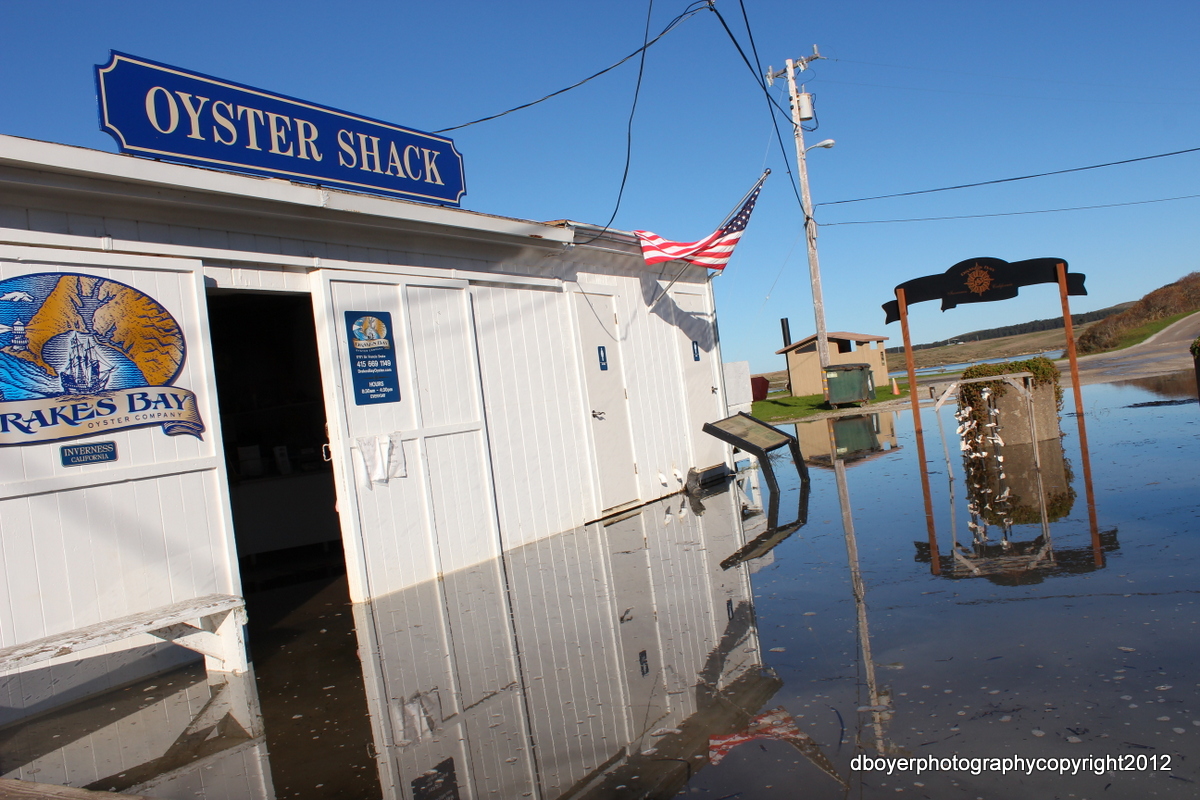
High Tide at the Oyster Shack
December 14, 2012
 
Castles made of sand...

Coalition to Protect Puget Sound Habitat Appeals 4th Geoduck Permit

Contact:
Contact: Laura Hendricks (253) 509-4987
Curt Puddicombe (206) 730-0288
The Coalition to Protect Puget Sound Habitat has appealed the 4th Substantial Shoreline Development Permit (SSDP) issued for a geoduck farm in the intertidal area of Thurston County (see News Release following this post). While the Decision requires an "open record review" prior to replanting or in 7 years (whichever comes first) to consider cumulative impacts it did not require a cumulative impacts analysis prior to beginning operation. While the Hearing Examiner had clear authority to require one based on the number and types of farms which currently exist in Eld Inlet, as well as those currently proposed, she instead accepted studies of small discrete farms to create her opinion.

Existing Geoduck Farms
Eld Inlet, South of Xia Farm
 
Native American Billy Frank, who has long championed for salmon in Puget Sound, said in an editorial today: Salmon are in trouble because of lost and damaged habitat. [click here for complete editorial] Salmon are no longer the only wild species in trouble. All of the diverse species who have evolved to survive in the intertidal area are at risk from industrial shellfish farming's expansion.
 
To believe that studies which look at small discrete shellfish farms show there is no impact from large numbers of contiguous farms operating simultaneously is not correct. Industrial shellfish farming, geoducks and otherwise, is not the "benign" activity of the past. "Predator nets" covering thousands of square feet disrupt habitats and the flow of species across them. Harvesting no longer occurs on one farm in isolation at slack tide but on multiple farms at the same time, both out of and under water, at any current speed. Geoduck planted in densities 10 times greater than wild densities extract from the waters calcifying agents needed by all species, including wild geoduck attempting to re-populate the large subtidal tracts being harvested. When shipped off to China, removed is any ability to return those agents to the waters of Puget Sound.
 
Puget Sound's intertidal habitat is being transformed by industrial aquaculture. Mr. Frank is absolutely right to be concerned, but he should not limit it to salmon. It is why growing numbers of citizens are contributing time and money to push back against the immense resources available to the shellfish industry who want only to expand their operations and profits at the expense of the future of Puget Sound's intertidal habitat.


News Release
February 4, 2013

NEWS RELEASE: Coalition To Protect Puget Sound Habitat Appeals 4th Geoduck Aquaculture Permit To
Save Shoreline Wildlife

Contact: Laura Hendricks
(253) 509-4987
Curt Puddicombe (206) 730-0288

The Coalition has appealed the 4th Thurston County geoduck aquaculture permit where over 60% of Eld Inlet shorelines have already been converted to industrial aquaculture. With habitat alteration being cited as a primary cause for the decline in salmon populations, citizens are calling for a cumulative impact analysis prior to additional permits being issued. Public records reveal that Governor Gregoire's Shellfish Initiative is being used as a lobbying tool by the shellfish industry to push state agencies and counties to minimize conservation priorities and to ignore citizen's right to safely use the shorelines.

Terrance McCarthy, the Pierce County Hearing Examiner in the 2008 Taylor Shellfish/Foss geoduck appeal supported the Coalition's position when he stated in his decision that:

“According to Megan N. Dethier, PHD, University of Washington, the harvest of geoducks from high density aquaculture beds will involve near total liquefaction of the sediment of at least 50cm. While organisms in the intertidal zone are adapted to small scale disturbance (from waves, ghost shrimp, crab pits, etc) the large scale physical disturbance is not part of the environment’s evolutionary history.”

“During high tide the tubes and net obstruct the use of shallow water of Puget Sound by watercraft, such as kayaks, canoes, shallow draft motorboats, intertubes and fishermen. The tubes and nets also obstruct use by windsurfers, divers and fishers. The obstructive nature of operations increases during planting and harvesting when barges, workers, hoses and other equipment are present.”

A Coalition member, APHETI, recently was successful in the Thurston County Hearing Examiner and County Commissioner decision that denied the Taylor Shellfish expansion of 58 (30 x 30 ft) mussel rafts in Totten Inlet. Another member, Case Inlet Shoreline Association, was successful in their 2012 Longbranch Shoreline Hearings Board geoduck decision that required protections for forage fish spawning habitat


Saturday, February 2, 2013

Shellfish Politics in DC and a Vision for the Future

The East Coast Shellfish Growers Association (ECSGA) and Pacific Coast Shellfish Growers Association (PCSGA) have wrapped up their annual "Walk on the Hill" in Washington DC. Posted on the Facebook page of the ECSGA, among pictures of "the event" are two of significance. One, "The Vision", shows oyster farms fronting the shoreline in France. The second, "The Process", shows Kevin Lunny (owner of Drakes Bay Oyster Company) and other shellfish growers meeting with legislators in Washington DC.

A Vision of "Compatibility"
Oyster farming in Arcachon, France, where a Herpes virus
outbreak caused 80% of juvenile oysters to die.
High density shellfish farming
is not without risk.
 
"The Process"
"Pressing the flesh yields instant results over wine and oysters.
Our legislators have a healthy appetite for good oysters
 and they want to help us
create more green jobs in rural coastal areas." (ECSGA)
Kevin Lunny [center, owner of Drakes Bay Oyster Company]
 
High density shellfish farming of non-native species is not without risks. As any parent of a child in school knows, classrooms are breeding grounds for virus, spreading from one child to the next and home. In a natural environment of native species growing in natural densities, disease resistance has evolved over generations. Shellfish are not competing with each other for resources so are not stressed in their various life stages, continuing to remain healthy and thrive.
 
Infected Pacific oyster (bottom) and healthy (above).
 
 
Contrast this with the die offs from the Herpes virus in the high density plantings found in France. Contrast this with the die offs of the non-native Pacific oyster larvae in "hatcheries" from deep ocean upwellings in the northwest, which other species of oysters are able to cope with. Contrast this to the "Pacific oyster mortality syndrome" in Australia which overnight decimated the Pacific oyster population. [click here for article]
 
As with net pen fish farming, and any other highly concentrated population of species, rapid outbreaks and die-offs increase dramatically. "The Vision" does not come without risks. "Pressing the flesh" only risks spreading disease. Are shellfish politics healthy?

Friday, February 1, 2013

REI CEO to Head the Department of the Interior?

“She comes unencumbered by experience” in the political arena

Sally Jewell, current CEO of REI, has risen to the top of the contender list to replace the current Department of the Interior. [click here] Her integrity and credentials are stellar.