Our mission is to protect the habitat of Puget Sound tidelands from the underregulated expansion of new and intensive shellfish aquaculture methods. These methods were never anticipated when the Shoreline Management Act was passed. They are transforming the natural tideland ecosystems in Puget Sound and are resulting in a fractured shoreline habitat. In South Puget Sound much of this has been done with few if any meaningful shoreline permits and with limited public input. It is exactly what the Shoreline Management Act was intended to prevent.

Get involved and contact your elected officials to let them you do not support aquaculture's industrial transformation of Puget Sound's tidelands.

Governor Inslee:

Sunday, January 20, 2013

Drakes Bay Oyster Company Court Hearing January 25

 
"Will you be having Tea with your oysters?"

January 25, lawyers supported by Washington D.C.'s Cause of Action, an advocacy group with ties to the Koch Brothers, Darrell Issa, and Tea Party politics, will argue in U.S. District Court before Judge Yvonne Gonzalez Rogers in Oakland that Drakes Bay Oyster Company should be allowed to stay in operation until a court challenge to their lease expiration may be decided. [click here for article on Cause of Action] In addition to free legal support, Cause of Action has also created a well polished public relations campaign to help build public sympathy for the Lunny family whose lease for their commercial shellfish farm, purchased in 2004, was not renewed in December. The issue goes far beyond the Lunny family and their oysters.

Drakes Estero Shoreline Wilderness

Background - Cousin in the East Coast Shellfish Growers Association
In 2004 the Johnson family sold their commercial shellfish operation located in the designated wilderness area of Drakes Estero to the Lunny family. The Lunny's purchased the operation fully aware of the government's long-term goal of creating the only wilderness shoreline in the United States. The Lunny's apparent hope was they would be able to convince the government the lease should be extended and not end in 2012, a calculated gamble. Combined no doubt with encouragement found in Mr. Lunny being a cousin of the then President of the East Coast Shellfish Growers Association, Tom Kehoe, he stepped up and purchased the operation. In 2012, Interior Secretary Salazar confirmed the commercial shellfish operation did not fit within the definition of "wilderness" and allowed the lease to expire. Mr. Lunny lost the card game, but there is a bigger game being played.

Scientific Disagreements
Entwined within the argument of whether the lease should have been extended or not was an Environmental Impact Statement performed by the Nationnal Park Service. After a multi-year process the EIS showed there were significant adverse impacts from the commercial shellfish operation, ranging from the introduction of non-native shellfish species (Pacific oysters and Manila clams) to the spread of the non-native invasive tunicate, Didemnum vexillum. The conclusion was that these adverse impacts would continue and get worse, a conclusion the shellfish industry became alarmed about. [click here for EIS]

Non-native Invasive Tunicates from
Taylor Shellfish's Mussel Raft in Totten Inlet
Also found in Drakes Estero on shellfish from DPOC.


Shellfish Lobbying Groups Mobilize
In 2005, the Pacific Coast Shellfish Growers Association (PCSGA) became engaged in the process, and, in 2006, brought in their Washington DC lobbyist, David Weiman, to lobby for the renewal. In 2007, becoming aware of the growing body of scientific evidence showing the commercial operation's adverse impacts, PCSGA had their attorney (Mr. Plauche) become involved and filed a complaint under the "Data Quality Act", rejected by the National Park Service. [click here for an article on the Data Quality Act from The National Law Journal]

In 2010, concerns within the shellfish industry continued to grow, extending to the East Coast Shellfish Growers Association (ECSGA). Then President Tom Kehoe, the cousin of Kevin Lunny, asked members to engage in the process. Requests for support of Mr. Kehoe's cousin from the ECSGA continued with requests to sign petitions; requests to contact representatives; and general pleas for support, finally reaching a climax with Executive Director Bob Rheault telling members the more it went on, "...the more libertarian I become."

December 2012: The Water Boils - Dan Epstein, Darrell Issa, and the Koch Brothers
Late 2012, Secretary Salazar did not renew the lease, "...based on the incompatibility of commercial activities in wilderness ...." As put in the East Bay Express:  "In short, Salazar essentially decided that it would be a mistake to set a national precedent, and thus open the door for other commercial enterprises on potential wilderness land around the country to request lease extensions, too. If the secretary's reason for closing the oyster farm sounds familiar to Express readers, it's because this newspaper noted back in June that the intense controversy over whether Drakes Bay Oyster Company was harming the environment was irrelevant, and that the real issue at stake in Point Reyes was the precedent it would set if Salazar decided to re-up the oyster farm's lease." (December 5, 2012).
 
An invitation distributed last year by the shellfish lobbying
groups, noting Shell Oil as a co-sponsor. Shell Oil
 has currently grounded one of its drilling rigs used in the Arctic.
The decision was well thought out and avoided the shellfish industry's Data Quality questions, something which the industry would have dragged on for years. But when larger players began to realize what it meant for other industries seeking opportunities in designated wilderness areas, the game became bigger and Lunny was encouraged to sue. Enter Dan Epstein, described by Mother Jones as:  "a former GOP counsel on the House's Committee on Oversight and Government Reform under California Republican Darrell Issa. Epstein is also a veteran employee of billionaires Charles and David Koch; he used to work at the Charles G. Koch Charitable Foundation and for a Koch Industries lawyer." [click here for article]

The ironic part of what Cause of Action professes to be upset about and defending - "public accountability" - is that the leases which Mr. Lunny and his shellfish operation operates under collect virtually nothing for his million dollar plus operation (the National Park Service was paid $2,800 per year [click here for NPS Permit]). Were Cause of Action truly following their "public accountability" belief, they would have instead been pursuing a suit demanding compensation for the use of public lands the Lunny's were using for virtually nothing. (Note: A separate lease was also in effect with California.) But that was not their concern. Instead, they have attempted to frame the issue as one of "an illegal taking", despite the operation occurring on public lands, let alone on now designated wilderness.


Precedence -
At issue, and why the Cause of Action is so involved, is that if it can be shown a commercial operation such as the Lunny's commercial shellfish operation may operate in designated wilderness areas, the door is opened to any commercial operations operating in designated wilderness areas. Not just shellfish farms and not just existing operations whose leases are set to expire. The Koch brothers and their allies in the energy field do not care about the Lunny's nor their oysters. They are nothing more than a pawn. What they care about is the precedence set in allowing the lease for a commercial operation in a designated wilderness area to continue, including access to energy sources which may lie in designated wilderness areas such as those found in the shale formations below Theodore Roosevelt National Park. [read National Park Advocate article here]

Reality, not PR: T-Shirts Saying "Drakes Bay Oyster" at Court are Not Relevant
(from a recent press release on the upcoming court hearing: "It would also be helpful if you have a DBOC sweatshirt or T-shirt to wear it.")
Well polished public relations campaigns and T Shirts paid for by those who put their own self interests above those of the general public and future generations (perhaps even those they profess to support) should not be allowed to influence any decision about Drakes Estero, whether in court or otherwise. The Lunny's, most likely encouraged by their cousin who was then President of the East Coast Shellfish Growers Association, made a bad business decision. Gamblers should not be rewarded nor rescued when they make a bad bet, which is exactly what the Lunny family did.

"We have millions of dollars of oysters which will go to waste." The West Coast shellfish industry is crying for more oysters to grow. The Lunny's have a ready market at the grower level where these oysters may be sold. Saying "millions of dollars will be lost" is simply not true.

"30 employees will be out of a job." Using the skilled workers being displaced is deplorable. The shellfish industry has said for years they cannot get the skilled labor of the very kind the Lunny's are so concerned about. These skilled workers are the backbone of the shellfish industry and can find jobs in one of a number of locations, ranging from Humboldt Bay to Puget Sound. Whether they are paid what they are worth is a separate subject, but well worth delving into at some point.

"Removing shellfish will result in increased nutrient loads and low dissolved oxygen." The amount of nitrogen and sediment removed from Drakes Bay Estero by the "filtering" and "harvesting" of shellfish is a fractional amount of nutrients which enter the waters. If, in fact, the Lunny's and the shellfish industry are truly concerned about the health of Drakes Estero waters, they should instead focus on their own cattle.

"Getting rid of the oyster farms is just part one." The greater risk to cattle farms on Point Reyes are shellfish operations in the waters around Point Reyes. Shellfish operations may easily bring focus to the perceived threat of runoff from cattle and dairy farms, putting in question whether they should continue. It is not the National Park Service they need to be concerned about, it is the very people supporting the Lunny's continued shellfish operation they should be concerned about - the shellfish industry.

What will the Lunny Family Do?
The Lunny's have been operating a cattle ranch on public lands in the same location on Point Reyse for generations now. Their cattle are able to feed on those public lands for very little and people pay a premium price for the meat from those cattle. The Lunny's, and their children, will continue to live far more comfortably than many people in the United States. They will also have the Drakes Estero Shoreline Wilderness area to enjoy, along with everyone else. Their finally agreeing to the the lease expiration will also help ensure other designated wilderness areas will not come under threat. As Mr. Epstein says on his Cause of Action web site: "...the clients we select are secondary to our educational mission." It's something the Lunny's should consider over morning coffee, or tea.


Saturday, January 19, 2013

Mason County Shoreline Master Program Update Hearings Scheduled

Mason County has published a "Public Notice" and the Shelton-Mason County Journal has written on two important upcoming workshops on the County's Shoreline Master Program Draft Policies and Regulations. They will be held:

January 28, 6PM at 411 North 5th Street, Shelton

February 11, 6PM at 411 North 5th Street, Shelton (aquaculture will be discussed at the this meeting)

To view differences between the existing "Policies" and "Regulations" and those proposed, click on either of the two links here:
[click here for "red line" Policies]
[click here for "red line" Regulations]

Also available is an interactive map of Mason County to find such things as how waterfront areas are defined (e.g., nature; conservancy; etc.), where beach front armoring (i.e., bulkheading) is located, or public beach front access is found. (Despite a wealth of current information available, not found are where current shellfish operations are located.) [click here for interactive map]

Thursday, January 17, 2013

Tuesday, January 15, 2013

Mason County Shoreline Plan Update Citizen Meeting

Mason County's Shoreline Master Program Website notes the Citizen Advisory Committee will meet January 16, from 9AM to 12PM at Alderbrook Resort. The meeting location is a change, as was the addition of the January 16 date.
[click here for Mason County's Shoreline Master Program web site]

Mason County may cancel the meeting, or change the meeting place, so citizens should call Mason County to confirm there is a meeting taking place at which the public is invited. As a reminder of what Mason County's "Public Participation" plan is, click here. Not noted is when the Draft SMP will be posted to the web site. Unlike other counties who have posted not only their drafts but comments and responses to those comments as well. To view what Mason County has made available on their website, click here.

To receive information regarding the Shoreline Master Program Update:
Call: (360) 427-9670 Ext. 408, or,
Email LaJane Schopfer: lajanes@co.mason.wa.us

To contact Commisioners on how to better improve public awareness and involvement, contact information is:
Commissioners: Randy Neatherline, Tim Sheldon, and Terri Jeffreys
Call - (360) 427-9670 X419
For email, click here and scroll to the bottom of the page.


Sunday, January 13, 2013

Thurston County Approves Taylor/Arcadia Geoduck Farm Permits

"Small steps towards a cumulative impact analysis being required were taken."


If facts at the time of the review warrant cumulative impact analysis under then-applicable law, it shall be conducted during the review. [click here for permit approvals]

The Thurston County Hearing Examiner has approved the Shoreline Substantial Development Permits from Arcadia Point Seafood (on the Thiesen and McClure tideland parcels) and Taylor Shelllfish (on the Lockhart tideland parcel) for new geoduck farms in Henderson Inlet. While the Examiner noted there was not sufficient evidence presented to warrant a cumulative impact analysis at this point in time, a "Condition" for reconsideration of this requirment after harvesting, or 7 years, was made part of the permit. 

A cumulative impact analysis would have been appropriate now, especially in light of the denial of a permit for Taylor Shellfish's mussel farm permit (currently being appealed by Taylor Shellfish before the Shoreline Hearings Board). However, a small step towards analyzing the combined impacts from numerous "small" individual geoduck farms was taken by the Hearing Examiner.

A house built of cards will fall.


In time, science will catch up and weaknesses in current "science" used to support these tideland developments will evolve. Scientists, and agency personnel responsible for protecting Puget Sound will find it important enough to come forward. Until then, citizens will continue to push back on attempts by the shellfish industry to lessen regulatory oversight of their developments in the tidelands of Puget Sound, such as that seen in Seattle Shellfish's lawsuit against the Army Corps.

In that complaint, Seattle Shellfish is saying the Corps, Fish and Wildlife, and NMFS should just accept the fact that the shellfish industry supplied them with inaccurate information in 2007 and should now allow expansion with no further review. They feel evaluations and assessments written by geoduck farmers should be accepted without question. Papers written as Master's Thesis by graduate students should be accepted as peer-reviewed. It is a house of cards folding in on itself. [click here for recent post]

You can help support efforts to preserve Puget Sound's tideland habitat through reasonable regulation by contributing to Case Inlet Shoreline Association, APHETI or Protect Our Shoreline. All are 501c3 non-profit organizations dedicated to preserving Puget Sound's habitat.

Wednesday, January 9, 2013

Seattle Shellfish Files Complaint Against Army Corps: "We want it all, even if we didn't have it all planted."

Can a Biological Opinion based on inaccurate information provided by an industry now be used to justify expansion of an activity by that industry?
 
Arcadia Point, Totten Inlet
Reported "Project Area" from Seattle Shellfish
to Army Corps in June, 2007 = 20.5 Acres (in red)
Acreage Reported to be Leased/Cultivated to WDFW
after 2007 by Seattle Shellfish (in yellow) = 2 Acres
 
Too Much Money and Still Not Enough Tidelands
Funded by the immense profits from geoduck farming Seattle Shellfish, with verbal support from Taylor Shellfish, has filed a "complaint" against the Army Corps in District Court. In the "complaint", Seattle Shellfish claims the Army Corps should not require Individual Permits for expansion of shellfish operations. Seattle Shellfish's position is that any tideland area that it defines as its "Project Area", owned or leased where it claimed to have planted shellfish prior to March of 2007 should be, in its entirety, considered an existing operation and allowed to expand under the Nationwide Permit 48, with little to no additional consideration to impacts from those expanded activities. [click here for court papers filed December 11]

Information Considered was Not Accurate
The company's complaint further states that the 2009 Biological Opinions from the US Fish and Wildlife Service (USFWS) and National Marine Fisheries Services (NMFS) considered all acreage reported, under lease or owned as being cultivated, not just that planted (i.e., "existing" included areas never cultivated before).

However, as discovered by the Corps and the Department of Ecology, from the information provided by the shellfish industry in 2007, it was impossible to accurately determine what that acreage was, what was being cultivated, and how. For example, the shellfish industry implied that over 6,000 acres of tidelands were being cultivated with geoduck. As it turned out, somewhere between 400 and 500 acres were actually being used.

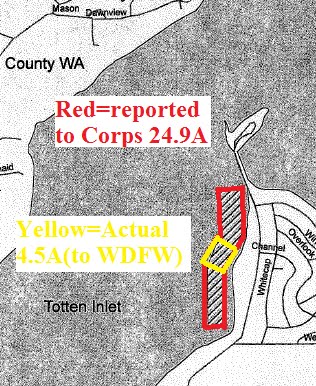
As seen in the examples above and below, Seattle Shellfish was one of the companies that significantly overstated acreage they had under cultivation by claiming existing "Project Areas" far greater than what was actually under lease and planted therein. Examples provided here show 60 acres claimed to have been leased and cultivated by them when, in fact they reported to WDFW (a separate state agency) that only 7 acres had been leased and cultivated. Based on maps from WDFW, even that number does not accurately reflect what was actually being cultivated with what in 2007.

Carlyon Beach,
Reported Project Area from Seattle Shellfish
to Army Corps June, 2007 = 24.9 Acres (in red)
Acreage Reported to be Leased/Cultivated to WDFW
after 2007 by Seattle Shellfish (in yellow) = 4.5 Acres


Nationwide Permits (NWP) Recognize that a Balance is Needed
The Corps is aware there is a need for permitting that recognizes a balance between development and protection of waters of the US, as defined by the Clean Water Act. Thus is why the Nationwide Permit (NWP) system is in place. Through NWPs, small impacts to critical habitat are allowed by the Corps, but only after a careful analysis by the USFWS and NMFS. In that analysis, the agencies determine whether activities are similar enough "in nature and in environmental impact to warrant regulation under a single General permit." The agencies must also be able to quantify total discharges to determine cumulative impacts. If that can be done, a NWP is developed and may be used. Every five years NWPs are reconsidered.

NWP 48 - Allowed Existing Shellfish Operations to Continue if in Place before March of 2007
In the case of shellfish cultivation, the critical issue considered by these federal agencies between 2007 and 2009 was, first, whether cultivation was underway ("in the ground" or "fallow" following a previous planting) prior to March of 2007; what that cultivation method was; and which species were being cultivated. In order to determine whether those areas reported to be under cultivation were having a significant impact, alone or together, the Corps required growers to submit applications showing what tideland areas were currently being cultivated, with what, and how. That information, obtained from forms submitted by shellfish growers, was then provided to the USFWS and NMFS.

Windy Point

Reported Project Area from Seattle Shellfish
To Army Corps June, 2007 = 15.2 Acres (in red)  
Acreage Reported to be Leased/Cultivated to WDFW
by Seattle Shellfish (in yellow)  = .5 Acre

Quality of Data Submitted and Seattle District Discretion
Information provided was inaccurate, at best, and certainly not of the quality a sound decision should be based off of [read about Information Quality Act here]. Adding to the difficulty was that geoduck farming in Puget Sound was new and unique to the area which had not been studied (i.e., it was not a "Nationwide" practice). This was recognized by the Corps' Northwestern Division in Portland who in turn gave the Seattle District the discretion to address the method and develop additional conditions, based on the then inaccurate information submitted.

This inaccurate information, coupled with the uniqueness of the impacts from geoduck farming is why both the Department of Ecology and the Army Corps of Engineers, driven from the Seattle District level, required resubmission of new forms to accurately reflect what was being cultivated, how, and where. As noted above, those resubmissions were finalized in 2010, after the 2009 Biological Opinions from USFWS and NMFS were submitted. [click here for a summary table showing how innacurate the information submitted by growers was, compiled by Protect Our Shoreline citizens in 2007]

USFWS and NMFS Could Not Have Determined Impact
Because the information submitted in 2007 was not accurate, and not updated until 2010, the Biological Opinions issued by the USFW and NMFS in 2009 (those that the Seattle Shellfish "complaint" claims support its position) could not have determined whether operations were "similar" and whether they alone, or together, had a significant impact. Numerous communications between the Corps, NMFS and USFWS between 2007 and 2009 clearly indicate the inability to accurately determine how many acres were being cultivated, and with what. (e.g., from NMFS - "it is difficult to identify precisely the locations of existing shellfish aquaculture operations in Washington State"; "Corps needs to provide better information about the acreage of the operations being covered under NWP 48")


Given that, it was impossible for USFWS and NMFS to determine whether expansion of existing farms should be allowed. As such, claims in the complaint - those stating that the 2009 Biological Opinions support expansion - have no foundation to build on. Attempts to define "Project Areas" as "expansive" are countered in numerous communications which clearly define it narrowly - as an "existing operation." In short, you cannot claim a tideland not planted prior to March of 2007 is "existing" any more than you a float establishes an "existing" dock.

Permits Take Time - Especially When Information Provided Isn't Accurate and What's Being Protected is More Important than Money to be Made
Seattle Shellfish and Taylor Shellfish complain about no permits having been issued in many years. It would have helped if, at the outset, the shellfish industry not viewed the Nationwide Permit as a hindrance to expansion but instead as a means to protect the very thing they - and everyone else - benefits the most from: a robust and healthy Puget Sound habitat, capable of supporting a diverse number of species for a diverse number of people.

Tuesday, January 8, 2013

Mason County Shoreline Master Program Update: Citizen Advisory Meeting January 9

Mason Count will hold its final Citizen Advisory Committee (CAC) meeting on the Draft Shoreline Master Program (DSMP) update. Its meeting in December was canceled. The public is encouraged to attend and hear how the document is being crafted by the various parties involved.

Time and Date:  9AM-12PM, Wednesday, January 9.
Location:  100 W Public Works Drive
Discussion Item: Draft SMP

It is unclear whether a copy of the DSMP will be made available to the public at the meeting. The update must be delivered to the Department of Ecology by June 13. [click here for the county's "Public Participation" plan]

Monday, January 7, 2013

Governor Gregoire to head the EPA? Look to the past to see the future.

Governor Gregoire is rumored to be under consideration to head the Environmental Protection Agency. It would be a mistake of monumental proportions to believe a life-long Washington state politician, unable to take a stand against business interests over the environment, is the person to put in charge of protecting the environment, in whatever position, but especially the EPA. [click for a general overview of the Governor's effectiveness here]

Excluded from SEPA by Department of Ecology
In her waning days of office she supported the Department of Ecology's allowing developments of up to 30 homes to be excluded from the State Environmental Policy Act. [click]
 
"An example to the rest of the globe." 
At the Ocean Acidification press conference, the Governor was asked whether exporting hundreds of tons of coal through Washington to China, the largest emitter of CO2, was really a good idea. She hid behind "the process" and refused to take a stand. [click here for a 1 minute video clip of her response] Unlike other West Coast Governors, present and past, who took a clear stand against exporting coal, and demonstrating leadership and a broad/long-term awareness of the environment, she simply side stepped the issue. Worse, she then went on to explain how Washington state needed to be "an example to the rest of the globe" on moving to clean energy. Given other opportunities to explain how exporting coal to China was setting "an example" she faded into political sound-bites.

What "dressing down" the Governor can get you. 
Last December she was reminded how the then head of the Department of Ecology had been "dressed down" by the shellfish industry for lack of action on water problems. [click here] In their current push to expand their developments in the tidelands and waters of Puget Sound, she is now being pressed for further reductions of regulatory oversight by "streamlining" the permit process for their these developments. Through "executive actions," millions of dollars are being pulled from other programs to support an industry whose problems are, in part, of  their own making (e.g., "Hatching" non-native Pacific oysters in colder waters has been a problem since its introduction in the early 1900's. Genetically modifying the species to create sterility for year-round edibility only adds additional stress to the life cycle.)

Puget Sound is being transformed
through the Governor's "leadership."

As Mr. Ruckelshaus clearly remembers as first head of the EPA, the protection of the environment is not always in the best interest of business. Resisting the pressures created from profits at the expense of ecosystems destroyed in "the process" requires strong leadership to face down industries far more significant than the shellfish industry. It also requires far more than day-to-day sound bites created by local Public Relations firms, where the Governor's skills may be better suited.

Get involved in "the process." Contact the President and your representatives and tell them there are better choices to head the EPA and protect the environment.
[Click here to contact the President]
[Click here to find your Representative]


Friday, January 4, 2013

Willapa Bay's Migratory Waterfowl told to "Eat Something Else "

"Go Eat Something Else Somewhere Else"
Brants Geese, Willapa Bay
courtesy of Chris Sidebotham
 
"Go eat something else, somewhere else." In stark terms, this is the response of the Willapa Bay shellfish growers to the migratory waterfowl who for over 1/2 of a century have been using Japanese eelgass as a food source on their migrations north and south.
 
Unhappy with spraying of Imazamox on shellfish beds only, where the problem was acknowledged to be an issue, they successfully convinced the Noxious Weed Board to declare Japanese eelgrass in all tidelands a noxious weed. Effective January 13 this change - made without any supporting scientific evidence and against the recommendation of the Weed Board's own advisory committee - will become law. [click here for comments, beginning on page 8]

Contact your state representatives and suggest they ask the Board to reconsider.

[Find your representatives here] (enter address or click on map then click on name(s) to find email and phone information)


Wednesday, January 2, 2013

Vibriosis Contracted from Washington Oysters Continues to Increase: DOH Requests Rule Changes

Brian Sheldon, Northern Oyster Company: "Industry is caving in"

Public Involvement: Contact Rick Porso at DOH - rick.porso@doh.wa.gov (reference "Vibrio Rule Making")
To be made part of what the State Board of Health has described as a "collaborative rule making with a stakeholder committee process to develop the proposed rule," the public is encouraged to contact Rick Porso by email, or by mail at:
Rick Porso
Department of Health, Office of Shellfish and Water Protection
P.O. Box 7824
Olympia, WA 98504-7824

Why the proposal?

Despite a March 2009 revision to safety regulations, Washington's shellfish industry has failed to reduce Vibriosis contracted from Washington oysters. In fact, the State Board of Health notes it has "steadily increased." As a result, the Department of Health has asked the State Board of Health to modify state regulations to better protect consumers. [click here for announcement] Also involved will be the FDA who has been attempting to prevent contraction of vibriosis as well as deaths caused by Vibrio vulnificus (Vv), a more virulent strain of Vibrio spread through oysters harvested in the Gulf states during warm months. Of major concern is the warming water temperature of Puget Sound which will cause the more virulent Vv to begin growing.

"Industry is caving in" (Brian Sheldon, Northern Oyster Company, Willapa Bay)
For the sake of all those who have become ill, and to prevent future illnesses and associated economic loss, it is hoped the attitude of the shellfish industry will be more cooperative than that reflected by Brian Sheldon, owner of Northern Oyster Company in Willapa Bay. At the August Pacific Coast Shellfish Growers Association meeting he complained that comments made in the July meeting about another grower purchasing a refrigerated truck to help keep temperatures down and Vp from growing made it appear industry was supporting safety concerns. He demanded those comments be stricken from the notes of the July meeting because it made it appear "industry is caving in." No doubt he was also worried it would impact his "business plan" as he claims Japanese eelgrass has.

Why should it matter to the public?
Beyond the attitude reflected by Mr. Sheldon, the shellfish industry has also stymied FDA attempts to communicate to the public the dangers in disease contracted from the consumption of shellfish contaminated by Vibrio. They felt these attempts to help maintain food safety created an "economic hardship" for the industry (see Issue Paper below). There is apparently little concern to the economic hardship incurred by individuals, families, government agencies, and taxpayers when contaminated oysters enter the market and cause outbreaks.

Governor Gregoire's recent funding of hatcheries which produce genetically modified triploid Pacific oysters will only make matters worse. These genetically modified oysters grow faster, and as they are sterile, maintain their "firmness" during the warm summer months. When combined with NOAA and the Governor pressuring agencies to lessen regulations, a significant risk to an increase in Vibriosis related disease is apparent, and why the State Board of Health has acted to control what the industry cannot. Unfortunately, the new regulations developed under the "collaborative rule making" process outlined will not be finalized until early 2014, leaving the summer of 2013 one to remember.

(click to enlarge)