Our mission is to protect the habitat of Puget Sound tidelands from the underregulated expansion of new and intensive shellfish aquaculture methods. These methods were never anticipated when the Shoreline Management Act was passed. They are transforming the natural tideland ecosystems in Puget Sound and are resulting in a fractured shoreline habitat. In South Puget Sound much of this has been done with few if any meaningful shoreline permits and with limited public input. It is exactly what the Shoreline Management Act was intended to prevent.

Get involved and contact your elected officials to let them you do not support aquaculture's industrial transformation of Puget Sound's tidelands.

Governor Inslee:
Showing posts with label clean water act. Show all posts

Tuesday, February 16, 2016

WDFW Investigation Reveals Contaminants Filtered and Retained by Shellfish in Puget Sound

What is filtered and retained by
Puget Sound's filter feeders?
"long-banned pesticides, flame retardants, toxic metals
 and other human-caused contaminants
are creeping into all parts of Puget Sound."
 
"one oyster, one mussel, one bite of fish at a time"
Washington's Department of Fish and Wildlife's (WDFW) continues to expand awareness of pollutants in Puget Sound's waters in an expanded program with results first published in the 2011/2012 Mussel Watch Phase 1". As it was noted in the 2012 Quality Assurance Plan:
"... expanded spatial distribution and additional mussel monitoring sites are needed to address regional questions regarding the fate, transport, and effects of chemical contaminants in the Puget Sound’s nearshore urbanized waters." 
(sample locations from 
2/19/2013 progress report)

Did I want to know that?
Building on the 2010/2011 Mussel Watch program, the implementation of the expanded program was designed to create a "...more regionally-focused, nearshore contaminant status and trends monitoring program in Puget Sound." While current results will not be known until 2017, program implementation results from 2012 were reported by WDFW in 2013. In that "Field Summary and Progress Report", four highly carcinogenic compounds (PAHs, PCBs, PBDEs, and DDTs) were found in mussels tested. As would be expected, the highest levels were found in the most urbanized areas (Elliott Bay, Salmon Bay, Commencement Bay, and Sinclair Inlet near Bremerton). However, as the Puget Soundkeeper noted in November:
"All four carcinogens were found in every mussel sample, regardless of location."

 ""I don't eat shellfish anymore," [Maradel Gale said.
"Not since I've been doing this."
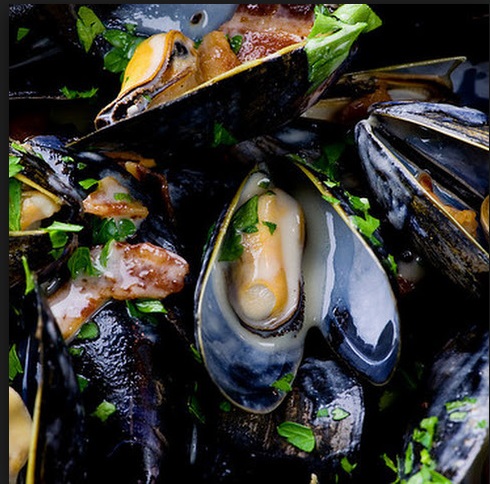
There's more carried by the tides throughout the Puget Sound basin than algae and bacteria.
While current agency programs attempt to limit illnesses contracted from naturally occurring bacteria (e.g., various strains of vibrio) and naturally occurring toxic algae (e.g., diatoms producing domoic acid), there has not been a long term program tracking industrial pollutants in the nearshore environment where shellfish are harvested from and eaten. Chemicals entering Puget Sound's waters, through urban runoff and industrial activities, both current or past, exist throughout the basin being filtered and retained by shellfish. And as was noted in the Kitsap Sun article:
[Agencies] don't routinely test for metals, petroleum hydrocarbons and other substances that cause problems slowly, accumulating in the body in low dosages. 

Meanwhile, down on the farm the Department Of Ecology, EPA moves to impose water quality rules DOE cannot
Tribal rights include “..not only a right to take those fish, but necessarily include an attendant right to not be exposed to unacceptable health risks by consuming those fish.” (from EPA's 9/14/2015 proposed rule, part III. Necessity Determination for Washington)
At the same time as WDFW is reporting carcinogens in mussels tested throughout Puget Sound, the Department of Ecology is in a tug-of-war with the Environmental Protection Agency over what the average amount of seafood consumed is and what should be tested. After years of being unable to determine what the average amount of seafood consumed per day should be and what should be tested, the EPA told the Department of Ecology it had waited long enough and was now developing rules which DOE was unable or unwilling to, publishing in the Federal Register, September 4, 2015, the proposed rules. As far back as 2013 the EPA was telling DOE it was concerned about its lack of progress, writing in a letter dated June 21, 2013:
"The best available science includes evidence of consumption rates well above 6.5 grams per day among high fish consumers and shows that the human health criteria currently currently in effect for Clean Water Act purposes in Washington are not sufficiently protective."
Father knows best. He just can't make up his mind.
In a letter from tribal members to the EPA regarding DOE's lack of motivation, they wrote as recently as December 23, 2015, to encourage the EPA to do what DOE was unable or unwilling to, saying:
"The state of Washington has avoided, deferred, and delayed adoption of revised water quality standards that would safeguard public health for high fish consuming groups including tribes. The state has attempted to trade off a more protective fish consumption rate [175 g/day] for a less protective standard [6.5 g/day]  for cancer risk. EPA has given the state multiple opportunities to develop and adopt revised human health criteria. We have no confidence that the state of Washington will adopt more protective water quality standards in the next 12 months, if at all, and urge you to promulgate the EPA’s proposed rule without further delay."
Trust us - we know better than the EPA what's good for the state. Did Flint, Michigan?
"Ecology is in the best position to develop human health criteria (HHC) for the state of Washington." DOE to EPA, December 2015
It was not until February 3 DOE agreed fish consumption rate assumptions were too low and called for comments on new water quality standards. However, they noted they did not agree with EPA on standards for industrial pollutants or time frames to control discharges, stating on their website calling for comments:
"EPA's draft rule [being imposed on the state due to inaction] contains stringent limits for PCBs and arsenic, and adds a new limit for methyl mercury that will be difficult for Washington dischargers to meet. Our new draft rule would maintain the current standards, as proposed in our initial rule, for PCBs. Criteria for mercury would remain under federal regulation. Arsenic would align with the federal Safe Drinking Water Act standard." [fish consumption rates were raised to 175 g/day]
Do you really want to know?

In the end shellfish are only as safe to eat as the regulations you make controlling what flows into the water and they filter out of it.
Puget Sound's waters are a state-wide treasure. Seafood taken from Puget Sound, whether shellfish or fish, should be safe to eat in both the short and long term, and consumption rates safety is based off of should be realistic. The EPA has told Washington their regulations are weak. Results from the Mussel Watch program confirm mussels - and all other filter feeders - retain what is being discharged into those waters. Those chemicals are not being adequately monitored in seafood consumed and DOE has agreed their assumed consumption levels are far below what it should be, but does not want to implement new regulations any time soon. Until the state finds the political will to act, Ms. Gale's advice on not eating shellfish harvested from Puget Sound is something for everyone to consider.


Tuesday, May 5, 2015

Coalition Files Legal Petition with Army Corps - Cumulative Impacts Analysis Needed

If one is found to have no significant adverse effect...

...then hundreds are just fine. Right?

If one baby is cute why not have 5?
Harsh? Of course. However, this is the point made in a petition sent to the Army Corps of Engineers by The Coalition to Protect Puget Sound Habitat. In the notice mailed to the Corps it is argued the Corps' Nationwide Permit 48 (used for permitting shellfish farms) has not considered the massive expansion of industrial shellfish activity now occurring in the tidelands and waters of Puget Sound.
The fragmentation of Puget Sound's 
most valuable and fragile resource.

Connect the dots.
In a public notice sent out today (see below) the Coalition points out the original analysis performed by the Corps, the basis for reissuing the 2012 NWP48, assumed the permit would be used "about 50 times a year for 5 years" or, 250 permits. In the first two years the Corps has received 1,000 applications and issued over 900.

Just give them the candy. Maybe they'll stop screaming "I want I want I want".
This is a motivated industry flush with cash. As the Coalition has argued before county examiners, commissioners, the shorelines hearings board, and in court, the cumulative impacts of discrete farms, when taken as a whole, are adversely transforming Puget Sound's intertidal areas. The proposal to spray the neurotoxin, imidacloprid, in Willapa Bay to destroy the native burrowing shrimp and the herbicide imazamox are only two examples of an industry which has reached a scale considered industrial by any metric used. Continuing to issue permits may stop one group from screaming, but another, concerned about the expansion, will only get louder.
.
Kevin Lunny - A lease not renewed, 
a settlement agreement signed,
still kicking, and is now "terrified."
(Wondering, "Is that the answer I was supposed to give?")
(April 29, before the House of Representatives,
answering Representative Labrador.)

Control the conversation
Well paid lobbyists and public relations firms such as the Glover Park Group continue to try and frame the shellfish industry as small families trying to make a living, overburdened by regulations. Attempts to create regulations are met with well paid contract scientists generating opinions and evaluations showing no harm, some owning the very types of operations they are expressing opinions on. Academic scientists and institutions are funded with money controlled by politicians who are lobbied and presented with testimony from people such as Kevin Lunny whose lease ended but who feels he has been somehow persecuted when the simple reality is he bought a company knowing its lease would not be renewed. Representative Labrador, playing Mr. Lunny like a pawn, is better served by looking at this industry and the "science" used to justify their expansion than listening to an individual who made a bad business decision being used to frame a false conversation.

Get involved and stay involved. The Coalition to Protect Puget Sound Habitat is, has been, and will be.

Press Release from the Coalition
(links to letter sent are at the end)
 PRESS RELEASE  

Date:  May 5, 2015

Contact: Laura Hendricks  (253) 509-4987

The Coalition To Protect Puget Sound Habitat (Coalition) filed a legal Petition today with the US Army Corps of Engineers, asking that the Corps suspend the use of the Clean Water Act Nationwide Permit (“NWP”) 48, which allows industrial aquaculture activities in Puget Sound. 

The Coalition contends that the Corps has authorized too many of these industrial style shellfish operations. This Petition follows on the heels of the same group prevailing in Thurston County Superior Court.  On April 3, 2015 the Court upheld a Shorelines Hearings Board Decision that ruled there was insufficient cumulative impact analysis in a Pierce County Shoreline permit for one of the industrial aquaculture projects at issue.The Conservation group cited and submitted over 51 studies and other documents, supporting their Petition.  They claim the Corps is acting unlawfully, by continuing to issue permits without adequate analysis of the impacts. 

Numerous detailed comments have been filed by the Coalition with the Corps, and with County planners, opposing operations of the sort allowed by NWP 48.  Scientists have pointed to scientific studies documenting harm of many types from industrial scale aquaculture, including plastic pollution in Puget Sound waters. Shellfish operations use hundreds of thousands of plastic PVC tubes, High Density Polyethylene (HDPE) netting, plastic bands, HDPE oyster bags and HDPE mussel disks for their operations.  

Scientists who have looked closely at the issue say the resulting plastic debris and plastic particles harm aquatic life. According to Charles Moore, the world renowned marine plastic debris expert who has testified for the Coalition in a recent Shorelines Hearings Board proceeding: "At the present time, it does not appear possible to introduce any conventional plastic into the marine environment, without harmful consequences."

At the heart of the Coalition challenge is an analysis that the Seattle District of the Corps did when NWP 48 was reauthorized in 2012.  That analysis presumed that the permit would be used only about 50 times a year, for 5 years.  So the impact evaluation that the Corps conducted was premised on a maximum number of shellfish operations of roughly 250.  However, in the first 2 years of the NWP’s existence, the Corps has already received over 1,000 applications and already issued over 900 permits.  A map of the applications provided by the Coalition shows in stark contrast the enormous number of applications approved or pending in South Puget Sound. 

The Conservation group contends that the Corps should have long ago stepped back and reevaluated.  Laura Hendricks, a Citizen Representative said her members were outraged that the Corps continued to process and issued these permits, after it should have become clear to the Corps in the first 6-8 months that they had grossly underestimated the number of shellfish operations that would seek authorization under NWP 48.

“We’ve been advocating for a cumulative impacts analysis to be completed for years” said Hendricks.  “For some reason, the Corps simply refuses to listen." Coalition to Protect Puget Sound representative Curt Puddicombe was equally upset: "We don’t understand why the Corps continues to process permits at this insane pace.  They are supposed to be implementing the Clean Water Act in a way that does not allow harm to the public interest, and they are supposed to take a thorough ‘hard look’ at the environmental impacts of a project, before they approve it. Instead, they seem to be using a proverbial ‘rubber stamp’ and allowing the commercial shellfish industry to potentially damage the Sound with an excessive number of industrial scale aquaculture operations.”

This legal action comes shortly after the Coalition voiced opposition to the shellfish industry's use of pesticides in Washington marine waters and the intended spraying of the new pesticide Imidacloprid. After public outcry, the Washington Department of Ecology (Ecology) canceled the Imidacloprid permit, but Imazamox is scheduled to be sprayed in Willapa Bay/Grays Harbor in the next few weeks on over 3,000 acres unless the Pollution Control Hearings Board (PCHB) grants a new injunction. The Coalition filed an injunction in 2014 to stop the prior spraying on 300 acres and the PCHB denied the motion based on Ecology's objection.

For more information, and a copy of the Petition for Suspension, the staggering number of permitted aquaculture sites in Puget Sound and supporting literature check out:  


Monday, July 15, 2013

California River Watch Notice to Drakes Bay Oyster

Press release from California River Watch on Clean Water Act violations and intent to sue.
 
For Immediate Release                                                          July 15, 2013
Contact: Sarah Danley, Esq.,  RiverWatch.press@gmail.com
Drakes Bay Oyster Company Facing New Lawsuit for Clean Water Act violations in Pt. Reyes


Point Reyes, Ca. - California River Watch, a Sebastopol-based organization devoted to protecting Northern California's water quality, today announced it is preparing a lawsuit against the Drakes Bay Oyster Company, saying the industrial operation operating in the Point Reyes National Seashore is polluting the ocean with waste water and other pollutants and has failed to obtain necessary permits for its operations.

In the 60-day notice to the oyster company that it intends to sue (attached below), which is required by the federal law, California River Watch alleges that the oyster company has been unlawfully discharging waste water from its shellfish operations into Drakes Estero in violation of the Clean Water Act. The 60-day notice demands immediate cessation of all unlawful discharges, and that Drakes Bay Oyster Company apply for the proper permit, something it has failed to do for over seven years.

"Drakes Bay Oyster Company, which has been repeatedly cited by state agencies for its pollution and violation of permits, is at it again," said Sarah Danley of California River Watch. "It contributes discharge waste water into the ocean, fouling our waters and degrading one of the most pristine wilderness areas established in the United States."

Drakes Bay Oyster Company was cited by the California Coastal Commission earlier this year for a host of violations of the California Coastal Act, and for failing to obtain the required coastal development permit.  Rather than complying, the oyster company sued the Commission. The Commission counter-sued the oyster company for ongoing violations of the Coastal Act and Cease and Desist Orders which could carry fines and penalties totaling tens of thousands of dollars.

Wednesday, July 10, 2013

California River Watch Sends Notice of Violations Under the Clean Water Act And Intent to File Suit to Drakes Bay Oyster Company

[Update: Read Lunny Grading and Paving "Notice of Violations" here.]

The California River Watch has sent Drakes Bay Oyster Company a notice of Clean Water Act violations noting their intent to file suit within 60 days. Unlike the shellfish processing plants operated by Taylor Shellfish in Washington, DBOC is not in possession of a National Pollution Discharge Elimination System (NPDES) permit. As such there is no control over what DBOC may  discharge into Drakes Estero, the only shoreline wilderness on the west coast. (See one of Taylor Shellfish's NPDES permit here.)

Drakes Bay Oyster Company
Is this really compatible with wilderness?
 
"I'm an environmentalist." By whose definition?
This is not the first "notice of intent to sue" which Mr. Lunny has received. Earlier this year his "Lunny Grading and Paving" also received a "notice" from the California River Watch for alleged Clean Water Act violations. In that "notice" a variety of violations were described which were related to its operation of the Nicasio rock quarry. These are on top of violations which the California Coastal Commission described as "egregious."
 
Nicasio quarry operated by
Mr. Lunny's "Lunny Grading and Paving."
5400 Nicasio Valley Road, Nicasio, CA

Specific to the Nicasio quarry operation, the California River Watch alleges:
The General Permit requires storm water dischargers to comply with its terms, including adequate monitoring, reporting and implementation of BMPs [Best Management Practices]. From January 5, 2008 to January 5, 2013, Nicasio has been in violation of the Clean Water Act for its failure to: 1) comply with the General Permit; 2) make and record the required observations concerning stormwater discharges; and 3) implement BMPs using BAT [Best Available Technology] and/or BCT [Best Conventional Technology] to eliminate pollution in stormwater discharges from the site.  
River Watch alleges that Nicasio has not implemented BMP by not using BAT or BCT to control or eliminate its non-stormwater discharges. Nicasio is violating the General Permit by: (1) allowing materials other than storm water (non-storm water discharges) that discharge either directly or indirectly to waters of the U.S.; (2) causing or threaten to cause pollution, contamination, or nuisance; exceeding the specified effluent limitations identified above; (3) discharging storm water containing a hazardous substance equal to or in excess of a reportable quantity listed in 40 CFR Part 117 and/or 40 CFR Part 302; (4) failing to reduce or prevent pollutants associated with industrial activity in storm water discharges and authorized non-storm water discharges through implementation of BAT for toxic and non-conventional pollutants and BCT for conventional pollutants; (5) failing to development and implementation of an  SWPPP that complies with the requirements in Section A of the General Permit and that includes BMPs that achieve BAT/BCT constitutes compliance with this requirement; and (6) discharging storm water and non-storm water to surface or ground water which adversely impact human health or the environment. 

Corporate Environmentalism
Through the eyes of some the environmental impacts of the sort detailed by California River Watch in their Clean Water Act notifications sent to Mr. Lunny may not be "adverse." They are just "part of doing business." In part it is why Drakes Bay Oyster Company found the likes of Cause of Action, Senator Vitter and Representative "Doc" Hastings rushing to its support when their special use permit was not renewed. Allowing the only commercial operation within the designated wilderness area to continue operation would open the door for other extraction industries (energy/mining) to operate within wilderness areas. Mr. Lunny's quarry operation only helped tie the knot tighter.

If environmental regulations are able to be weakened to the point where Mr. Lunny's alleged violations are acceptable it will open broaden the definition of a new "Corporate Environmentalism" where impacts to the environment are less important than corporate profitability. It is a clear and simple strategy which with minimal effort is easily exposed.

Attempts by well paid Public Relations firms and lobbyists to portray what Mr. Lunny is dealing with as "government overreach" or "eco-McCarthyism" may find traction with some and most certainly helps in billing hours. It should not find traction with those who put future clean waters ahead of short-term profits.

Ending Operations is a One Time Event
Drakes Bay Oyster Company's attorneys may complain that ending ongoing commercial operations and removing the artificial structures is a significant event which must be avoided. What they do not point out is that removal of these structures and the ceasing of its commercial operations will be a one time event and then be over, resulting in a wilderness for everyone, instead of a profit center for one.

You can help support the California River Watch here.


Wednesday, January 9, 2013

Seattle Shellfish Files Complaint Against Army Corps: "We want it all, even if we didn't have it all planted."

Can a Biological Opinion based on inaccurate information provided by an industry now be used to justify expansion of an activity by that industry?
 
Arcadia Point, Totten Inlet
Reported "Project Area" from Seattle Shellfish
to Army Corps in June, 2007 = 20.5 Acres (in red)
Acreage Reported to be Leased/Cultivated to WDFW
after 2007 by Seattle Shellfish (in yellow) = 2 Acres
 
Too Much Money and Still Not Enough Tidelands
Funded by the immense profits from geoduck farming Seattle Shellfish, with verbal support from Taylor Shellfish, has filed a "complaint" against the Army Corps in District Court. In the "complaint", Seattle Shellfish claims the Army Corps should not require Individual Permits for expansion of shellfish operations. Seattle Shellfish's position is that any tideland area that it defines as its "Project Area", owned or leased where it claimed to have planted shellfish prior to March of 2007 should be, in its entirety, considered an existing operation and allowed to expand under the Nationwide Permit 48, with little to no additional consideration to impacts from those expanded activities. [click here for court papers filed December 11]

Information Considered was Not Accurate
The company's complaint further states that the 2009 Biological Opinions from the US Fish and Wildlife Service (USFWS) and National Marine Fisheries Services (NMFS) considered all acreage reported, under lease or owned as being cultivated, not just that planted (i.e., "existing" included areas never cultivated before).

However, as discovered by the Corps and the Department of Ecology, from the information provided by the shellfish industry in 2007, it was impossible to accurately determine what that acreage was, what was being cultivated, and how. For example, the shellfish industry implied that over 6,000 acres of tidelands were being cultivated with geoduck. As it turned out, somewhere between 400 and 500 acres were actually being used.

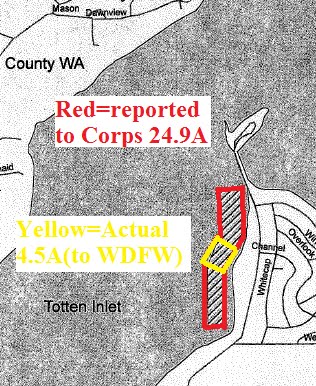
As seen in the examples above and below, Seattle Shellfish was one of the companies that significantly overstated acreage they had under cultivation by claiming existing "Project Areas" far greater than what was actually under lease and planted therein. Examples provided here show 60 acres claimed to have been leased and cultivated by them when, in fact they reported to WDFW (a separate state agency) that only 7 acres had been leased and cultivated. Based on maps from WDFW, even that number does not accurately reflect what was actually being cultivated with what in 2007.

Carlyon Beach,
Reported Project Area from Seattle Shellfish
to Army Corps June, 2007 = 24.9 Acres (in red)
Acreage Reported to be Leased/Cultivated to WDFW
after 2007 by Seattle Shellfish (in yellow) = 4.5 Acres


Nationwide Permits (NWP) Recognize that a Balance is Needed
The Corps is aware there is a need for permitting that recognizes a balance between development and protection of waters of the US, as defined by the Clean Water Act. Thus is why the Nationwide Permit (NWP) system is in place. Through NWPs, small impacts to critical habitat are allowed by the Corps, but only after a careful analysis by the USFWS and NMFS. In that analysis, the agencies determine whether activities are similar enough "in nature and in environmental impact to warrant regulation under a single General permit." The agencies must also be able to quantify total discharges to determine cumulative impacts. If that can be done, a NWP is developed and may be used. Every five years NWPs are reconsidered.

NWP 48 - Allowed Existing Shellfish Operations to Continue if in Place before March of 2007
In the case of shellfish cultivation, the critical issue considered by these federal agencies between 2007 and 2009 was, first, whether cultivation was underway ("in the ground" or "fallow" following a previous planting) prior to March of 2007; what that cultivation method was; and which species were being cultivated. In order to determine whether those areas reported to be under cultivation were having a significant impact, alone or together, the Corps required growers to submit applications showing what tideland areas were currently being cultivated, with what, and how. That information, obtained from forms submitted by shellfish growers, was then provided to the USFWS and NMFS.

Windy Point

Reported Project Area from Seattle Shellfish
To Army Corps June, 2007 = 15.2 Acres (in red)  
Acreage Reported to be Leased/Cultivated to WDFW
by Seattle Shellfish (in yellow)  = .5 Acre

Quality of Data Submitted and Seattle District Discretion
Information provided was inaccurate, at best, and certainly not of the quality a sound decision should be based off of [read about Information Quality Act here]. Adding to the difficulty was that geoduck farming in Puget Sound was new and unique to the area which had not been studied (i.e., it was not a "Nationwide" practice). This was recognized by the Corps' Northwestern Division in Portland who in turn gave the Seattle District the discretion to address the method and develop additional conditions, based on the then inaccurate information submitted.

This inaccurate information, coupled with the uniqueness of the impacts from geoduck farming is why both the Department of Ecology and the Army Corps of Engineers, driven from the Seattle District level, required resubmission of new forms to accurately reflect what was being cultivated, how, and where. As noted above, those resubmissions were finalized in 2010, after the 2009 Biological Opinions from USFWS and NMFS were submitted. [click here for a summary table showing how innacurate the information submitted by growers was, compiled by Protect Our Shoreline citizens in 2007]

USFWS and NMFS Could Not Have Determined Impact
Because the information submitted in 2007 was not accurate, and not updated until 2010, the Biological Opinions issued by the USFW and NMFS in 2009 (those that the Seattle Shellfish "complaint" claims support its position) could not have determined whether operations were "similar" and whether they alone, or together, had a significant impact. Numerous communications between the Corps, NMFS and USFWS between 2007 and 2009 clearly indicate the inability to accurately determine how many acres were being cultivated, and with what. (e.g., from NMFS - "it is difficult to identify precisely the locations of existing shellfish aquaculture operations in Washington State"; "Corps needs to provide better information about the acreage of the operations being covered under NWP 48")


Given that, it was impossible for USFWS and NMFS to determine whether expansion of existing farms should be allowed. As such, claims in the complaint - those stating that the 2009 Biological Opinions support expansion - have no foundation to build on. Attempts to define "Project Areas" as "expansive" are countered in numerous communications which clearly define it narrowly - as an "existing operation." In short, you cannot claim a tideland not planted prior to March of 2007 is "existing" any more than you a float establishes an "existing" dock.

Permits Take Time - Especially When Information Provided Isn't Accurate and What's Being Protected is More Important than Money to be Made
Seattle Shellfish and Taylor Shellfish complain about no permits having been issued in many years. It would have helped if, at the outset, the shellfish industry not viewed the Nationwide Permit as a hindrance to expansion but instead as a means to protect the very thing they - and everyone else - benefits the most from: a robust and healthy Puget Sound habitat, capable of supporting a diverse number of species for a diverse number of people.

Monday, December 12, 2011

Citizens File Petition to Ammend Shoreline Regulations, not Streamline Them

Case Inlet Shoreline Association and the Coalition to Protect Puget Sound Habitat have petitioned the Department of Ecology to amend WAC 173-26-241(3)(b) Aquaculture Standards.
http://www.caseinlet.org/uploads/Petition_for_Rulemaking.pdf 

This petition has been filed to correct a legally flawed opinion by the Attorney General carried forward into Ecology's recent guidance regulations, specifically focused on geoduck aquaculture.  As noted earlier, a recent court decision determined geoduck aquaculture does in fact use structures and thereby meets the definition of a development, requiring a shoreline permit, just as all developments along the shoreline do, whether a dock; a bulkhead; or a home.
http://www.caseinlet.org/uploads/taylor_10-21-11.pdf (Judge's transcript)

When asked how this fits with the shellfish initiative to "streamline" the permitting process, the simple answer is "it doesn't."  "Streamlining" the permit process for aquaculture is not what the Shoreline Management Act and the Clean Water Act are in place for.  They are in place to protect the very unique and valuable habitat which Puget Sound provides, for everyone and everything, not just the shellfish industry.  As seen in this brief youtube slide show, the shellfish industry is transforming the tideland habitat of Puget Sound in a way which will forever degrade the biodiversity provided from this habitat area:  http://youtu.be/lC1IjM45UbU 

Totten Inlet Non-native Mussel Farm
Slated for Expansion
With Non-native invasive Tunicate Problems


The recently announced initiative does contain important components in the form of restoration of native species; financial assistance for upland owners' failing septic systems; financial assistance for
cattle and dairy farmers; and, increased access to publicly owned shoreline.  But make no mistake:  this effort is primarily an attempt to bypass regulations which have evolved over the past four years which the shellfish industry does not like.

Many citizens have watched the transformation of aquaculture from small mom and pop operations to large corporate entities.  Anyone who cares about Puget Sound should be very concerned about attempts to "streamline" permitting.  If this is allowed to move forward, future generations will only look back on this time and say "What were they thinking?"

You can help by supporting Case Inlet Shoreline Association (http://www.caseinlet.org/) and the Sierra Club (http://washington.sierraclub.org/tatoosh/Aquaculture/index.asp).

Monday, November 14, 2011

Trespass Settlement Terms Disputed

The Squaxin Tribe has challenged 2010 trespass settlement terms.

Should the bigger question be:  Were the 17 treaty Indian tribes aware in 2007 tidelands managed by the State may have Tribal Treaty rights impacted?
 http://nwifc.org/about-us/shellfish/commercial-shellfish-growers-settlement/

In 2010, settlement terms for trespassing may have done so. 

In 2009 Taylor Shellfish, Seattle Shellfish, and Arcadia Point Seafood were all found to be trespassing on State tidelands.  These tidelands were adjacent to private tidelands which had been leased and cultivated, in one case since 1998.  Over this period one, perhaps two harvests occurred with the recent plantings being perhaps a third "crop."  In the 1998 case, settlement terms allowed harvest of the 1/2 acre of planted State lands for a payment of $75,000.

[Our comment:  1/2 acre of geoduck, after expenses, nets up to $500,000 for the grower.  Was a settlement of $75,000 for geoduck worth $500,000 in the best interest of the State and the Tribes?  Were Tribal members notified cultivation and harvesting would occur on State tidelands when letters from the growers were mailed or did those letters only identify the privately held tideland parcels?  Should the growers be allowed to retain ownership of the geoduck planted on State tidelands?]

The Squaxin Tribe does not agree with the settlement terms for reasons outlined in a Magistrate's decision here: 
http://turtletalk.files.wordpress.com/2011/10/dct-order.pdf 

If the Magistrate's decision stands, should the 2007 settlement also be challenged?