Support Truly Sustainable Aquaculture
Wednesday, November 22, 2017
November 29-30: Upland Salmon Farming in Closed Pens Workshop
A workshop on salmon farming in closed pens will be held in Vancouver, BC on November 29 and 30. Participants include Atlantic Sapphire's Johan Andreassen whose product was recently picked up by Portland based New Seasons Market. Grown in closed Recirculating Aquaculture Systems (RAS) these enclosed facilities eliminate the risks to native salmon which facilities such as those operated by Cooke Aquaculture create. It is the only means by which Atlantic salmon achieve Monterey Bay Aquarium's Seafood Watch "Green" "Best Choice" rating.
Saturday, November 18, 2017
Coalition to Protect Puget Sound Habitat Year End Fund Raising
The Coalition to Protect Puget Sound Habitat has released its year end fund raising letter. It reviews 2017's activities and what it looks forward to in 2018.
Dear Members,
It is hard to believe that our Coalition to Protect Puget Sound is now being joined by National Organizations like the Center for Food Safety and the Center for Biological Diversity who are speaking out about the degradation of Puget Sound and Willapa Bay/Grays Harbor by the shellfish industry. In addition, Wild Fish Conservancy and the Sierra Club are now taking the lead on demanding the end of finfish Atlantic salmon net pens in Washington State waters. Many of us can remember when we were laughed at and excluded as we presented the threats of industrial shellfish and finfish aquaculture to local, state and Federal Agencies--now the aquaculture industry is no longer laughing.
The following lists our accomplishments as we continue to move forward:
1. We won the Washington State Court of Appeals decision that stopped the 5 acre Detienne geoduck operation in Henderson Bay/Pierce County. This case is now published, is precedent setting and is also being used by other environmental groups trying to protect eelgrass and forage fish.
2. By next spring, our Coalition lawsuit against the Army Corps for ignoring destructive cumulative impacts from shellfish aquaculture will be heard in Federal Court. After many years of working with the Center for Food Safety, we are excited that they have also sued the Army Corps for the adverse effects of shellfish aquaculture--especially on endangered species. Our litigation will be heard at the same time. To thank them for their invaluable pro-bono help, we encourage you to sign up with them as follows:
If you would like to learn more about CFS and stay updated on the work CFS is doing on shellfish aquaculture and other issues, it is free to sign up!
3. We have been told that nearly 1,000 comment letters opposing another Imidacloprid spray in Willapa Bay have been received by the Dept. of Ecology. Individuals, chefs and large national organizations stepped up after our years of alerting everyone of the devastation by the shellfish industry. This important coastal estuary has endured the shellfish industry spraying some form of pesticides directly in the water for over 40 years. Charts clearly show the corresponding plummeting of Chinook Salmon, ESA listed green sturgeon, ESA listed marbled murrelet, herring spawning and eelgrass beds.
4. Bainbridge Island and Pierce County continue their battle with the Department of Ecology to protect their shorelines with comprehensive aquaculture regulations in the Shoreline Master Program updates.
5. Our members have turned out to:
a.. Demand and see Jill Guernsey no longer the lawyer for the Pierce County Shorelines after reporting her conflict of interest of taking a donation from the shellfish industry's attorney for her Gig Harbor run for mayor at the same time she was representing Pierce County
b. Demand and see Dr. Glen VanBlaricom no longer presenting SeaGrant science after reporting his biased testimony at the Shoreline Hearings Board on behalf of the shellfish industry
c. Demand and see the Washington State Executive Ethics Board violation order against Kim Patten, who was the WSU scientist providing the "no harm" supporting science that has been used to issue pesticide spray permits for the shellfish industry in Willapa Bay/Grays Harbor for decades
d. Demand and see the first shellfish industry EIS required for the Burley Lagoon/Pierce County 25 acre geoduck application by Taylor Shellfish
We are currently working on other actions that will also protect our communities and we will announce these as soon as we are able to. Just know that we continue to move forward and greatly appreciate your time, donations and kind thoughts. If you are making any year end donations, please keep us in mind as we will use those funds wisely.
Tax deductible donations can be sent to: The Coalition To Protect Puget Sound Habitat
P O Box 233, Burley, WA. 98322
Wishing all of you the very best during this Holiday Season!
Sincerely,
Laura Hendricks
(253) 509-4987
Thursday, November 16, 2017
Senator Rankor Introduces a Bill to End Atlantic Salmon Farming in Puget Sound
Time for nonnative salmon and Cooke to go.
(See testimony of DNR, DOE, WDFW, Lummi Chairman Julius, and Cooke representatives/lobbyist here: https://www.tvw.org/watch/?eventID=2017111058)
Thursday: Washington State Senator Rankor announces he will introduce legislation to end Atlantic salmon farming in Washington.
(Read Seattle Times article here: https://www.seattletimes.com/seattle-news/environment/washington-state-senator-says-hell-file-bill-to-ban-atlantic-salmon-farming/)
Not satisfied with Cooke Aquaculture presenting themselves as fishermen/farmers focused on NOAA talking points of feeding the world through aquaculture and why they are respected in the northeast, Senator Rankor has agreed with Washington citizens: Cooke Aquaculture and Atlantic salmon have no place in Washington. Despite a glowing presentation before the House Agriculture and Natural Resource Committee highlighting who Cooke Aquaculture is, it was not enough to stop Senator Rankor from announcing that he was moving forward with introducing legislation which would ban these operations growing nonnative invasive Atlantic salmon in Washington's waters.
As pointed out in the article, Cooke Aquaculture is a large foreign company and will use its lobbying strengths to influence legislators and attorneys to fight attempts to limit its operations. After all, their bank loan is dependent on these leases and, as they say, it's all about the money.
Saturday, October 28, 2017
Pesticides in Willapa Bay: It's not about bees. It's about Willapa Bay's aquatic ecosystem and native marine invertebrates, the very foundation of the food chain.
Comments due November 1
Reminder: Comments on the proposal to apply the neurotoxic pesticide Imidacloprid to shellfish beds in Willapa Bay are due by November 1.
You may submit comments here: http://ws.ecology.commentinput.com/?id=aefUM
(Alternatively, you may say you support the comment letter from the Coastal Watershed Institute found here: https://commentinput.com/attachments/projectID_1001/10063/merged//12829.pdf)
(Or, you may say you support the comment letter from Northwest Center for Alternatives to Pesticides, found on The Coastodian's site, here: https://coastodian.org/wp-content/uploads/2017/10/comment-letter-oyster-imidacloprid-proposal-SEIS-2017_updated-1.pdf)Willapa Bay is not a template for shellfish growers to profit from. It's time for them to step back.
Anthropogenic Extinction
of a Native Oyster
(From The History and Decline
Native oyster, native habitat, gone.
In the mid-1800's one of the great anthropogenic acts of extinction began in Willapa Bay. An estimated 27% of Willapa Bay was originally covered with native Olympia oyster. By 1920 that population, whose beds were estimated to have been as dense as 116 oysters per square meter, were all but gone, a direct result of overharvesting. After the shellfish industry first stripped the more easily harvested intertidal and low subtidal areas, they then convinced politicians in 1899 they should be allowed to dredge the remaining subtidal population. Shortly after that point, the native population of Olympia oyster, likely genetically distinct to Willapa Bay, were all but gone. Thanks to little more than the goal of short sighted profits by the shellfish industry.
Bring in the nonnatives, spray the invasives (as defined by the shellfish industry)
Left with nothing more than empty tidelands the shellfish growers, instead of restoring the native Olympia oyster, attempted to introduce the nonnative Eastern oyster. Shipped by rail and packed in Spartina, it was a failure after mass die-offs. What didn't die-off was Spartina. Considered a beneficial plant on the east coast because of its ability to stabilize soils in the nearshore environment and habitat it provided, shellfish growers considered it an invasive species. Through political lobbying they were able to get approved one of the largest herbicidal spraying operations in a marine environment. While successful in minimizing Spartina, its sediment retention properties were lost, resulting in dispersal of sediments previously held in place throughout Willapa Bay.
If at first you don't succeed - try again. And strip ownership of tidelands from those who made it succeed.
After the failure of the Eastern oyster, Willapa Bay shellfish growers turned to the nonnative Japanese Pacific oyster. Growers from Japan had been successfully importing and growing the Pacific oyster privately owned tidelands since 1905. Until "passage by a State Legislature of a law (1922) restricting the ownership of lands by aliens, [when] the
Japanese Company was forced out of business" (from "The Immigrant Oyster", a history of how the nonnative Pacific oyster came to be introduced and cultured in Washington's waters). At that point, after the failure of the Eastern oyster, the nonnative Pacific oyster was what was grown.
Bring in the nonnatives, spray the invasives. Part 2.
Along with the nonnative Pacific oyster imported from Japan, also came the nonnative Japanese eelgrass. As with Spartina, in Japan this species of eelgrass is considered beneficial in the habitat and food provided to aquatic and avian species. But, as with Spartina, shellfish growers here considered it to be a "noxious weed." Shellfish growers successfully convinced the Noxious Weed Board to classify Japanese eelgrass as a "noxious weed" which in turn led to approval spraying Imazamox, an herbicide, into Willapa Bay in order to more easily grow nonnative Manila clams and nonnative Pacific oysters.
Kill off the natives with pesticides so nonnatives can grow.
Now, shellfish growers believe it is time to remove a native species, the burrowing shrimp. Growers claim the burrowing shrimp is spreading throughout the bay, making their tidelands too soft to grow nonnative shellfish on. And with the removal of the burrowing shrimp, any other aquatic invertebrate in the area, making up the very base of the food chain in Willapa Bay. The shellfish growers' response? It helps the population to kill them off. (Dick Sheldon, October 10, before the Department of Ecology)
Willapa Bay needs a new chef. It's not a "chemical soup" and not a profit template.
It's time for shellfish growers to be told to step aside. Their short sighted actions have done little more than transform what had been a bay whose tidelands were populated with native Olympia oysters in densities unimaginable today. Their short sighted actions have introduced multiple nonnative species into a thriving ecosystem which has done nothing more than create what Washington's attorney general described as "the chemical soup that was the bay." A chemical soup created by chefs who call themselves shellfish growers.
Get involved. Industrial aquaculture is transforming Washington's marine ecosystems. Aquaculture can be done, within reason. But just because it is "aquaculture" should not mean it can do what it wants, where it wants, however it wants.
Comments due November 1.
Labels:
imidacloprid,
neonicotinoid pesticides,
willapa bay
Tuesday, October 24, 2017
It's Just Beginning: Mason County Tideland Owner Complains of Higher Valuations - Thank Taylor Shellfish and Mason County's Shoreline Master Program
[Update: The individual complaining of her tideland parcel increasing in value should have said 2,600 percent, not 26,000 percent. The appraised value increase from $1,600 to ~$43,000. In comparison, Taylor Shellfish's parcel in Hammersley Inlet which has been a commercial geoduck operation for over a decade only increased in value from $1,230 to ~$4,000. It is not clear why a parcel with a commercial operation increased so little in comparison to a parcel on which the owner has only expressed interest in starting a farm, and is in an area which the Department of Health closes during heavy rainfall.]
________________________________________________
Be careful what you wish for.
Because now you've got it
and now you can pay for it.
$43,000* [corrected] because Taylor Shellfish
convinced the county to include in its SMP update
that the majority of tidelands owned are presumed
to be for commercial shellfish operations.
This commercial tideland parcel is worth far more than $1,600 and should pay far more than $17/year in taxes. You wanted it, you got it.
The Mason County Assessor's office has received a complaint of tidelands valued at what the owner claims is "an increase of 26,000* percent." [In fact, the increase was 2,600%.] Another parcel owned by the same person is claimed to have "increased 64,000 percent." Assuming those numbers are correct [the former was not], the former ~4 acres of tidelands (seen in the map above) increased in value to $43,000 [corrected]. Unreasonable? Not if you intend on commercially growing geoduck, a multi-million dollar return every 5 years, or even oysters. Even if you simply own tidelands as "open space" with no intention of ever commercially growing shellfish on them, the county may think otherwise.
Upland property owners get to pay
to support shellfish growers.
Then listen to them complain
when their tideland tax parcels
are assessed at their true value.
Shellfish Protection Districts: Upland taxpayers pay so shellfish growers are able to grow shellfish in public waters on tidelands undervalued by any standard.
Both tideland parcels are owned in McLane Cove, off of Pickering Passage, which was declared a Shellfish Protection District (SPD) by Mason County in July of 2016. Notes from a meeting held in February of 2016 state this property owner noted her family was a "past commercial shellfish grower." Notes from that same meeting note her interest in growing shellfish, with Jim Hayes of Hood Canal Oyster Company doing the growing. There is no question the intent is for these tidelands to be put to commercial use, that they were used in the past for commercial use, but that is exactly what this tideland owner complains about - the Assessor's Office determining their true value if a commercial shellfish operation is taking place, or may take place. And, as noted above, even if she hadn't played her hand in February of 2016, because of Taylor Shellfish's involvement in the SMP update, virtually all tidelands may be considered as "commercial" and assessed/taxed as such.
Which tidelands are commercial?
Taylor Shellfish has defined that
through their involvement
in the Shoreline Master Program update.
All Bush Callow tidelands are commercial
as well as all tidelands which are "fallow"
including those in McLane Cove.
The tideland grab in Mason County.
As Mason County's Shoreline Master Program update evolved, it became obvious the primary driver in its development was the shellfish industry's desire to expand as much as possible with as little oversight as possible. Representatives from Arcadia Point Seafood and Taylor Shellfish were instrumental in drafting regulations - or lack thereof - which resulted in virtually all tidelands in Mason County being considered "existing shellfish operations." As such, no permits were needed and unlike upland barbecues, any structure related to aquaculture were allowed. Those sold as Bush Callow tidelands had to be shown to be "abandoned" in order to fall out of the "existing" category. The remaining tidelands simply needed to be shown as being"fallow", a loose definition which virtually anyone could claim. Including the County Assessor. Coupled with not caring about "structures" used for aquaculture, it was the largest land grab obtained through the twisting of the Shoreline Management Act ever seen. And the Department of Ecology simply sat back, went along for the ride, and approved it.
Get involved. If you're not, what has occurred in Mason County will occur in any SMP update or amended update.
The Department of Ecology accepting the shellfish industry's definition of "existing" operations in Mason County will not stay in Mason County. Any shoreline county can now have tidelands defined as Mason County did, creating something from nothing. Then county residents can listen to tideland owners whose tidelands are re-assessed as a commercial operation complain about it. Taylor Shellfish is involved. It's why their tidelands are assessed so low. Others whose aren't should consider that.
Email the Department of Revenue's Marilyn O'Connell: lyno@dor.wa.gov
Tell her that it's time for tidelands with commercial shellfish operations to taxes based on the true value of their tidelands, not the current undervalued numbers. The Department of Revenue can tell county assessors to do so.
Politics pays - Taxes on Taylor Shellfish
11 acres growing geoduck?
$28 in 2017.
Friday, October 20, 2017
Pesticide Support from Willapa Bay Shellfish Growers: "No other way."
Shellfish growers testify
there is no other alternative to
spraying pesticides on
Willapa Bay shellfish beds.
Willapa Bay's public water are more than something to grow oysters in.
"My great great great grand father helped drive Willapa Bay's native population of Olympia oysters to near extinction. Let me help destroy the rest of the native species by spraying pesticides onto the shellfish beds." And pretend to be growing oysters in "pristine waters". Then wonder why nobody wants to buy shellfish grown in Willapa Bay.
Companies die when people are lazy
and unable to adapt to the changing environment.
It's time for these old timers to step aside.
It's not a vacation, it's a business, and you have to adapt to succeed.
Willapa Bay shellfish growers are blinded by their belief they are unable to adapt to a changing environment and that it is the environment they must change. Old timers say this is the way we are going to do it because there is no other way. It's time for the old timers to take their blinders off and adapt, or step aside. Willapa Bay's ecosystem is not theirs to destroy because it's easier to make a profit that way.
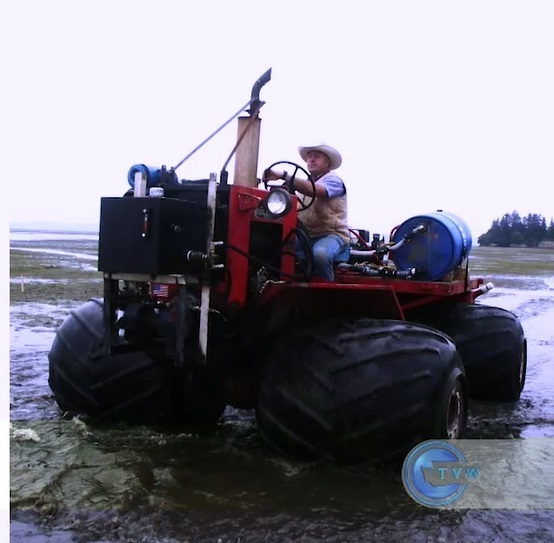
If you can build this
you can learn how to grow oysters
with other methods.
Times in Willapa Bay are changing.
The waters around you have grown.
Better start swimming
or you'll sink like a stone.
Get involved. Tell DOE they do not have enough studies to support putting Imidacloprid on Willapa Bay shellfish beds and in the public's waters.
The Department of Ecology is accepting comments on its draft supplemental EIS until November 1. You may submit comments here:
You may read the DSEIS here:
You may hear the October 10 hearing here:
Labels:
aquaculture,
imidacloprid,
willapa bay
Thursday, October 12, 2017
Cooke Aquaculture: Money Doesn't Buy Lummi Nation Silence on Net Pens
Read what integrity is.
“Your demand to keep quiet for a few extra dollars is insulting,”
(From the Seattle Times, October 12)
(From the Seattle Times)
If we pay for the tape will you be quiet?
Money didn't work. The surprise is Cooke didn't try beads and shiny metal.
The Seattle Times' Lynda Mapes writes on the response from the Lummi Nation to Cooke Aquaculture's attempt to stop the Lummi from advocating for the removal of net pen operations growing nonnative invasive Atlantic salmon. Cooke's stumbling down a path leaving footprints of half truths and utter confusion ran into a wall of integrity built by the Lummi Nation. Given Cooke's past response - or lack thereof - to the problems it was surprising they didn't offer beads and trinkets instead of money to buy silence. This is a company which should be told to close down their operations and move their idea of integrity and what is good for them somewhere outside of Washington's public waters.
We'll hire the best scientists,
trained in the art of deception!
(You too can create fake science, here.)
Let us hire a scientist who will show there's no problem. Trust us.
Adding further to the insulting belief that the Lummi Nation's silence could be bought for a few dollars is Cooke's belief that people - from whatever nation - would honestly trust a "study" funded by them on the impacts of escaped nonnative invasive Atlantic salmon from their collapsed net pen. A collapse which they could have easily been avoided by removing fish in July when the collapse first began. Instead, pursuing additional pounds and additional profits, they chose to squeeze another month out of a failing pen, a pen which collapsed completely one month later, releasing 165,000 mature and well fed nonnative invasive Atlantic salmon into Puget Sound. Then who blamed the "eclipse".
You drive a hard bargain. Let us fund positions and make you wealthy. Just be quiet!
Putting a bow on the obvious knot which Cooke was trying to tie around the Lummi Nation to silence them, they offered to fund a position in the Lummi's natural-resource department and to “...explore and implement economic partnerships that would be very beneficial to your tribal members, in the form of jobs and revenue, potentially with a total economic benefit that exceeds $1 million annually to the members of your tribe.” (September 13 Letter from Cooke to Lummi, Seattle Times, October 12)
This is not what Cooke wants you to see -
the core of what this company is.
Bainbridge Island net pen. DNR's reponse:
You are in default of your lease.
How about an all expense paid trip to Nova Scotia? Or Maine? Or Scotland? No, not Bainbridge Island.
In an August 30 letter from Cooke to the Lummi Nation they also extended an offer to fund a trip to see Cooke operations across the world and show what good stewards they were. It would seem a trip to the Bainbridge Island facility was not going to be included, a facility which the Department of Natural Resources found in such disrepair they wrote a letter of default demanding the repairs be made within 60 days. A facility which simply represents the core of what this company is.
Thank you to the Lummi Nation
Thank you to the Seattle Times.
Get involved - Cooke was just issued a permit by WDFW to import another 2 million nonnative Atlantic salmon eggs from Iceland.
These nonnative invasive Atlantic salmon do not belong in the public's waters, nor in the Lummi Nation's traditional waters. Cooke can see nothing but profits and believes everyone will simply do as they please if paid enough money. It's time to realize that aquaculture in Washington is not grandpa's oyster farm anymore. These are large corporations who have money and motivation to expand into Washington's marine ecosystems. They believe money can buy any kind of science they want; that politicians and agencies will simply roll over and agree these industrial operations are "in the state wide interest"; and that integrity does not exist. It does. Get involved.
Finally - Support investigative journalism.
The Seattle Times has been instrumental in laying bare the disaster which Cooke Aquaculture and complacent state agencies allowed to happen and, more importantly, the subterfuge they created in attempting to hide their negligence. Subscribe to the paper and support investigative journalism of this caliber.
Labels:
cooke aquacluture,
lummi nation,
marine ecosystem,
net pen failure,
nonnative atlantic salmon,
Puget Sound
Wednesday, October 11, 2017
Two faces of the Shellfish Industry: Polluting Willapa Bay with Pesticides; Suing Over Dairy Farmers' Perceived Threat
Tell the Department of Ecology to deny Willapa Bay shellfish growers' request to apply pesticides on Willapa Bay shellfish beds and the public's waters.
Click here to comment (Due by Nov 1)
Two Faces of the Shellfish Industry
One side:
Sue one agency claiming they aren't doing enough
to keep the waters clean enough.
The other side:
Demand another agency allow them to apply pesticides
onto Willapa Bay's shellfish beds and into its waters.
Do you want an oyster grown in waters
polluted with pesticides?
Mine for the taking.
Unfolding before us in real time is the shellfish industry wanting to have it both ways. On the one hand they sue one agency, claiming an industry is being allowed to pollute the public's waters, preventing them from growing shellfish and profits in those public waters, creating a "taking". On the other hand they demand another agency grant them a permit to spray pesticides into the public's waters and onto shellfish beds, claiming those waters are somehow "pristine" and theirs for the taking.
Cow: "Don't sue me, I'm not your problem."
DEQ: "Don't sue me, I'm not your problem."
Attorney to Hayes Oyster Co: "Who should I bill?"
The source of fecal coliform? Cows are easy to see. Who to sue? Not so easy to see.
In a lawsuit filed in Oregon, (the second attempt moving further, after the first was dismissed), Pacific Shellfish Growers Association member, Hayes Oyster Company, is suing Oregon's' Department of Environmental Quality. Hayes' suit claims DEQ's inaction has resulted in fecal coliform levels preventing them from growing oysters entirely on 250 of his 600 oyster beds, with the other 350 being closed intermittently during high rain events in the winter. The suit seeks $100,000 in damages (a "taking") and that DEQ act against the dairy farmers who Hayes sees as the problem. Dairy farmers point out they are currently issued "CAFO" (confined area feed operation) permits by the Oregon Department of Agriculture which, in part, regulate the amount of manure they are able to apply to their fields. The Oregon Dairy Farmers Association notes that in addition to CAFO permit oversight they have also voluntarily fenced off streams and planted riparian zones along those streams to minimize impacts. Perhaps more importantly, they note there are multiple sources of fecal coliform, ranging from wildlife to septic systems to waste water discharge plants, and they may not be the source to begin with. But, as long as the Hayes Oyster Company continues to pay the bill, their attorney is happy to file suits, wherever, against whomever.
[As an indication of the apparent financial challenges Hayes Oyster Company is facing, Oregon's Corporate Division indicates they have not paid their annual registration fee and are on the verge of another "Administrative Dissolution" being filed by Oregon. DEQ's attorneys and Haye's attorney may want to consider how that impacts the standing of Hayes Oyster Company.]
Buying tidelands seemed like a good business decision.
Until the Nesbit family's Goose Point Oysters found out
Tideland parcels an estimated $2 million will buy you,
purchased by the Nesbit family's
Goose Point Oysters in 2015.
Willapa Bay's native species make paying off a bad investment difficult. That's not Washington's problem.
In Washington's Willapa Bay, instead of adapting to different growing techniques as Taylor Shellfish has, most other growers are demanding that the Department of Ecology issue a permit which would allow them to spray Imidacloprid, a neurotoxic pesticide, onto shellfish beds and into the public waters of Willapa Bay. This demand has shed a light on the shellfish industry's past practices of spraying Carbaryl (also known as Sevin) onto shellfish beds and into Willapa Bay for years, all while claiming shellfish were being grown in "pristine waters". It has also shed light on companies such as the Nesbit family's Goose Point who paid millions for tidelands in 2015, likely hoping they could spray pesticides on their shellfish beds and waters of Willapa Bay. Instead, they and other growers discovered the public considers calling Willapa Bay waters "pristine" while spraying pesticides and herbicides onto shellfish beds not to be in the state wide interest. But, the growers are persistent and are back, demanding another permit be issued. It's cheaper that way.
[Note: The Department of Ecology is currently accepting comments, until November 1, on the Willapa Bay shellfish growers' proposal to apply Imidacloprid on shellfish beds and waters of Willapa Bay.]
Get involved. Don't buy oysters grown in pesticides.
Industrial aquaculture is rapidly evolving and transforming marine ecosystems into little more than corporate profit centers with little care for the real and growing impacts. Cooke Aquaculture's recent drive for profits resulted in the escape of 165,000 nonnative invasive Atlantic salmon into Puget Sound, as well as significant problems being found in other operations. Nonnative Pacific oysters threaten the habitat of Olympia oysters which millions of dollars are being spent on to restore. Aquaculture has money, is motivated, and wants to grow. They have successfully "baked into Washington law" the "benefits" of aquaculture. That cake needs to be taken out of the oven in order to protect, preserve and restore the marine environment. And don't eat oysters from Willapa Bay.
Labels:
aquaculture,
cooke aquaculture,
deq,
DOE,
goose point oyster,
hayes oyster company,
imidacloprid,
willapa bay
Thursday, September 28, 2017
Ethics in Science - Imidacloprid in Willapa Bay: Lead Washington State University Scientist Under Ethics Investigation
"State officials and employees of government hold a public trust that obligates them, in a special way, to honesty and integrity in fulfilling the responsibilities to which they are elected and appointed. Paramount in that trust is the principle that public office, whether elected or appointed, may not be used for personal gain or private advantage." RCW 42.52.900, Ethics in Public Service
Killing a native species with pesticides
in Willapa Bay. Based on what science?
There's a shrimp burrowing through trust in DOE's decision making.
The Department of Ecology has released its Draft Environmental Impact Statement on the application of Imidacloprid on up to 2,425 acres of shellfish beds in Willapa Bay over a 5 year period. The DEIS notes on page 1: "The Willapa Grays Harbor Oyster Growers Association (WGHOGA) and Washington State University's Long Beach Research and Extension Unit began testing imidacloprid (a neonicotinoid instecticide) in 1996..." WSU's Kim Patten has been involved since 1996, being the head of the Extension Office since 1990. Kim Patten owns tidelands which benefit directly from DOE's reliance on his studies, comments, and/or papers.
"Dr. Patten led most of the studies
of the effectiveness of imidacloprid in reducing burrowing
shrimp densities in Willapa Bay, Washington"
(DEIS, page A-10)
Shellfish bed owner, user of state resources
for personal gain, Kim Patten
Education: Bachelor’s degree in plant science
from University of California-Davis in 1977;
master’s degree in horticulture from Iowa State University in 1980;
Ph.D. in horticulture from Washington State University in 1984
Aquaculture is not horticulture.
DOE was aware of the conflict of interest, but chose to ignore it. [click here for letter provided to DOE's director Maia Bellon in January of this year]
September 8, after an investigation begun in January, the Washington State Executive Ethics Board found there "...is reasonable cause to believe..." that Kim Patten has or may be violating RCW 42.52, the Ethics in Public Service law. The detailed conflicts of interest and use of public resources for individual gain detailed in the investigation, were known to the Department of Ecology prior to their decision to renew and modify the permit for the application of the herbicide Imazamox to shellfish beds in Willapa Bay. Despite knowledge of the clear conflict of interest - detailed in a comment letter to DOE which pointed out his ownership of tidelands which would benefit from issuance of the permit- DOE simply dismissed the detailed information in their response to comments (p. 8 bottom) and said:
"Ecology is not aware of an instance where purposely misleading data or falsified data has been submitted regarding this permit. Additionally, we rely upon the best available science at the time that the Ecology action is taken."
Integrity above all.
The Department of Ecology has many responsibilities to the public, but paramount to all of these is trust. Trust that when DOE makes a decision it is made based on studies created by those who have no conflict of interest in the outcome of those studies. Trust that when DOE is provided summaries of studies all studies related to the question at hand are provided, not a select few which support the sought for outcome, which would result in financial gain to the person providing those studies. Trust that when a probable conflict of interest is pointed out they not dismiss it but examine the questions completely. Once again, DOE is aware of Kim Patten's clear conflict of interest in his supporting the application of the pesticide Imidacloprid on Willapa Bay shellfish beds and public waters.
Get involved.
Spraying pesticides onto Willapa Bay shellfish beds is a bad idea, no matter who creates the "science." There are alternative growing methods used by Taylor Shellfish, Coast Seafoods and others who have said they do not need to use Imidacloprid. Get involved and tell DOE to reject this DEIS on its face and not approve a permit. Comments - and a copy of the ethics violation - may be sent to DOE at:
Email: burrowingshrimp@ecy.wa.gov
Derek Rockett, droc461@ecy.wa.gov
Water Quality Program
Washington State Department of Ecology
Southwest Regional Office
PO Box 47775
Olympia, WA 98504
Attend the Open House/Public Hearings.
Open House/Public Hearing
Oct 7 and Oct 10
Most effectively: Stop buying/eating oysters and clams from Willapa Bay until this proposal is dropped.
Labels:
imidacloprid permit,
kim patten conflict of interest,
wghoa,
Willapa bay oysters,
willapa grays harbor oyster growers association
Tuesday, September 26, 2017
King Salmon Return to the Elwah River- And guess who else has discovered a new home?
The miracle of life seen in native salmon
returning to a habitat recreated in the Elwah River.
Great effort and faith returns a habitat buried for decades.
Al Bergstein's Olympic Penninsula Environmental News writes on the return of King salmon to the Elwah River and spawning habitat recreated by the removal of dams. As Mr. Bergstein notes, it took great effort, focus and money to remove the Elwah Dam and Glines Canyon Dam which had been in place for over 100 years. That removal freed the river, recreating habitat lost to native salmon, part of the Lower Elwah Klallam Tribe's traditions for untold generations.
Guess who else has discovered the Elwah River?
Thank you Cooke Aquaculture.
Nonnative invasive Atlantic salmon
escaped from Cooke Aquaculture's failed net pen
moving into the Elwah River.
It's "only one" because the river is closed to fishing. How many more are migrating upstream, undetected, to a new habitat?
The Department of Fish and Wildlife's "catch map" now notes a nonnnative invasive Atlantic salmon having been caught just up from the mouth of the Elwah River on September 6. Despite the fact that the Elwah River is closed to fishing. These fish being caught by citizens and being reported to WDFW are not being snagged. They are aggressively pursuing lures and/or bait in order to survive. They are far from what NOAA has described as "couch potatoes" who will linger around pens if they escape and who don't know how to eat anything but artificial feed and coloring.
This is not the same.
Cooke Aquaculture's failed net pen in August.
This, after a partial collapse in July.
"It's happened before, don't worry. Trust us. We have studies." It's not the same.
What happened on August 19 has not happened before. Attempts to establish Atlantic salmon in the past did not use 160,000 mature, 10 pound adult salmon released in the heart of Puget Sound. Escapes in the past were not 160,000 adult salmon, mature and ready to spawn. They were young, immature salmon, adolescents lost in the woods. Cooke Aquaculture, NOAA and other agencies attempting to pacify the public by using self serving studies only continues to darken the veil industrial aquaculture has created through false narratives and contract scientists in order for a few large corporations to profit greatly from the public waters of Puget Sound and rivers feeding into that body.
"Look at this new home they made for us!"
Atlantic salmon do not belong here.
Get involved. Demand these pens be removed and moved to upland, isolated facilities.
Chris Dunagan writes in the Kitsap Sun about the possibility of the Puget Sound Partnership agreeing that these net pens should be banned from Washington's waters. Cooke Aquaculture saying "we're sorry" isn't good enough. These should never have been allowed in the first place. Claiming they "can do better" is not good enough. Agencies forming emergency response teams, after the fact and all fumbling along the way is not good enough. It only takes one mistake to destroy what took millions of dollars, untold hours and perseverance to do - recreate a habitat for native salmon to return to, spawn at, and create a new circle of life for future generations. It was not done for nonnative invasive Atlantic salmon to claim as their new home.
Subscribe to:
Posts (Atom)