Our mission is to protect the habitat of Puget Sound tidelands from the underregulated expansion of new and intensive shellfish aquaculture methods. These methods were never anticipated when the Shoreline Management Act was passed. They are transforming the natural tideland ecosystems in Puget Sound and are resulting in a fractured shoreline habitat. In South Puget Sound much of this has been done with few if any meaningful shoreline permits and with limited public input. It is exactly what the Shoreline Management Act was intended to prevent.

Get involved and contact your elected officials to let them you do not support aquaculture's industrial transformation of Puget Sound's tidelands.

Governor Inslee:
Showing posts with label imidacloprid. Show all posts

Tuesday, June 18, 2019

Imidacloprid in Willapa Bay: Goose Point Oyster/Others Press On - "No other way."

Pristine Waters of Willapa Bay?
It just needs pesticides added directly to it.
Growers complain of urban runoff. 
But direct application of pesticides by them is okay.

Welcome to business. If it were easy, everyone would be doing it. 
In a presentation put forth for OPB, owners of Goose Point oyster claim there is no other way for them to grow oysters than to be allowed to spray their beds with the pesticide Imidacloprid, banned in the European Union. Because there is a lack of willingness to develop and implement alternative growing methods such as those Taylor Shellfish has, Goose Point's owners believe the only way is to spray Willapa Bay with Imidacloprid, one of the neonicotinoids being banned in foreign countries*.
*Some ask why let a foreign country control US policy? Some ask why foreign countries grounded 737 Max jets before the US. Sometimes the US isn't always right.
The threat to Willapa Bay is not native species.
It is pesticide use from oyster growers.
And a lack of imagination and willingness
to accept that sometimes business has expenses.

Welcome to "pristine" waters of Willapa Bay. Where pesticides were applied directly.
Willapa Bay is often described as having "pristine waters" which grow some of the best oysters in the world. While it's true that Willapa Bay grows an enormous number of oysters, claiming the waters to be "pristine" while spraying pesticides on oyster beds for decades stretches integrity. Washington's Attorney General went so far as to describe the waters as a "chemical soup" in 2012 (see p. 32 here). Direct application of Carbaryl/Sevin by growers then only made it worse, as Imidacloprid will today.

Use some Thinking Time.
It's not rocket science.

Welcome to business problem solving. It's not, "We don't know what else to do!"
Oyster growers claiming there is no other way are not taking the time to problem solve. Some claim that pole and rack/line systems would work like those used by Taylor Shellfish, but sediments are so soft poles used fall over. Do they not make longer poles which get driven into firmer sediments?  Just because oyster growers have been used to simply throwing oyster shell onto the bedlands of Willapa Bay, spraying pesticides, and using the public waters as a food source to grow oysters doesn't mean there aren't alternative methods. It only means there is a lack of will because it may cost more to grow oysters. Business is tough sometimes.

All the PR help in a tall building
will not convince consumers
oysters from beds sprayed with 
pesticides are safe/good to eat.

Welcome to bad PR advice. The Hard Reality: You will kill demand for oysters from Willapa Bay and all of Washington.
Public Relations firms will be more than happy to take money and make a point you want them to. It's what they get paid to do in their 25th floor offices. It's not to tell you the hard realities in life. In this case, if oyster growers are successful in their appeal to Washington and are granted a permit, the demand for Willapa Bay and Washington oysters will drop. Efforts to export Washington oysters to the European Union will be for nothing when they discover Imidacloprid - a pesticide the EU has banned - is being sprayed on the oyster beds Washington oysters are grown on. The East Coast Shellfish Growers Association has already said, pointedly, they "...use no feeds, fertilizers, pesticides or antibiotics." That is the hard reality Washington oyster growers will be up against if Willapa Bay growers are successful. That advice is free.


Friday, April 19, 2019

Taxpayer Dollars Funding Research on Toxic Chemicals to Remove Native Burrowing Shrimp in Willapa Bay Remain

[Update 4/26: EHB 1109, the 2019-2021 operating budget, is waiting for a House/Senate conference meeting to work through disagreements between the two houses. Still remaining in the bill is $534,000 of taxpayer dollars allocated to assess "...the toxicity of candidate chemicals..." to poison native burrowing shrimp (see below for current wording).]

$534,000 to Study Toxicity of Chemicals
Applied to Oyster Beds and Marine Waters
of Willapa Bay and Grays Harbor Remains
in Final Budget Bill

Changes have been made to the final budget bill, removing mention of Imidacloprid, but retaining the belief that the only way to deal with this native species is by eliminating it, "...assessing the toxicity of candidate chemicals..". As of yet, funding to assist growers in moving to alternative growing methods used by the oyster growers around the world, and within Willapa Bay, has yet to be accepted as a better alternative. According to the office of Governor Inslee, this funding will cease June 1, 2019. (See final bill, page 625, by clicking here)

(9) $534,000 of the state toxics control account—state  appropriation is provided ((solely for a monitoring program to study the impacts of the use of imidacloprid as a means to control 16 burrowing shrimp and related costs)) to support research related to burrowing shrimp infestations in Willapa bay and Grays harbor. Department costs include, but are not limited to, oversight and  participation on a technical advisory committee, technical assistance, planning, and reporting activities. The department may also use the funding provided in this subsection, as needed, for payments to Washington State University, the United States department of agriculture, and outside consultants ((for their participation in the monitoring program and technical advisory committee)). Research funded pursuant to this appropriation includes but is not limited to dye dispersal studies to understand the oceanographic dynamics of Willapa bay, Grays harbor, or both, laboratory studies to assess toxicity of candidate chemicals to control burrowing shrimp, and support of researchers in publishing original research related to control of burrowing shrimp, including research assessing potential impacts to nontarget organisms in Willapa bay and Grays harbor. The department must report to the appropriate committees of the legislature by June 1, 2019, on the progress of ((the monitoring program)) expenditures under this subsection.


It's time to stop looking to the past
for a solution for tomorrow.

At some point in time legislators and growers will come to realize that taxpayer dollars for funding of ideas from oyster growers who drive by looking in the rear view mirror for solutions to a perceived problem will not work nor be accepted by consumers of Washington oysters and Washington taxpayers. Instead, it will be legislators and companies who drive while looking forward through an evolving marine ecosystem, which does not need to have toxic chemicals applied to it, will be who survives.

Saturday, April 13, 2019

Canada Further Restricts Use of Imidacloprid/Neonicotinoids: Willapa Bay Shellfish Growers Continue Appeal to Use in Marine Waters and On Washington Oyster Beds

My grandfather did it this way
and my father did it this way.
It doesn't make it right.

Should Canada drive policy decisions? They helped ground the 737 MAX when the FAA wouldn't. They should also help drive the decision to reject the appeal by the Willapa Grays Harbor Shellfish Growers Association who continue to walk into a cement wall of resistance to applying pesticides to oyster beds, not understanding the wall isn't going to move.

Despite being told by the public, in no uncertain terms, they do not want oysters raised on beds sprayed with pesticides, Washington shellfish growers either support or are silent on the pursuit of a permit to do so. (Read on decision to appeal here: https://www.kiro7.com/news/local/oyster-growers-appeal-state-decision-to-deny-pesticide-use-1/863242698)

Despite being told by agencies the application of Imidacloprid on Washington oyster beds should not be permitted, Washington shellfish growers either support or are silent on the appeal of that decision by WGHOGA. (See denial letter from DOE to WGHOGA here:  https://ecology.wa.gov/DOE/files/9f/9f907372-0c3d-4d5c-aea2-116a38516e10.pdf)

"Our Imidacloprid is different."

How much did it cost to convince 
a lobbyist to believe that?

Despite being printed on virtually every label of a product containing Imidacloprid that it is toxic to marine invertebrates and should not be applied in the intertidal area, shellfish lobbyists convinced the EPA that in the case of Willapa Bay and Grays Harbor, their proposed use of Imidacloprid was different. Their profits should override the concerns every other manufacturer of products containing Imidaicloprid had and they should be allowed use it to eliminate native burrowing shrimp - and any other marine invertebrate which happens to be in the area - so they are able to grow nonnative Pacific oysters. All the while complaining about urban runoff, dairy/cattle farms, and septic systems  impacting marine waters and their ability to grow oysters.

How many times does Washington's shellfish industry need to walk into this wall of resistance to their idea - or silence on it - before they realize it is their product which will be tainted and, along with it, whatever profits they hoped to gain.

The European Union will never accept oysters from Washington when they find out what growers in Governor Inslee's "green state" have done and want to continue to do. That's a wall you don't want to walk into.

Get involved. Tell Washington oyster growers - whether they support the appeal or are currently silent on it - to stop the process. There are alternative ways to grow oysters which will effect their profits far less than a market refusing to buy oysters from Washington where pesticides are applied to oyster beds.

Monday, February 18, 2019

Public Hearings February 19, 1:30 and 3:30 - Pesticides in Washington Oysters: See it live or on TV

Washington Legislature to the 
Department of Ecology:
"You will authorize the use 
of pesticides on oyster beds
in Washington State."

At 1:30 and 3:30 the Washington State legislature will hold 2 hearings on Senate and House bills which will force the Department of Ecology to authorize the use of the neurotoxic pesticide Imidacloprid on Washington oyster beds. 

After DOE denied a permit application. 
After the European Union banned the use of Imidacloprid. 
After France banned the entire class of pesticides Imidacloprid is one of (neonicotinoids). 
After the East Coast Shellfish Growers pointedly said they "...use no feeds, fertilizers, pesticides or antibiotics."

All of Washington's oysters which will be perceived as poisoned.
Washington's oyster industry is about to be tainted in its entirety because a few growers in Willapa Bay are unwilling to change their growing methods. And because a few large growers won't tell them and their lobbyists to drop the idea. Washington's oyster industry and the legislature needs to wake up.

Get Involved
Public Hearings Tuesday, February 19, 1:30 and 3:30
SB5626: "By May 15, 2019, the department [of ecology] shall authorize the use of imidacloprid" in Willapa Bay.
Senate Agriculture, Water, Natural Resources & Parks, 1:30
Live on TVW here: https://www.tvw.org/watch/?eventID=2019021318
Comment here: https://app.leg.wa.gov/pbc/bill//5626

HB1611: "Directs the Department of Ecology (Ecology), by May 15, 2019, to authorize the use of imidacloprid" in Willapa Bay.
Environment and Energy Committee, 3:30
Live TV here: https://www.tvw.org/watch/?eventID=2019021324
Comment here: https://app.leg.wa.gov/pbc/bill//1611

Friday, February 15, 2019

Politics and Pesticides in Willapa Bay: Public Hearings on Bills to be held February 19

Didn't you hear the Department of Ecology
and consumers of Washington's oysters say "No"
to spraying pesticides on oyster beds?
Someone go start a Gofundme 
for a hearing aid for 
the WA oyster industry.

Get involved
House Bill 1611 and its companion bill in the Senate, Senate Bill 5626 will have public hearings on February 19. Both would allow spraying the neonicotinoid Imidacloprid onto Willapa Bay oyster beds and the public/tribal waters flowing over them.

Public testimony on House Bill 1611 is currently scheduled to be heard by the  House Committee on Environment & Energy at 3:30 PM. Public testimony on Senate Bill 5326 is scheduled to be heard by the Senate Committee on Agriculture, Water, Natural Resources & Parks at 1:30 PM.

The public is encouraged to submit comments at the hearings at the hearings or to comment on the bills here:
HB1611: https://app.leg.wa.gov/pbc/bill//1611
SB5326: https://app.leg.wa.gov/pbc/bill//5626


See politics in action.

Bring the political process into focus
The public hearings may also be seen live on TVW (HB1611 here and SB5626 here). See who shows up to testify in favor of poisoning Washington's oyster beds. See politics at its worst. Video of the hearings will also be recorded for viewing at a later time.


What could go wrong?
Lots.

What is "not subject to change": Pollution is pollution
The schedules are "subject to change". What is not subject to change is the adamant opposition to this ill thought idea of spraying the neurotoxic pesticide Imidacloprid onto Washington's oyster beds and marine waters. The oyster industry has, for years, abused the political and scientific system in order to convince people consuming oysters from Willapa Bay they are from "pristine waters" when, in fact, these waters have been polluted by that very industry with a variety of pesticides and herbicides, all the while complaining about upland sources of pollution impacting these very same waters.

Wednesday, February 6, 2019

Oyster Industry, Politics and Pesticides

Read it and weep.
This is not a good idea.

Who needs science when you can spend the money on politicians instead?
The Seattle Times writes on the current push by politicians who feel the oyster industry should be free to spray pesticides on oyster beds and the marine waters of WA so they won't have to spend money on improved growing techniques. Or on science which shows this ill thought idea is somehow in the statewide interest.
Read the article here: https://www.seattletimes.com/seattle-news/environment/politics-has-science-on-the-run-and-not-just-in-the-other-washington/

Like a bad oyster,
this just makes you sick.

Ad nauseam: It makes you feel worse than a bad oyster because it just keeps coming and coming.  
Unlike what the recent lawsuits filed against Pierce County by Taylor Shellfish and the Foss family claim, ad nauseam, the Shoreline Management Act is not in place to "plan for, foster, and give preference to aquaculture." It is in place to protect the critical marine ecosystems from industries who have become blinded by profits and feel their developments and actions within this ecosystem should be allowed to grow, unfettered, free from oversight.
Read Taylor lawsuit against Pierce County's Shoreline Master Program here:
 https://app.box.com/s/mjxvavgay49rqcs3fwvvw09utjjegu28
Read the Foss family's companion lawsuit here:
https://app.box.com/s/aaiclnj3ovyq9h5n5ix4mhi90wcdpgsa

"Shazam! I've created something from nothing!"


It doesn't matter how many times you say it. It's not there.
Nowhere in the Shoreline Management Act does it say aquaculture is supposed to be fostered and given preference over everything else as these suits, and the Department of Ecology seems to believe. The priority of the SMA is to protect this unique and fragile ecosystem from fragmentation.

The Shoreline Management Act is not subservient to NOAA policies created to do nothing more than promote aquaculture, many times based on dubious - at best - "science".

The Departement of Ecology's "handbook" on aquaculture painfully tries to outline the "legal" framework for why aquaculture should be placed on a pedestal, tripping over NOAA and national policies. The reality is the Shoreline Management Act was passed before NOAA's Coastal Zone Management Act. It was passed before the National Shellfish Initiative was created. It was passed before Washington's shellfish initiative was created. The SMA was voted on, and approved, by the citizens of WA.  Most importantly, both the National and State initiatives are nothing more than marketing documents created by lobbyists for the industry and politicians beholden to those lobbyists. They were not voted on - and overwhelmingly approved - by citizens.

Get involved. There are 3 bills politicians are trying to pass which would allow the application of Imidacloprid, a non-discriminate neurotoxic pesciticide (it doesn't care if you're a shrimp or a crab or any other crustacean) on oyster beds and Washington's marine waters. Tell your representative(s) and Governor Inslee the Shoreline Management Act is not meant to allow a wave of the wand to allow pesticides in Washington's marine waters. 

House Bills 1611 and 1037
https://app.leg.wa.gov/pbc/bill//1611
https://app.leg.wa.gov/pbc/bill//1037

Senate Bill 5626
https://app.leg.wa.gov/pbc/bill//5626

Governor Inslee:
https://www.governor.wa.gov/contact/contact/send-gov-inslee-e-message


Friday, January 25, 2019

Another Day, Another Bill: Imidacloprid on Oyster Beds and Marine Waters of Willapa Bay and Grays Harbor

Pesticides in Washington's Marine Waters:
Washington's Oyster Industry 
Tries Again
"Imidacloprid for All"

"Twisted logic"
Oyster industry logic reflected in House Bill 1611: The oyster industry tells cattle farms, dairy farms, hobby farms, agriculture, industry and residents they cannot allow runoff onto their oyster beds and into the public and tribal marine waters. But they say spraying pesticides - in this case Imidacloprid - onto those same beds and into those same public and tribal waters is just fine. 

"There's no harm here, just move along"
Contrary to "studies" created by a scientist from Washington State University, who also happens to own tidelands leased to grow shellfish in Willapa Bay, and whose associates would benefit financially from approval to apply Imidacloprid, pesticides in Washington's waters do cause significant harm to a wide variety of aquatic species (read Audubon comment letter here).  It is a non-discriminant pollutant which kills all invertebrates and impacts the entire food chain. And Washington's oyster industry wants to apply it directly to oyster beds and in public and tribal marine waters.

Mom: "No Johnny, you can't have the car tonight."
Dad: "Go ask your mother Johnny."
Mom: " How many times do I have to say no?"
Child: I'll be back.
Despite having had a permit to apply Imidacloprid withdrawn and another denied, and having already introduced a Bill which would allow Imidacloprid's widespread use on oyster beds (HB1037), Washington's oyster industry thought they may as well try another Bill, this time declaring there is "state of emergency" because a native species is growing where the industry would like to grow non-native oysters. How many times does this industry need to be told "No"?

Tell your representatives to "Just Say No" - again.
Find your District and representative:  https://app.leg.wa.gov/districtfinder
Comment on the Bills: 

Get involved: This is an industry who won't adapt their growing techniques and instead feels pesticides in public and tribal waters is their only answer. It is not. 

Wednesday, January 16, 2019

House Bill 1037/Imidacloprid - Pesticides/Politics/Oyster Lobbyists in Washington State

An Exercise in the Political Process In WA:
Polluting Washington's Marine Waters.

If at first you don't succeed: How to get approval to apply pesticides directly onto oyster beds and marine waters in Puget Sound, Grays Harbor and Willapa Bay: 

1. Give a Bill a sweet sounding name: "The Aquaculture Fairness Act" (House Bill 1037)
2. Claim that because others are polluting Washington's marine waters then you should be allowed to as well. Section 2(2) of HB1037
"...runoff from the yards pours into storm drains in urban areas and is carried out to the sea"
3. Never give up: After being told by the Department of Ecology they would not approve a permit to apply Imidacloprid to oyster beds and marine waters in Willapa Bay and Grays Harbor, the oyster industry did not give up. They appealed the denial.
4. Continue to be involved in the Department of Ecology's Clean Water Committee:  When the process fails, continue pressing within the political process and stay involved in Committees. Try to mend fences with other industries you've upset and turn a blind eye to what's being proposed by others within your industry.
From DOE on the shellfish industry being involved in a Clean Water Committee: Polluted runoff from our streets, forested lands and farms can carry nutrients, bacteria and other pollution into our lakes, streams and rivers. Preventing this type of pollution is our greatest challenge to restoring the health of Washington’s waters – a public resource.
5. Approve the draft of a Bill which supports your position that because runoff from the land is polluting Washington's marine waters then it should be okay for you to apply a pesticide directly onto Washington's oyster beds and in its marine waters (HB1037).
[Special Note: In the proposed Bill and any language used to promote the new narrative, be sure that you don't mention other industries as the source of runoff you're concerned with. It's only "...runoff from the yards...". Not dairy, cattle, agriculture or forestry the shellfish industry has so loudly complained about in the past.]

To read more on the history of the shellfish industry's involvement in transforming the tidelands and marine habitat, read M. Pearle's "Toxic Pearl" (read a review of the book here).


Available for purchase: at Amazon or Orca Books


Friday, January 11, 2019

Neurotoxins in WA Waters: The Shellfish Industry Tries Again - Imidacloprid in Marine Waters

[Update 1/16/2019: Application of Imidacloprid in Washington's waters flows along in the political process. HB1037 is introduced.]

House Bill 1037:
Pollution happens
so we should be allowed
to pollute too. 
Sounds good to me - write it up in a Bill!

How to promote a book 
about marine pollution by an industry:
Propose a Bill to allow pesticide application
in Washington's marine waters.
(available at Orca Books)

Imidacloprid: It's back.
In the world of the shellfish industry, "no pesticides in Washington's marine waters" is not understood. Once again, they are attempting through political means to have the neurotoxic pesticide Imidacloprid be permitted for use in Washington's marine waters, not only in Willapa Bay, but as House Bill 1037 is written, in any marine waters along "the Pacific coast of Washington."

Twisted logic: Indirect pesticide pollution happens
so why not allow direct application of pesticides?
Politics.

The "Bizarro World" of Politicians, Lobbyists and the Shellfish Industry
In a world which only a politician, lobbyists and the profit driven shellfish industry lives, the following logic is being used in HB1037 to allow the direct application of Imidacloprid to Washington's marine waters: 
 Section 2(1) of HB1037: Imidacloprid is found in lawn care products that the people of Washington may purchase without permit and frequently apply to yards. The runoff from the yards pours into storm drains in urban areas and is carried out to the sea with unknown quantities of imidacloprid.
Out damned spot!
Spraying herbides on the shore.

Extinction of Native Species Before our Eyes
Impacts from pollution and rising temperatures on Washington's marine habitat are having an devastating effect on native species. Whether the Southern Resident Orca or Sea Stars, species are nearing extinction before our eyes, within a period of years, not decades. Polluted stormwater runoff entering Puget Sound should in no way justify the direct application of pesticides in Washington's marine waters.  It wasn't a good idea when first proposed and it's still not a good idea. Contact your legislator and tell them to put on their thinking cap and throw this Bill - and its supporters - out. 

Get involved:
Find your District and legislator here:
https://app.leg.wa.gov/DistrictFinder/
Comment directly on HB1037 here:
https://app.leg.wa.gov/pbc/bill//1037

Friday, June 1, 2018

Willapa Bay's Ecosystem Does not Need to Adapt for Shellfish Growers to Profit

Willapa Bay and Imidacloprid:
Kim Patten, WSU, on DOE's denial of the permit to apply pesticides in Willapa Bay - If you don't like Ecology's denial of a permit, legislate them out of the decision making and put the Department of Agriculture in charge. "They have different restrictions and laws..."
(Read Chinook Observer quoting Kim Patten here:
Politics does not solve everything.
In an article in the May 23rd Chinook Observer, Washington State University's Kim Patten describes his idea of how to deal with DOE's denial of the permit to apply the pesticide Imidacloprid into Willapa Bay:
"If the oyster growers decide to sue the Department of Ecology, it would then go in front of the Pollution Control Board for a hearing. If they find in favor of Ecology, then it’s over as far as any chemical treatment. If they find against, it would go back to Ecology — and they would maybe look at the points the Hearing Board cited and try to address those concerns. Whether they could do that and still not issue the permit, we don’t know. Or there could be a law passed by the Legislature to move the permitting process from Ecology perhaps to the Washington Department of Agriculture. Then Ag would have to say, ‘Now it’s ours, here’s what we’re going to do.’ And they’d begin some kind of study [with Kim Patten in charge?]. They have different restriction and laws to look at than Ecology has so the outcome could change."

It's time for new glasses.


There is a better way.
Despite Taylor Shellfish describing in the article how they address the problem of burrowing shrimp through a different growing technique, a few growers in Willapa Bay are myopic in their singular focus on the use of pesticides being the only way to deal with a native species they do not like. Taylor points out the survival rate of oysters in their technique is higher and, not mentioned, is the shape of oysters using their technique is apparently what the half shell market prefers (cupped and rounded). It is a better way.

It's time to let go.
It's time for growers and Kim Patten to realize the use of pesticides in Willapa Bay is not going to happen. It is the growers and Kim Patten who have to adapt to that reality. Willapa Bay's ecosystem need no longer adapt to them.

Friday, May 4, 2018

Imidacloprid in Willapa Bay: Comments on the DOE's Permit Denial are Due May 14

DOE Accepting Comments 
On Denial of Permit
Until May 14

Photo: Kevin Ebi/Alamy
The National Audubon Society

There's far more to Willapa Bay and Grays Harbor than non-native Pacific oysters
The Department of Ecology will accept comments on its decision to deny a permit application to a few select oyster growers in Willapa Bay and Grays Harbor. These few short-sighted growers saw the application of pesticides to shellfish beds and public waters as the only way to deal with a native species which other growers dealt with through alternative growing methods, very profitably. 

Rich Doenges
Ecology Southwest Regional Office 
P.O. Box 47775
Olympia, WA 98504-7775

Questions?
Rich DoengesSouthwest Region Manager
burrowing.shrimp@ecy.wa.gov
360-407-6271


You've had your turn, now it's the public's
Shellfish growers in Willapa Bay have had multiple chances to show they are can create a sustainable model. Multiple times they have failed and simply tried to transform these waters into something they see as nothing but profit centers. In the mid-1800's they began to harvest the vast beds of native Olympia oysters to near extinction. They next tried importing Eastern oysters and found disease did not allow this non-native oyster to grow, but in the process of unpacking oysters shipped from the East Coast, they introduced the non-native Spartina grass which took decades of herbicidal application to control. Following that failure, they turned west and began importing the non-native Pacific oyster which, when unpacked from shipping crates, introduced the non-native Japanese eelgrass which, like Spartina, is being sprayed with herbicides to control. And now, pesticides to eliminate a native species.

Time to stop believing grandpa-knows-best 
Shellfish growers have had their turn. Now it's time for a new generation of forward looking growers, tribes and the public, who care about these great bodies of water and all they support (not just nonnative oysters)  to take back control and allow them to perform the great ecological services they have for thousands of years. Grandpa doesn't always know best, and in this case, it's time for him to sit down.

Get involved
It was only because a large number of people were willing to stand up to an industry used to getting its way that this short-sighted idea was brought to a stop. Groups such as the Coalition to Protect Puget Sound Habitat; The Audubon; The Exerces Society; Beyond Pesticides; the Sierra Club; and, untold numbers of individuals worked long and hard to begin bringing the control of these great estuaries back to the species so desperately in need of habitat. They were involved. You should be too, for the present and the future.

Friday, February 2, 2018

Willapa Bay and Imidacloprid: EPA Risk Assessment Released December 22, After DOE Closes Public Comments

Willapa Bay is Too Important
Don't allow another problem like the escape 
of Atlantic salmon to occur. It can be stopped now.
This is a public body of water 
for all of the public to enjoy.

You can't have a food chain without a foundation.
After public comments closed on November 1, of  2017, the EPA released its preliminary risk assessment on imidacloprid on December 22. Shellfish growers in Willapa Bay wish to apply imidacloprid directly to the waters and shellfish beds of Willapa Bay. In the EPA's assessment, a clear risk to aquatic organisms was shown, due to imidacloprid's persistence and how it spread throughout the aquatic ecosystem once it entered. Those aquatic organisms make up the very base of the food chain which species build on, causing a cascading effect on the aquatic food web. [Click here to see EPA's risk assessment, dated December 22.]

Critical points made in the report released December 22, after DOE closed the comment period on November 1.
1. "...aquatic invertebrates in particular are highly sensitive to imidacloprid exposure." (p. 7)
2. "...the potential exists for indirect risks to fish and aquatic-phase amphibians through reduction in their invertebrate prey base." (p. 8)
3. "Chronic risks were also identified for saltwater invertebrates from all foliar spray and combination application method scenarios modeled." (p. 8) [Note: The assessment did not look at the direct application of imidacloprid to the aquatic ecosystem proposed by the shellfish industry.]
4. "The vast majority of use scenarios modeled with soil applications also indicated chronic risk concerns with freshwater and saltwater invertebrates" (p. 8) [Note: Same as above - direct application to the marine environment was not looked at.]
5. "...concentrations of imidacloprid detected in streams, rivers, lakes and drainage canals routinely exceed acute and chronic toxicity endpoints derived for freshwater invertebrates...' (p. 9) [Note: There has been no testing on widespread application to aquatic environments such as that proposed by shellfish growers, only small sample areas.]
6. "the risk findings summarized in this assessment are in general agreement with recent findings published by Canada’s Pest Management Regulatory Agency and the European Food Safety Authority." (p. 10) [Note: Preceding this comment in the report was mortality of crayfish due to a "run off event". Again, this was not a direct application to the aquatic ecosystem as proposed by the shellfish growers in Willapa Bay.] 
7. "...environmental fate properties of imidacloprid suggest high mobility and solubility" (p. 11)
8. "Aquatic invertebrates, specifically aquatic insects, have been shown to be among the most sensitive taxa to acute and chronic exposures of imidacloprid" (p.11)
9. "...new aquatic toxicity data has been generated for imidacloprid since the Agency conducted its most recent ecological risk assessments..." (p. 12) [Some from Willapa Bay, some generated from a scientists found in violation of state ethics laws for not disclosing, in part, his ownership of shellfish beds and a contractual relationship with one of the largest shellfish growers who would benefit if  studies of herbicide application showed positive results. Click here to read agreed to stipulation.

Get involved
Willapa Bay is a public body of water within which a diverse set of aquatic species exist. The Department of Ecology's denial or approval of this permit is dependent on having a clear picture of what the short term and long term impacts of this proposal will be. As noted in the EPA assessment, aquatic invertebrates are "highly sensitive" to imidacloprid. These make up the very base of the food chain upon which a larger population depends on.  The assessment showed there was "high mobility and solubility" in the marine environment, meaning it very likely when applied this pesticide would spread and kill an unknown number of non-target species. 

Shellfish Growers Have Alternatives to Pesticides in Public Waters
Washington's marine ecosystems are too important to simply brush aside the very real adverse and significant impacts which come along with aquaculture, which in this case is the proposal to apply a pesticide to Willapa Bay's public waters. There are funding opportunities to develop alternative growing methods (already used by some growers) which the National Marine Fisheries Services pointed out in their November 1 public comment letter, which opposed approval of this permit. Those funding sources include NMFS' Saltonstal-Kennedy Grant Program; NOAA Sea Grant's Marine Aquaculture Grant Program; NOAA Small Business innovation Research Program; and, NMFS' Finance Program. 

Tell your elected officials you are opposed to the application of pesticides in Willapa Bay. The shellfish industry has both alternative methods and funding to develop those methods available.

Elected representatives:
http://app.leg.wa.gov/DistrictFinder/

Saturday, October 28, 2017

Pesticides in Willapa Bay: It's not about bees. It's about Willapa Bay's aquatic ecosystem and native marine invertebrates, the very foundation of the food chain.

Comments due November 1

Reminder: Comments on the proposal to apply the neurotoxic pesticide Imidacloprid to shellfish beds in Willapa Bay are due by November 1. 
You may submit comments here: http://ws.ecology.commentinput.com/?id=aefUM
(Alternatively, you may say you support the comment letter from the Coastal Watershed Institute found here: https://commentinput.com/attachments/projectID_1001/10063/merged//12829.pdf)
(Or, you may say you support the comment letter from Northwest Center for Alternatives to Pesticides, found on The Coastodian's site, herehttps://coastodian.org/wp-content/uploads/2017/10/comment-letter-oyster-imidacloprid-proposal-SEIS-2017_updated-1.pdf)

Willapa Bay is not a template for shellfish growers to profit from. It's time for them to step back.

Anthropogenic Extinction
of a Native Oyster


Native oyster, native habitat, gone.
In the mid-1800's one of the great anthropogenic acts of extinction began in Willapa Bay. An estimated 27% of Willapa Bay was originally covered with native Olympia oyster. By 1920 that population, whose beds were estimated to have been as dense as 116 oysters per square meter, were all but gone, a direct result of overharvesting. After the shellfish industry first stripped the more easily harvested intertidal and low subtidal areas, they then convinced politicians in 1899 they should be allowed to dredge the remaining subtidal population. Shortly after that point, the native population of Olympia oyster, likely genetically distinct to Willapa Bay, were all but gone. Thanks to little more than the goal of short sighted profits by the shellfish industry.

Bring in the nonnatives, spray the invasives (as defined by the shellfish industry)
Left with nothing more than empty tidelands the shellfish growers, instead of restoring the native Olympia oyster, attempted to introduce the nonnative Eastern oyster. Shipped by rail and packed in Spartina, it was a failure after mass die-offs. What didn't die-off was Spartina. Considered a beneficial plant on the east coast because of its ability to stabilize soils in the nearshore environment and habitat it provided, shellfish growers considered it an invasive species. Through political lobbying they were able to get approved one of the largest herbicidal spraying operations in a marine environment. While successful in minimizing Spartina, its sediment retention properties were lost, resulting in dispersal of sediments previously held in place throughout Willapa Bay.

If at first you don't succeed - try again. And strip ownership of tidelands from those who made it succeed.
After the failure of the Eastern oyster, Willapa Bay shellfish growers turned to the nonnative Japanese Pacific oyster.  Growers from Japan had been successfully importing and growing the Pacific oyster privately owned tidelands since 1905. Until "passage by a State Legislature of a law (1922) restricting the ownership of lands by aliens, [when] the Japanese Company was forced out of business" (from "The Immigrant Oyster", a history of how the nonnative Pacific oyster came to be introduced and cultured in Washington's waters). At that point, after the failure of the Eastern oyster, the nonnative Pacific oyster was what was grown. 

Bring in the nonnatives, spray the invasives. Part 2.
Along with the nonnative Pacific oyster imported from Japan, also came the nonnative Japanese eelgrass. As with Spartina, in Japan this species of eelgrass is considered beneficial in the habitat and food provided to aquatic and avian species. But, as with Spartina, shellfish growers here considered it to be a "noxious weed." Shellfish growers successfully convinced the Noxious Weed Board to classify Japanese eelgrass as a "noxious weed" which in turn led to approval spraying Imazamox, an herbicide, into Willapa Bay in order to more easily grow nonnative Manila clams and nonnative Pacific oysters.

Kill off the natives with pesticides so nonnatives can grow.
Now, shellfish growers believe it is time to remove a native species, the burrowing shrimp. Growers claim the burrowing shrimp is spreading throughout the bay, making their tidelands too soft to grow nonnative shellfish on. And with the removal of the burrowing shrimp, any other aquatic invertebrate in the area, making up the very base of the food chain in Willapa Bay. The shellfish growers' response? It helps the population to kill them off. (Dick Sheldon, October 10, before the Department of Ecology) 

Willapa Bay needs a new chef. It's not a "chemical soup" and not a profit template.
It's time for shellfish growers to be told to step aside. Their short sighted actions have done little more than transform what had been a bay whose tidelands were populated with native Olympia oysters in densities unimaginable today. Their short sighted actions have introduced multiple nonnative species into a thriving ecosystem which has done nothing more than create what Washington's attorney general described as "the chemical soup that was the bay." A chemical soup created by chefs who call themselves shellfish growers. 

Get involved. Industrial aquaculture is transforming Washington's marine ecosystems. Aquaculture can be done, within reason. But just because it is "aquaculture" should not mean it can do what it wants, where it wants, however it wants.

Comments due November 1. 

Friday, October 20, 2017

Pesticide Support from Willapa Bay Shellfish Growers: "No other way."

Shellfish growers testify 
there is no other alternative to
spraying pesticides on 
Willapa Bay shellfish beds.

Willapa Bay's public water are more than something to grow oysters in.
"My great great great grand father helped drive Willapa Bay's native population of Olympia oysters to near extinction. Let me help destroy the rest of the native species by spraying pesticides onto the shellfish beds." And pretend to be growing oysters in "pristine waters". Then wonder why nobody wants to buy shellfish grown in Willapa Bay.

Companies die when people are lazy
and unable to adapt to the changing environment.
It's time for these old timers to step aside.

It's not a vacation, it's a business, and you have to adapt to succeed.
Willapa Bay shellfish growers are blinded by their belief they are unable to adapt to a changing environment and that it is the environment they must change. Old timers say this is the way we are going to do it because there is no other way. It's time for the old timers to take their blinders off and adapt, or step aside. Willapa Bay's ecosystem is not theirs to destroy because it's easier to make a profit that way.

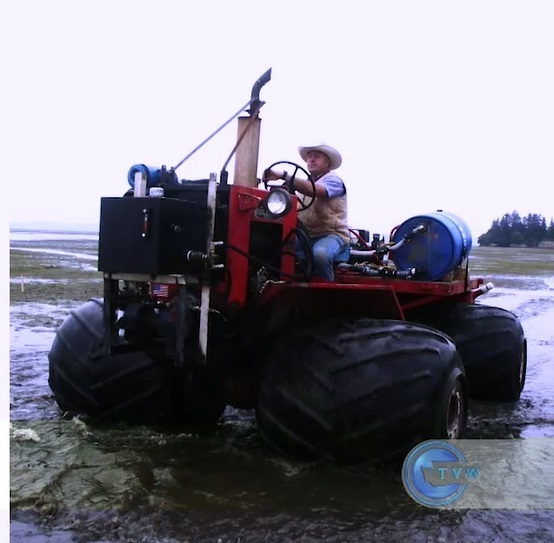
If you can build this 
you can learn how to grow oysters
with other methods.


Times in Willapa Bay are changing.
The waters around you have grown.
 
Better start swimming 
or you'll sink like a stone.

Get involved. Tell DOE they do not have enough studies to support putting Imidacloprid on Willapa Bay shellfish beds and in the public's waters.
The Department of Ecology is accepting comments on its draft supplemental EIS until November 1. You may submit comments here:
You may read the DSEIS here:
You may hear the October 10 hearing here: