Our mission is to protect the habitat of Puget Sound tidelands from the underregulated expansion of new and intensive shellfish aquaculture methods. These methods were never anticipated when the Shoreline Management Act was passed. They are transforming the natural tideland ecosystems in Puget Sound and are resulting in a fractured shoreline habitat. In South Puget Sound much of this has been done with few if any meaningful shoreline permits and with limited public input. It is exactly what the Shoreline Management Act was intended to prevent.

Get involved and contact your elected officials to let them you do not support aquaculture's industrial transformation of Puget Sound's tidelands.

Governor Inslee:

Thursday, May 25, 2023

Burley Lagoon Geoduck Farm: Gig Harbor Advisory Commission (PAC) votes to DENY Taylor Shellfish permit for a geoduck farm in Burley Lagoon.

(Summary of meeting follows)

Burley Lagoon in Pierce County

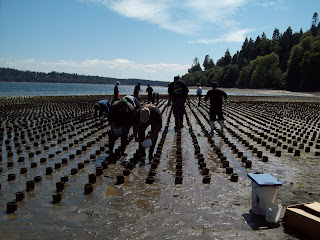
Example of what a geoduck farm looks like.
.
Taylor Shellfish has proposed up to 25 acres be converted.

May 24: At a meeting held May 24, after hearing testimony from Pierce County and Taylor Shellfish representatives, Gig Harbor votes against Taylor Shellfish's proposal for conversion of tidelands to a  geoduck farm. While only advisory, the decision reflects strong local opposition to the proposal. 

(A recording of the meeting may be found here - scroll to "Agendas and Documents", then click on "5 24 23 PAC Recording - Audio": https://www.piercecountywa.gov/5934/Gig-Harbor-Peninsula-Advisory-Commission)

Highlights:

Question - Was all 300 acres farmed? Taylor Shellfish claims all 300 acres have historically been farmed. Some question whether that is the case, or if the acreage actually farmed is less. Taylor claims the geoduck farm would represent "only" 8% of the Lagoon. If fewer than 300 acres was actually used, the percentage of tidelands impacted would grow dramatically.

Question - How long will harvesting take place? Taylor Shellfish noted harvesting would occur during low tides in the summer and dive harvesting would occur during winter.

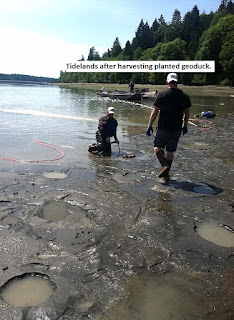
Sediment disturbed during dive harvesting.

Question: How will this farm uphold the values reflected in the community plan? (focus on how the farm would uphold these values) The County responded there are subjective opinions but felt the EIS addressed these concerns, pointing out the EIS is being appealed.

Question: If, after 5 years, it was found that goals were not being met, what recourse is there? The County stated the Hearing Examiner might require the county to monitor complaints. While revocation of a permit is possible, it is a "heavy lift" and staff does not have a boat to run out on. Not liking how it looked sounded unrealistic to address.

Question: If the 25 acres is approved, what is the process should Taylor wish to expand to 50 acres? The County said Taylor has told them 25 acres is all they want. But, a permit revision for expansion is available, or possibly a new permit would be required. (It was noted past regulations are not what future regulations may be. There was no clear answer.)

Question: Isn't this just farmland? If so, aren't they also under the same sort of restrictions as upland farms (e.g., wetland setbacks)? The County said tidelands are different as the public use of waters is also involved, bringing up why it's so difficult to install a dock, touching on issues of the "Public Trust".

Question: Aren't tidelands taxed far less than upland parcels are? The County "did not know" (For readers unaware, tidelands are taxed at a fraction of upland parcels.)

Opinion: Farming is good, all farming creates monocultures, in short, a farm is a farm is a farm. Except this is taking place in a marine environment. The County responded that if an existing upland farm wanted to expand they too may be subject to new regulations.

Question: Has the County acted on citizen complaints about debris and operational hours? The County said Taylor has been responsive to complaints about noise and debris. No attempt at setting up mediation has occurred, but it may be worth considering. The County expects complaints to continue.

Statement: The County said limit hours of operation has been attempted in the past but shellfish companies do not like those restrictions. It's possible the Examiner may put something in place.

Question: Logging and forestry are restricted, isn't aquaculture? The County said not really because this area is an existing farm and much of it was established when there was no noise requirement. While there is a noise pollution ordinance, it is enforced by the Health Department and they do not have the staff. Theoretically, it's possible, but, there is a question of whether only the new 25 acres would be impacted.

Question to Taylor: How long has Taylor actively farmed the area? Taylor responded they begun leasing tidelands in 2012 and actively farmed since 2014.

Question to Taylor: Why change to geoduck now? The owner asked Taylor to change. Taylor's attorney's "recollection" is markets change and product demand changes, creating a need for "diversification" of the "portfolio", including the risk of disease. (Taylor's attorney again pointed out 25 acres is "only" 8% of the area.)

Question to Taylor: Aren't there other areas Taylor can use? Taylor's attorney responded yes, although the attempt to do so was simply a scattering of seed in the water, both within and outside of the Lagoon.

Question to Taylor: If scattering is successful, why the need for PVC tubes and netting? Predation is too high and survival too low without PVC tubes and netting.

Question: Have all of Taylor's permit applications been approved? The County responded yes, pointing out his is the possibly the largest of all applications. (One in a subtidal area, the "Detienne" farm, was ultimately denied.

Comment: The County noted other agencies are involved in permitting.

Question: Is this site typical in proximity to residential surroundings? The County responded that most are on exposed tidelands, but not similar to a lagoon such as Burley Lagoon. "This one is different." In part it was why an Environmental Impact Statement was required.

Question: Are aware if any areas where upland owners are compensated?  The County noted again that Burley Lagoon is different in that there is a high density of development and use, again pointing out his was why an EIS was required.

Question: Did past applications have existing farms? The County responded that most did not.

Question: What is the County's take on the reduction in property values as farming increases? The County has said no reduction in property values has occurred, that they know of. The County could not say clearly what they would need in order to be convinced property values do become lower, although independent appraisers might be helpful. Taylor's attorney had recollections of the Haley farm testimony being experts having differing opinions and the examiner not acting on it.

Question: How would the County address a "taking" if property values decreased? It was no known, but the EIS did attempt to address probable significant adverse issues, and property values was not one of the issues. The questioner responded that many of the community members, who she spoke for, does have concerns.

Question: What was the County's involvement in the creation of an EIS? The County provided issues, responses were made, more issues were brought up, more information was provided, in short, that the County was involved from the beginning.

Question: Because of the involvement, does the County agree there is no net loss from whatever base line is established? The County agreed, pointing out, no net loss is not the same as no impact, and why mitigation may be required.

Question: Did the County have any input into who the consultant creating the EIS was? The County discussed the amount of time Dave and Ty have spent on previous permitting questions. Many of those past actions have presented consultants who were involved in the EIS's creation, but the County did not chose them. The County pointed out the applicants do chose the consultants and every EIS has had complaints about bias.

Question: With the change in tideland use, is there any mitigation in place to offset the changes which will occur? The County said there were things required, but visual issues were important, but they were unclear about what requirements there may be to minimize the visual impact, pointing out the subjectivity of it. 

Opinion: Many people don't find PVC pipes in the tidelands very appealing.

Question: What is the grandfathered use of tidelands in the past? The County was not clear, but that there were many letters describing exactly what was taking place, disagreeing with the statements of past use. The question of expansion/intensification was addressed years ago, but there was no clear answer beyond having to go re read the letters again.

Question: If shellfish were being grown in the past, where is the line between one shellfish species and another? The County responded the means and methods used to grow geoduck are very different than how clams/oysters are grown and harvested.

Opinion: Silt and sediment and water create a large disturbance within Burley Lagoon. The County determined only a "moderate" impact would occur, and why in part, an appeal of the EIS has occurred.

Dive harvesting disturbs large volumes of sediment.

Final comments: It's a farm; it does not fit within the community plan; nets are a navigational hazard; it's unique but geoduck are grown differently and property rights of upland property owners are as important as tideland owners; there won't be less geoduck for sale at Safeway if this does not go in; hours of operation should be put in place; it's an estuary with two important creeks; selling farm products to China make money; residential and aquaculture have competing interests; we're not taking aquaculture away from Taylor as they may continue to grow oysters and clams as they have; products sold overseas may benefit a few economically, but not the general population; environmental protection and sustainable practices are important to the advisory commission; changing the nature of the Lagoon and what the Lagoon has become is an important aspect; is selling natural resources overseas what the US really wants

Motion to DENY approval the permit as requested: Motion carried (i.e., DENIAL of approval).  


Friday, January 6, 2023


Tuesday, December 6, 2022

Al Bergstein writes on the recent presentation by the Center for Food Safety's attorney Kristina Sinclair. Ms Sinclair discusses the ongoing lawsuit against the Army Corps' permitting of shellfish farms in Puget Sound. 

Mr Bergstein's piece:  https://olyopen.com/2022/11/18/what-you-should-know-about-industrial-raised-shellfish-aquaculture-an-overview/

Ms Sinclair's slide presentation: https://olyopen.com/wp-content/uploads/2022/11/2022-11-17-Industrial-Shellfish-Slides.pdf

Contact Center for Food Safety here:

Pacific Northwest Office
2009 NE Alberta St, Suite 207
Portland, OR 97211
phone (971) 271-7372


Monday, November 7, 2022

(From Protect the Peninsula)

What You Should Know About

Insudstrial Raised Shellfish


Join Protect the Peninsula’s Future for its 49th Year Celebration (Virtual)

Thursday, November 17, 7:00 PM      

 RSVP to PPF@olympus.net to receive the Zoom connection*

Our featured speaker this year is Kristina Sinclair,

Associate Attorney at the Center for Food Safety


*Space is limited to 100.

Kristian Sinclair, Associate Attorney
Center for Food Safety


Kristina Sinclair is an Associate Attorney at the Center for Food Safety (CFS), where she focuses on environmental cases challenging industrial agriculture, including commercial shellfish.


Kristina earned her J.D. from the University of California, Berkeley, School of Law. While in law school, Kristina was an Articles Editor for the California Law Review. She also participated in the Environmental Law Clinic, served on the steering committee for Students for Economic and Environmental Justice, and worked as a teaching assistant for Appellate Advocacy. Upon graduation, she received recognition for her pro bono work and a Certificate of Specialization in Environmental Law.


Since joining CFS, Kristina has been working on a lawsuit challenging highly disruptive industrial shellfish operations in Washington. In this case, CFS and Coalition to Protect Puget Sound allege that the U.S. Army Corps (USACE) failed to properly consider the potential risks before reissuing the nationwide permit for commercial shellfish activities in January 2021, in violation of the Clean Water Act, National Environmental Policy Act, and Endangered Species Act. In addition, USACE has authorized over 400 commercial shellfish operations without any public notice or environment review. Consequently, these operations have significant adverse, effects on Washington's local environment and wildlife. 


 In this webinar, Kristina will provide an overview of USACE's shellfish permitting requirements, as well as the ongoing litigation challenging USACE's unlawful shellfish permitting actions. She will also share some insights from this legal work and potential opportunities for future advocacy. 


Background on USACE's Permitting Requirements
History of USACE's Unlawful Permitting Actions in Washington
Previous Case
Current Case

Future Opportunities

Wednesday, June 8, 2022

Tell DNR and USFWS It's a Wildlife Refuge

Get involved and make a difference for today and tomorrow, to help preserve one of the few National Wildlife Refuges supporting the great migrations of sea birds. An industrial shellfish farm does not belong in the Dungeness National Wildlife Refuge

Plastic Grow Out Bags Do Not Belong in a Wildlife Refuge


Beyond Pesticides has written a piece on why plastic grow out bags do not belong in a Wildlife Refuge, which includes a link for comments

As they note so well: 

The Dungeness Bay Wildlife Refuge was created by Executive Order in 1915 by Woodrow Wilson, directing the area to be set aside as a “refuge, preserve and breeding ground for native birds and prohibits any disturbance of the birds within the reserve.” The Refuge provides habitat, a preserve and breeding grounds for more than 250 species of birds and 41 species of land animals. 

The front page of the Refuge website states: “Pets, bicycles, kite flying, Frisbees, ball-playing, camping, and fires are not permitted on the Refuge as they are a disturbance for the many migrating birds and other wildlife taking solitude on the Refuge.” With this level of concern, it is counterintuitive to allow destructive industrial aquaculture. 

Beyond Pesticides Article

Submit Comments Here


Wednesday, May 18, 2022

It only takes a little bit: 10 billion, only 10 to get you sick

CBC News on the Norovirus outbreak from oysters harvested in British Columbia.
(Read article here:
https://www.cbc.ca/news/canada/british-columbia/oysters-norovirus-bc-1.6452571)

The aquatic environment is impacted by many things, from climate change to recreational owners of boats discharging untreated waste to failing septic systems to ecosystem transformation from industrial aquaculture. In this article from CBC, the impact of what is suspected to be human waste has impacted the reputation of industrial shellfish operations in BC through illnesses contracted from the consumption of raw oysters. 


Friday, January 14, 2022

 WA Supreme Court Affirms Non-native Atlantic Salmon Should not be Grown in Puget Sound

Leaves Unanswered Whether Extra Genetic Material in Triploids are Native or Not

Washington Supreme Court affirmed unanimously, 9-0, that non-native Atlantic salmon do not belong in Washington's Puget Sound. All agreed that the Department of Fish and Wildlife did not have to require an Environmental Impact Statement (EIS) when Cooke Aquaculture proposed moving to triploid Rainbow trout. It left unanswered whether the Department of Natural Resources (DNR) should renew leases and what should be considered in that decision. Whether British Columbia will follow and remove non-native Atlantic salmon remains unknown as is whether Rainbow trout with extra genetic material is "native" or not. 

Normal (left) and  Extra Genetic Material (right)

= a sterile female 

(is a triploid native?)


Monday, December 20, 2021

 
Army Corps is sued again by the Center for Food Safety (CFS) and the Coalition to Protect Puget Sound Habitat (Coalition). The suit once again asks the court to stop the Corps from "...continuing the excessive expansion of industrial shellfish operations without considering the cumulative impacts to Washington's rich and diverse coastal waters [and tidelands]."

(See article here: https://olyopen.com/2021/12/20/groups-again-sue-army-corps-to-protect-washingtons-coastal-areas-and-endangered-species-from-industrial-shellfish-operations/)

(See papers filed here: https://www.centerforfoodsafety.org/files/2021-12-20--ecf-01--complaint_33955.pdf)


Amy Van Saun, senior attorney at CFS notes, “Despite clear statutory mandates and a previous court decision requiring the government to fully consider the potential impacts of proposed shellfish operations, the Corps continues to ignore its duties by allowing industrial shellfish operations to degrade important aquatic habitats, including through the use of plastics and pesticides, endangering Washington’s shorelines, biodiversity, and surrounding communities,” said Amy van Saun, senior attorney at CFS.

Laura Hendricks, director of the Coalition notes, “The Coalition is outraged that the Corps would try to avoid doing what is necessary as a bare minimum under the law to protect orcas, salmon, and marine life in Washington from the toxic and physical impacts of the massive number of industrial-scale aquaculture operations that have been proposed. This is precisely the sort of agency action that gives ‘government’ a bad name.”

Puget Sound's marine ecosystem is under pressure from a number of sources. While some argue "ecosystem services" from shellfish outweigh the transformation occurring to this critical habitat, it cannot simply be accepted without looking at the entire system and the cumulative impacts various actions have. This was argued once in court and was won. That it has to be argued again simply speaks to an agency's inability to do what it's role is.


Monday, October 19, 2020

 October 20, 1PM PCT/4PM ECT the Center for Food Safety will present a webinar on protecting the public's marine ecosystem from industrial scale aquaculture. While focused on Washington State, the significant and adverse impacts are a current and growing worldwide problem. Make a difference in life today which continues  into the future.

To register, click on this link: 

https://www.centerforfoodsafety.org/join/6168/webinar-the-fight-to-save-our-oceans-the-faces-behind-the-cases


Sunday, June 14, 2020

Cumulative Impacts Not Considered: District Court Issues Ruling on Vacating Shellfish Farms

Coalition to Protect Puget Sound Habitat and the Center for Food Safety
succeed in proving the Army Corps did not consider 
cumulative impacts when issuing permits.

The Court found that it [the Army Corps] violated 
the CWA [Clean Water Act] and NEPA 
(National Environmental Policy Act)
by failing to take a hard look 
at the anticipated environmental 
impacts of NWP 48*

Geoduck market collapses in China.
Court finds permits void.
Who will clean up the mess when growers
just walk away from their plastics?

*NWP 48 is a permit issued every 5 years to authorize common shellfish activities in the waters of the US. In Washington, it allowed permits to be issued on tidelands not used for aquaculture up to 100 years ago. Acreage numbers as high as 72,300 acres were presented. The Court stated: "its data regarding past uses of the permit was incorrect and its estimates of future uses are suspect"

Cumulative Impacts Matter
In the Court's October 2017 Order, the District Court ruled the Corps of Engineers had not considered cumulative impacts in approving their Nationwide Permit 48 in 2017 thereby voiding all permits issued. In its June 11, 2020 decision on whether to void all current permits, the Court found the logic presented by the Corps and shellfish growers lacking in evidence.
"...there is insufficient evidence in the administrative record to support the U.S. Army Corps of Engineers’ conclusion that the 2017 reissuance of Nationwide Permit (“NWP”) 48 would have minimal individual and cumulative impacts on the aquatic environment for purposes of the Clean Water Act (“CWA”) and (b) that the Corps’ environmental assessment related to NWP 48 did not satisfy the requirements of the National Environmental Policy Act (“NEPA”)."
Operators to go on vacation?
Following the decision, the Court was then faced with whether to force growers to vacate areas now found to be operating under an invalid permit, considering "(1) the seriousness of an agency’s errors and (2) the “disruptive consequences of an interim change that may itself be changed.” It was up to the Corps and growers (Taylor Shellfish and Nisbet Oyster) to provide the logic and evidence showing why they should be allowed to continue operating.
"...courts may decline to vacate agency decisions when vacatur would cause serious and irremediable harms that significantly outweigh the magnitude of the agency’s error. . . . Courts have considered remand without vacatur to be appropriate where serious irreparable environmental injury would result from vacatur. . . . In addition to environmental harm, it is appropriate to consider other practical concerns when weighing the consequences of vacatur"

Court to growers and the Corps: You made a serious error.
The Corps and growers argued the mistake was neither serious nor consequential because both the District and State were involved in oversight, minimizing the environmental impact. The Court did not agree, stating:
"The Corps/Intervenors have not shown that the District level verification process or state, local, and/or Tribal oversight of commercial shellfish aquaculture activities in Washington overcome the seriousness of the agency’s errors in this case."
Disruptive Consequences - Economics don't trump the environment. 
"environmental impacts of these activities are more than minimal, both individually and cumulatively"
In considering the disruptive consequences of finding all shellfish farms "unauthorized and in violation of federal law" the Court considered a number of things. Included was the Corps being "overwhelmed" by new permit applications; tribes may be unable to provide food for tribal members; growers would face devastating impacts on the continuing viability of their farms, their employees, their communities, the state and local economies of which they are a part, and the ability of Washington shellfish farmers to compete on a national or international basis; shellfish are "filter feeders" and their removal would harm the marine ecosystem; and, shellfish growers "retard" upland development activities. Growers argued they should just be allowed to continue on, harvesting and seeding. Even on tidelands which had no activities for 100 years.
"The problem is not that the Intervenors have failed to establish that the loss of their authorization to install shellfishing equipment and to discharge materials into the waters of the United States would have devastating impacts on their businesses, but rather that they have not shown that those impacts outweigh the environmental consequences of continuing their activities as currently permitted."
The Court's solution 
Because neither the growers nor the Corps could not support not vacating the permits, the Court stated:
"In the absence of meaningful assistance from the Corps and the Intervenors in helping to shape a compromise remedy, the Court will adopt a remedy based on the suggestions of plaintiffs, amici, and Swinomish."
That remedy crafted by the Court vacates all current permits but allows a pause of 60 days for an appeal; would allow currently planted shellfish to be harvested; seeding and planting within 6 months in areas without eel grass could occur; and, tribal rights would be respected. If growers intend ongoing activities (e.g., harvesting) they must, within 6 months, apply for a new permit. Planting new areas would not be allowed without a new permit. The Corps must process new individual permits but not without following CWA and NEPA steps outlined in the October 10, 2019 Order which concluded:
"The Corps’ issuance of a nationwide permit, at least with respect to activities in the waters of the State of Washington, was arbitrary and capricious and not in accordance with NEPA or the CWA. Pursuant to 5 U.S.C. § 706(2), the Court holds unlawful and sets aside NWP 48 insofar as it authorizes activities in Washington."
Get involved.
Make a difference in life and help protect Puget Sound's critical marine habitat. Whether from open net pens discharging plumes of untreated waste or plastics used in shellfish aquaculture, this habitat is under extreme pressure.