Our mission is to protect the habitat of Puget Sound tidelands from the underregulated expansion of new and intensive shellfish aquaculture methods. These methods were never anticipated when the Shoreline Management Act was passed. They are transforming the natural tideland ecosystems in Puget Sound and are resulting in a fractured shoreline habitat. In South Puget Sound much of this has been done with few if any meaningful shoreline permits and with limited public input. It is exactly what the Shoreline Management Act was intended to prevent.

Get involved and contact your elected officials to let them you do not support aquaculture's industrial transformation of Puget Sound's tidelands.

Governor Inslee:

Wednesday, August 8, 2012

Pierce County Shoreline Master Program Update

Next meeting: August 15, 2012
Fife Community Center
2111 54th Ave E, Fife
(click here for Pierce County website)

Pierce County held another public meeting on its Shoreline Master Program (SMP) update on August 1 (read Gateline.com article here). The meeting began with the county's biologist, Dave Griswold, expressing his belief that concerns about corporate aquaculture were founded in conflicts with shoreline owners. He went on to note studies from NOAA support the belief there was not a likelihood of significant impact and he did not find aquaculture to be intrinsically harmful to the shoreline. Mr. Griswold is deeply mistaken.

Not intrinsically harmful?

Look a little deeper.


That shoreline residents were the first to lift the veil and expose the growing impacts from unregulated corporate aquaculture should be no surprise. They were first hand witnesses to the  transformation of Puget Sound's tidelands occurring through industrial methods of aquaculture being developed. Protecting Puget Sound for the future of everyone through regulations is fully accepted and understood by shoreline property owners. It is why they and growing numbers of people are now expressing deep concerns about growing industrial aquaculture and corporate influence at meetings such as that held August 1. Industry's clear goal is minimizing any regulations which would impact their profits.

Corporate shellfish companies understand the importance of controlling regulations and government influence. They understand how to craft regulations to their liking, and when things do not go as they wish, how to deflect the focus into another area. If they become lost in the process they use lobbyists such as Jim Jesernig or public relations firms such as Gallatin Public Affairs to help get back on the path.

Jim Jesernig
Corporate Lobbyist


Currently, Washington's Shellfish Initiative is being used to begin minimizing regulatory oversight through "streamlining" the permit process in the name of "jobs" and "filter feeding." Taylor Shellfish's attorney wrote a letter to Kitsap County whose shoreline planner said could be considered a demand for a complete rewrite of the aquaculture section (read Kitsap Sun article here). The Governor's "Blue Ribbon Panel" on Ocean Acidification is being lead to believe "shellfish are critical to maintain clean water" when in fact it is clean water which is critical for shellfish (i.e., did shellfish clean Lake Washington's waters?).


Governor Gregoire with Bill Dewey,
Taylor Shellfish Government Relations

Using comments from NOAA to support the belief of no intrinsic harm is deeply flawed. NOAA, part of the Department of Commerce, is tasked with implementing the National Shellfish Initiative, not protecting Puget Sound's nearshore environment. If Mr. Griswold wishes Pierce County to use a Biological Opinion he should instead consider the US Fish and Wildlife* (USFWS) who is tasked with "Conserving the Nature of America."

The USFWS 2009 Biological Opinion had this to say:
If shellfish are present at "natural" levels, their filtering activities would not upset the balance of the intertidal food web. However, aquaculture species are mostly non-native, planted at high densities, and filter larger quantities of water (phytoplankton) than the native oysters. Therefore, they may have a competitive advantage and reduce available food for other planktivores. This may be a more significant issue in confined or isolated embayment [such as Burley Lagoon]. (page 124)
Areas with a higher degree of susceptability are primarily semi-enclosed tidal lagoons and estuaries with low-energy hydrodynamics features and are shallow in depth (Cranford et al. 2008, p. 5). Areas within the south Puget Sound action area would likely meet this description, and if aquaculture were present at sufficient densities, similar effects would be expected. (page 124)
Bed culture also affects the benthic community. Oyster bags are laid directly on the substrate over large areas of the intertidal shoreline covering the benthic community. (page 127) (click here)*The mission of the U.S. Fish and Wildlife Service is working with others to conserve, protect, and enhance fish, wildlife, plants, and their habitats for the continuing benefit of the American people.
Unpermitted Structures in Totten Inlet
Good for the benthic community?
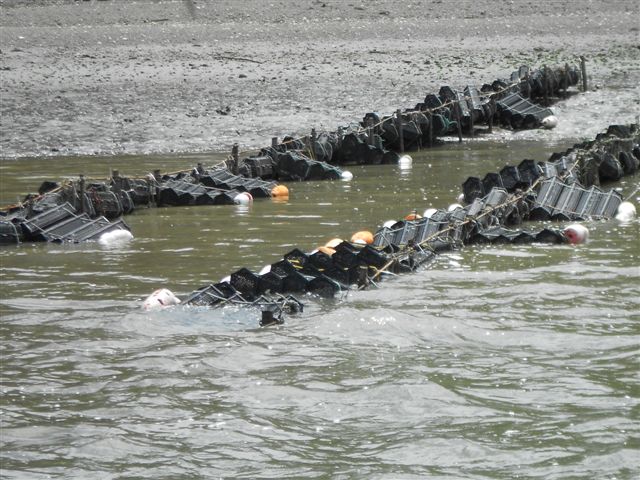
Puget Sound's Shoreline Management Act was created to prevent the fragmentation of Puget Sound's near shore environment for all of its citizens. Aquaculture then was practiced as it had been for generations. Then, it was benign. Since then shoreline property owners have seen the changes in methods and have seen the fragmentation of tidelands and waters unfolding. They, in fact, are the canary in the coal mine, and with others, are being heard as Pierce County and other counties update their Shoreline Master Programs.

These updates are critical to the future of Puget Sound and, if well written, will ensure future generations - no matter where they live - have a healthy Puget Sound to experience. Mr. Griswold will hopefully come to appreciate this point as more citizens submit comments.

Tuesday, August 7, 2012

Burley Lagoon: Taylor Shellfish Is Having a Party

Taylor Shellfish is Having a Party
Organized by Gallatin Public Affairs
("Strategists, Lobbyists, Communicators")


Thursday, August 16, 2012
5:30 PM - 7:00 PM
Taylor Shellfish Property
6721 Tyee Dr. NW
Gig Harbor, WA 98332
Please RSVP to Anna Boone
206-696-7970
"Taylor Shellfish invites you to a special business reception for local businesses in and around Burley Lagoon. We’ll share information about our clean-up efforts and future business plans in Burley Lagoon. We want to meet our new neighbors and we hope you can join us for a casual evening, featuring world famous Taylor shellfish for your enjoyment." (from a flier being distributed in the Burley Lagoon area)

Burley Lagoon
Purdy, WA
Important wildlife habitat or industrial aquaculture?
What will Gallatin's "strategists and lobbyists"
tell Taylor Shellfish to call it?
Taylor Shellfish has hired Gallatin Pubic Affairs in Seattle to help explain what it apparently cannot: What will it be doing to Burley Lagoon? Who is Gallatin Public Affairs? "We are strategists, lobbyists, communicators, policy experts,..."
(click here for GPA webite)

It should not be unexpected nor surprising to read about Taylor Shellfish hiring a lobbying firm to do what they cannot. As noted in the prior post, they will be generating close to $2 million in profits from geoduck planted on the state tidelands they were found to be trespassing on. They have the money to hire attorneys and lobbyists to press for what they want. They have become a large corporation used to getting their way.

Given the experts at Gallatin have suggested Taylor Shellfish ask for "neighbors" to come, perhaps they won't mind having the local residents also show up to speak both to Taylor Shellfish directly and to those businesses who may be present. The local businesses may find their customer base feels differently than what Gallatin is trying to craft.


Wednesday, August 1, 2012

DNR Requests Comments on $2.6 million Geoduck Harvest by Taylor Shellfish to Resolve Trespass

Comments due August 13
Email: sepacenter@dnr.wa.gov
Include file number 12-073001

The Department of Natural Resources (DNR) has issued a request for comments on a SEPA mitigated determination of non-significance (MDNS) for a proposal by Taylor Shellfish to harvest geoduck planted on state owned tidelands without a lease. Over 50% will be "dive harvested" in shallow waters. (SEPA Documents here)

Presumed Taylor Shellfish Trespass Area
On State Tidelands below Mean Low Tide
(south of Allyn on Pickering Passage)
(click to enlarge)
2006, DOE Coastal Atlas


In 2010 a DNR investigation into trespass on state tidelands found that Taylor Shellfish had been growing geoduck without a lease agreement on a state owned tideland parcel below mean low tide. The 2010 settlement terms for this trespass included allowing Taylor Shellfish to harvest the now ~175,000 pounds of geoduck on 1.8 acres. At a conservative $15/pound, the gross revenues from these geoducks alone approaches $2.6 million. Estimated net profit to Taylor Shellfish will be near $2 million. The state's Attorney General settled three cases in 2010, one against Taylor for $225,000 plus the right to harvest the planted shellfish (click here for the Kitsap Sun article).

Tuesday, July 31, 2012

Pierce County Shoreline Master Program Meeting August 1

Reminder:
August 1 there will be a meeting at 6:30PM to discuss Pierce County's update to their Shoreline Master Program.
August 1, 2012 Peninsula High School
14105 Purdy Drive NW, Gig Harbor
http://www.co.pierce.wa.us/pc/abtus/ourorg/pals/whatwedo/shoreline.htm
Get involved if you care about whether the shellfish industry should be regulated. Aquaculture may be a preferred use of the shoreline, but that does not mean corporate shellfish farmers should get a free pass to use whatever methods they wish at whatever hours of the day or night they want.

Burley Lagoon, Pierce County

Corporate claims that methods used are "no worse than a natural event" is no different than saying an open pit mine is no different than a flood. It is different. Waters recede and land recovers, open pit mining goes on and on with no recovery. Intensive aquaculture goes on and on with no recovery. It is not the same as a "natural event" no matter how many times lobbyists claim it is. Get involved. Corporate shellfish lobbyists are.

Friday, July 27, 2012

Important Reminders for Public Comments and Why Involvement is Important

Get involved in the public process. Corporate shellfish lobbyists have been shaping public regulations for years (see below).


Comments Due August 2 - Taylor Shellfish Wastewater Discharge Permit (~150,000 gallons per day of wastewater from Taylor Shellfish's processing plant near Shelton onto the ground where ground water seeps into Little Skookum Inlet. Nitrates, nitrites, chloride, sodium are all contained in the discharged water. See July 16 post for details)
Comments are due by August 2, 2012
email to - carey.cholski@ecy.wa.gov , referencing Permit ST 6157
Click here for Fact Sheet
Click here for Draft Permit
Taylor Wastewater Discharge Area


Comments Due August 21 - Pierce County Shoreline Master Plan (Important update to the land use document which will control where and how much tideland development by corporate shellfish companies will be permitted.)
Email comments due by August 21, 2012
email comments to Toni Faribanks at tfairba@co.pierce.wa.us
Copy to Pat Mcarthy at pmccart@co.pierce.wa.us
Click here for SMP information: http://www.co.pierce.wa.us/pc/abtus/ourorg/pals/whatwedo/shoreline.htm

Burley Lagoon, Pierce County


Get involved. Shellfish Politics are real and the shellfish industry is involved far more than you know. Some examples from corporate and lobbyist's documents follow: 
Regulations: Review current laws -local, state, federal and be involved in updating processes with the goal of simplifying.
NOAA: PCSGA requests that Congress urge NOAA and Commerce to include a National Shellfish Initiative with the release of their aquaculture policies and to support funding for implementation of the initiative.
Department of Ecology Guidelines: Due to significant participation by PCSGA and individual members in the stakeholder process, the new regulations retain Ecology's policies of protecting and providing preferred treatment of shellfish aquaculture, and contain use regulations that are significantly less stringent than those Ecology originally proposed.
Puget Sound Partnership: As a business representative on the Ecosystem Coordination Board, Bill Dewey [Taylor Shellfish Government Relations] continues to be engaged with them regarding the shellfish related actions including raising awareness that shellfish are critical to a healthy economy...
Shoreline Master Programs: PCSGA members are currently engaged in several SMP updates including efforts in Mason, Skagit and Jefferson Counties [and Pierce County].
Taxes:  ...the two bills that were introduced this week to extend the B&O tax exemption for seafood processing, (HB 2611 and SB 6342), while still important to the shellfish industry's processing sector, will not mean a B&O tax increase for shellfish producers who sell shellfish at the wholesale level.
Influence: Develop and maintain relationship with all levels of regulators.

Thursday, July 26, 2012

Blue Ribbon Panel on Ocean Acidification: Driving in the Fog?

Blue Ribbon Panel on Ocean Acidification
Next meeting, August 8 (location tbd)


Thick fog creates dangerous driving conditions which demands slowing down, even if it means being late for grandmother's dinner. Governor Gregoire's "Blue Ribbon Panel" being faced with an October deadline for specific recommendations on actions to deal with lowering pH levels in Puget Sound is creating a similar scene.

Scientists are clearly being pressed to give answers when information and models do not yet exist to support what they are being asked to provide. Specifically, are land based nutrients having a significant enough impact on pH levels in Washington's marine waters to justify regulatory actions focused on land use issues?   (listen here to the first 10 minutes of the June 20 meeting)

For example, is the fertilizer used on lawns adjacent to Puget Sound of enough significance to restrict how large a yard may be? Does CO2 generated by driving remain in the Puget Sound basin long enough to warrant limiting how many miles residents may drive? Should you be charged each time you flush your toilet? Should inspection and compliance officers be hired to inspect farms?

Which Train is on the Right Track?

Does the science create a clear enough vision to justify making recommendations beyond improved monitoring and modeling? Is growing the shellfish industry important enough to rush to a decision on actions based on a feeling? If the public does not become involved this may be how regulatory actions affecting Puget Sound will be decided. Get involved. Shellfish lobbyists are in more ways than you know.

Science: Not Feelings

Tuesday, July 24, 2012

Pierce County Shoreline Master Program Update and Meetings

Burley Lagoon, Pierce County
Protected Lagoon or Industrial Shellfish Farming?


The future of Burley Lagoon and Pierce County's tidelands and waters will be decided in the near future. Will the tidelands and waters of places like Burley Lagoon become converted to industrial shellfish operations at the expense of the public's right to enjoy those same areas? The answer to that question will be determined by how the public responds to the current opportunity. Is the requirement that aquaculture permits provide "A list of ...pesticides, herbicides, antibiotics" (Appendix C, B(i) page 90) a picture of what corporate shellfish owners want?

Comments on Pierce County's update to its Shoreline Master Program (SMP) will be taken until August 2. Comments may mailed to Pierce County Planning Commission, 2401 South 35th Street, Tacoma, WA 98409, or email comments to tfairba@co.pierce.wa.us .

The current proposed update can be found here:
http://www.co.pierce.wa.us/xml/abtus/ourorg/pals/docs/lrplan/smpdrafttitle18s.pdf

Dates of local meetings will be held at these locations:
July 25, 2012 Peninsula High School
14105 Purdy Drive NW, Gig Harbor
August 1, 2012 Peninsula High School
14105 Purdy Drive NW, Gig Harbor
August 15, 2012 Fife Community Center
2111 54th Ave E, Fife
August 22, 2012 Pierce County Annex
2401 S 35th Street, Tacoma

Get involved. Corporate shellfish lobbyists are.

Thursday, July 19, 2012

Taylor Shellfish Mussel Raft Permit Decision: Cumulative Impacts Not Adequately Considered

Thurston County's Hearing Examiner has issued a decision on Taylor Shellfish's proposed 58 raft mussel farm: cumulative impacts were not adequately considered. Taylor Shellfish has been given a choice on how to deal with this deficiency.


"First, it [Taylor Shellfish] may inform the Hearing Examiner that it wishes to challenge the determination that the present analysis of cumulative impacts is deficient and the requirement to perform an additional cumulative analysis. In that case, I will issue a supplemental decision denying the application on that basis, and the Applicant may appeal. Alternatively, the Applicant may inform the Examiner that it wishes to carry out the analysis of cumulative effects required by this decision. In that case, the Examiner and the parties will confer about the timing and nature of that analysis."

As noted in this blog and by others for many years, one shellfish farm may appear to be benign. When considered as a whole, however, Puget Sound's long term health is at risk from the cumulative impacts from the growth of industrial shellfish farming. Cumulative impacts do matter and they are significant. Thanks to APHETI this reality is now being forced to be considered by agencies.
(Note: To be added to APHETI's email list, you may email them at: APHETI@gmail.com.)
Current examples of cumulative effects:

New Geoduck Nursery in Spencer Cove
NE Harstene Island, ~300' in Length
(click to enlarge)
(needed for "increased geoduck seed demand")

Corporate Shellfish Barge
3 ea. 200 hp Outboard Motors
(click to enlarge)
(growing production is resulting in growing demand
for increased transportation)

Area of Low Dissolved Oxygen
In Totten Inlet Near
Taylor Shellfish's Processing Plant
Which Discharges ~150,000 Gallons of
Waste Water Each Day
(increased production at Taylor plant will result
in more waste water being discharged)

Farms Continue to Loose PVC Tubes in 2012
After Email to County in 2010
(click to enlarge)
(The old "Brass Foundry" on Highway 101 near Shelton 
is now being used as a storage area for PVC pipes.)

Cumulative impacts from corporate shellfish farming's developments in Puget Sound's tidelands and waters are real and they are impacting Puget Sound. The Shoreline Management Act was created to prevent the piecemeal development of Puget Sound's shoreline. Its intent is beyond question. This decision will help ensure that intent is met and corporate profits will not become the overarching philosophy.

Monday, July 16, 2012

IMPORTANT PUBLIC NOTICE: TAYLOR SHELLFISH WASTE DISCHARGE PERMIT

Aerial Photograph of Taylor's
Processing Facility and Waste Discharge Areas
(click on photo to enlarge)

Comments are due by August 2, 2012
email to - carey.cholski@ecy.wa.gov, referencing Permit ST 6157
Click here for Fact Sheet
Click here for Draft Permit

Taylor Shellfish has applied for a State Waste Discharge Permit for industrial waste water from their Shelton processing plant. Waste water volumes in 2011as high as 180,492 gallons per day were allowed under the previous permit which expired June 30 of this year. In April 2010, the monthly volume averaged 160,821 gallons per day. In July of 2007 the Department of Ecology stated the average over a seven year period was 150,000 gallons per day.

Despite Taylor Shellfish's claims of increasing demand; a pending permit for a mussel farm adding more than 1 million pounds to production; reports of increasing nitrogen in Puget Sound (shellfish contain ~30% seawater by volume); and the shellfish initiative potentially adding large numbers of acres for production, assumptions in the current Draft Permit and Fact Sheet assume no increase in volume.

Groundwater Flows Into
Little Skookum Inlet
(from page 7 of the July 2007 Fact Sheet)

(click to enlarge)
As described in the fact sheet, the upper layer of groundwater is separated from the deeper aquifer by a layer of clay like material. This results in the upper layer of soil becoming saturated during wet months which flows downgradient and exits into Little Skookum Inlet through adjacent streams and seeps. Downgradient seeps measured by Taylor indicate Nitrate/Nitrite levels which range from 2 mg/L to 5 mg/L, an order of magnitude higher than normal background levels, typically lower than 1mg/L. On page 5 of the fact sheet Taylor reports background aquifer levels of nitrate to be .72 mg/L; Sodium to be 4.09 mg/L; total dissolved solids to be 77 mg/L; and chloride to be 4.1 mg/L. (Note: There appears to be no background levels established for the upper level of groundwater.)

From the chart above, it would appear that as saturation levels rise and downgradient flows increase during the wet winter months so too do the various levels of components within the waste water being discharged (sodium, nitrate, total dissolved solids, and chloride). All downgradient levels are well above the background levels submitted by Taylor (see page 5 of the Fact Sheet). Taylor's report states the increased levels cannot be tied to their waste water discharge. What is the cause?

Why does the increase in nitrate/nitrite levels matter? In the water quality report recently submitted to the EPA the Department of Ecology noted one area in Totten Inlet which is considered to be "polluted" due to low dissolved oxygen levels not attributable to natural conditions: the mouth of Little Skookum Inlet.

Little Skookum Inlet
The Only Low Dissolved Oxygen Area
In Totten Inlet

While there are many causes of low dissolved oxygen, algae blooms feeding off of anthropogenic sources of nitrates and nitrites are felt to be a primary cause. While Taylor's mussel farm to the south may play a role, so too may Taylor's waste water discharge draining into Little Skookum Inlet. Either way, cumulative impacts from shellfish farming do have an impact on the water quality of Puget Sound which agencies need to consider in their permitting decisions.

(Note: The waste water discharge permit for Taylor Shellfish's Samish Bay facility which expired June 28, 2012, has avoided public comment through Ecology's administrative extension of the current permit for another five years. See extension letter here.)

Comments are due by August 2, 2012
Comments should be sent to:
Carey Cholski
Department of Ecology
Southwest Regional Office
P.O. Box 47775
Olympia, WA 98504-7775
E-mail comments should be sent to carey.cholski@ecy.wa.gov

Wednesday, July 11, 2012

Taylor Shellfish Mussel Farm Permit Decision Postponed to July 19

The permit decision for the proposed 58 raft mussel farm operated by Taylor Shellfish has been pushed out to July 19. Maintaining Totten Inlet's water quality is of critical importance. Maintaining the quality of life enjoyed by Washington's citizens who experience Totten Inlet is of equal importance.

While the shellfish industry may be important to some, this does not trump the Shoreline Management Act's focus to prevent the fragmentation of Puget Sound's tidelands and waters by corporate interests' developments.

For those who wish to have emails from APHETI (Association for the Protection of Hammersley, Eld and Totten Inlet) on the status of this permit you may send an email to APHETI@gmail.com and ask to be added to their email list.