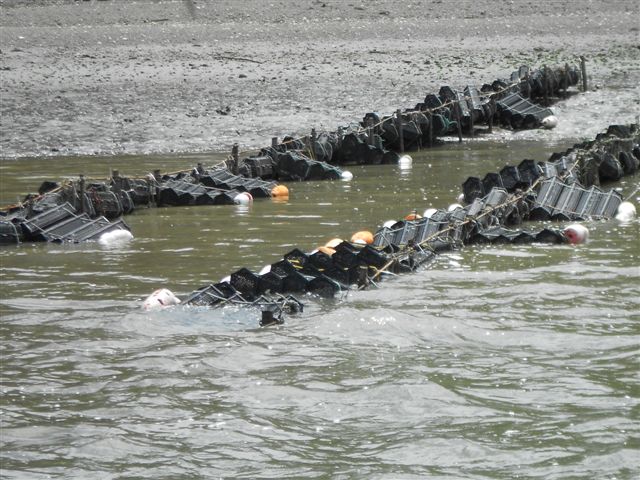
Our mission is to protect the habitat of Puget Sound tidelands from the underregulated expansion of new and intensive shellfish aquaculture methods. These methods were never anticipated when the Shoreline Management Act was passed. They are transforming the natural tideland ecosystems in Puget Sound and are resulting in a fractured shoreline habitat. In South Puget Sound much of this has been done with few if any meaningful shoreline permits and with limited public input. It is exactly what the Shoreline Management Act was intended to prevent.

Get involved and contact your elected officials to let them you do not support aquaculture's industrial transformation of Puget Sound's tidelands.

Governor Inslee:
Showing posts with label shorleine management act. Show all posts

Friday, November 4, 2016

25+ Acre Geoduck Farm: Comments on EIS scoping due November 8; Restoration of Burley Lagoon should begin.

EIS Scoping Comments Due Nov. 8
(click announcement below to enlarge)
This estuary is far
more than a receptacle 
for PVC pipe, plastic mesh and nets.

Comments Due November 8
Friends of Burley Lagoon have sent a reminder notice that comments on the required Environmental Impact Statement addressing the significant and adverse environmental impacts from a proposed 25 acre geoduck operation - and alternatives - in Burley Lagoon are due by November 8. The operation is proposed by Taylor Shellfish believing it is little more than a "conversion" and "intensification" of growing shellfish in Burley Lagoon.
Joan Thomas
1931-2011

“When the SMA was written in 1971, aquaculture meant oysters and clams and one salmon raising operation. This activity was recognized and protected as water-dependent. I do not read the original intent or the original guidelines to promote the industry as we know it today." Joan Thomas, 1991 (one of the original drafters of the Shoreline Management Act)

A small part of a far greater problem.
This proposed geoduck farm is a small part of a far greater transformation of an ecosystem into little more than an industrial operation which the shellfish industry continues to believe is a "preferred use" of Washington's critical marine habitat. In 1991, one of the original drafters of the Shoreline Management Act clearly stated that aquaculture then was not what it was in 1971, and should no longer be supported by the Shoreline Management Act. Fifteen years later the industrial impacts are far worse and far more pervasive. And the industry has far more money to promote their actions as being "in the state wide interest". They are not in the state-wide interest.

"Perhaps you'd like a smaller cup of bitters?" "It's still bitter." "But it's smaller."
Alternatives proposed by Taylor Shellfish include a 25 acre operation, a 17 acre operation, or continued use of netting over an ever expanding area in this ecologically sensitive body of water. No longer able to access a food source, migratory and resident water fowl have already diminished in numbers. Native mussels and barnacle encrusted rocks creating an ecosystem for native species have been cleared off and hauled away, with "predator nets" taking their place in order to grow non-native shellfish. The quiet and peace of night is now fractured by flood lights from large vessels dropping off and picking up large metal cages, driving wildlife away. 

Get involved.  The habitat alteration which occurs from geoduck operations should stop this from happening at all, at any size. In fact, the habitat destruction/alteration which occurs from current operations in this enclosed estuary should require an Environmental Impact Statement to be created. Nets now covering beaches which were cleared of any native structure should be restored. Any activity at night should cease. It's not grandpa's oyster farm anymore.

Governor Inslee: https://fortress.wa.gov/es/governor/
Legislative and Congressional contacts:
http://app.leg.wa.gov/DistrictFinder/

Wednesday, August 8, 2012

Pierce County Shoreline Master Program Update

Next meeting: August 15, 2012
Fife Community Center
2111 54th Ave E, Fife
(click here for Pierce County website)

Pierce County held another public meeting on its Shoreline Master Program (SMP) update on August 1 (read Gateline.com article here). The meeting began with the county's biologist, Dave Griswold, expressing his belief that concerns about corporate aquaculture were founded in conflicts with shoreline owners. He went on to note studies from NOAA support the belief there was not a likelihood of significant impact and he did not find aquaculture to be intrinsically harmful to the shoreline. Mr. Griswold is deeply mistaken.

Not intrinsically harmful?

Look a little deeper.


That shoreline residents were the first to lift the veil and expose the growing impacts from unregulated corporate aquaculture should be no surprise. They were first hand witnesses to the  transformation of Puget Sound's tidelands occurring through industrial methods of aquaculture being developed. Protecting Puget Sound for the future of everyone through regulations is fully accepted and understood by shoreline property owners. It is why they and growing numbers of people are now expressing deep concerns about growing industrial aquaculture and corporate influence at meetings such as that held August 1. Industry's clear goal is minimizing any regulations which would impact their profits.

Corporate shellfish companies understand the importance of controlling regulations and government influence. They understand how to craft regulations to their liking, and when things do not go as they wish, how to deflect the focus into another area. If they become lost in the process they use lobbyists such as Jim Jesernig or public relations firms such as Gallatin Public Affairs to help get back on the path.

Jim Jesernig
Corporate Lobbyist


Currently, Washington's Shellfish Initiative is being used to begin minimizing regulatory oversight through "streamlining" the permit process in the name of "jobs" and "filter feeding." Taylor Shellfish's attorney wrote a letter to Kitsap County whose shoreline planner said could be considered a demand for a complete rewrite of the aquaculture section (read Kitsap Sun article here). The Governor's "Blue Ribbon Panel" on Ocean Acidification is being lead to believe "shellfish are critical to maintain clean water" when in fact it is clean water which is critical for shellfish (i.e., did shellfish clean Lake Washington's waters?).


Governor Gregoire with Bill Dewey,
Taylor Shellfish Government Relations

Using comments from NOAA to support the belief of no intrinsic harm is deeply flawed. NOAA, part of the Department of Commerce, is tasked with implementing the National Shellfish Initiative, not protecting Puget Sound's nearshore environment. If Mr. Griswold wishes Pierce County to use a Biological Opinion he should instead consider the US Fish and Wildlife* (USFWS) who is tasked with "Conserving the Nature of America."

The USFWS 2009 Biological Opinion had this to say:
If shellfish are present at "natural" levels, their filtering activities would not upset the balance of the intertidal food web. However, aquaculture species are mostly non-native, planted at high densities, and filter larger quantities of water (phytoplankton) than the native oysters. Therefore, they may have a competitive advantage and reduce available food for other planktivores. This may be a more significant issue in confined or isolated embayment [such as Burley Lagoon]. (page 124)
Areas with a higher degree of susceptability are primarily semi-enclosed tidal lagoons and estuaries with low-energy hydrodynamics features and are shallow in depth (Cranford et al. 2008, p. 5). Areas within the south Puget Sound action area would likely meet this description, and if aquaculture were present at sufficient densities, similar effects would be expected. (page 124)
Bed culture also affects the benthic community. Oyster bags are laid directly on the substrate over large areas of the intertidal shoreline covering the benthic community. (page 127) (click here)*The mission of the U.S. Fish and Wildlife Service is working with others to conserve, protect, and enhance fish, wildlife, plants, and their habitats for the continuing benefit of the American people.
Unpermitted Structures in Totten Inlet
Good for the benthic community?

Puget Sound's Shoreline Management Act was created to prevent the fragmentation of Puget Sound's near shore environment for all of its citizens. Aquaculture then was practiced as it had been for generations. Then, it was benign. Since then shoreline property owners have seen the changes in methods and have seen the fragmentation of tidelands and waters unfolding. They, in fact, are the canary in the coal mine, and with others, are being heard as Pierce County and other counties update their Shoreline Master Programs.

These updates are critical to the future of Puget Sound and, if well written, will ensure future generations - no matter where they live - have a healthy Puget Sound to experience. Mr. Griswold will hopefully come to appreciate this point as more citizens submit comments.