Our mission is to protect the habitat of Puget Sound tidelands from the underregulated expansion of new and intensive shellfish aquaculture methods. These methods were never anticipated when the Shoreline Management Act was passed. They are transforming the natural tideland ecosystems in Puget Sound and are resulting in a fractured shoreline habitat. In South Puget Sound much of this has been done with few if any meaningful shoreline permits and with limited public input. It is exactly what the Shoreline Management Act was intended to prevent.

Get involved and contact your elected officials to let them you do not support aquaculture's industrial transformation of Puget Sound's tidelands.

Governor Inslee:

Monday, December 12, 2011

Citizens File Petition to Ammend Shoreline Regulations, not Streamline Them

Case Inlet Shoreline Association and the Coalition to Protect Puget Sound Habitat have petitioned the Department of Ecology to amend WAC 173-26-241(3)(b) Aquaculture Standards.
http://www.caseinlet.org/uploads/Petition_for_Rulemaking.pdf 

This petition has been filed to correct a legally flawed opinion by the Attorney General carried forward into Ecology's recent guidance regulations, specifically focused on geoduck aquaculture.  As noted earlier, a recent court decision determined geoduck aquaculture does in fact use structures and thereby meets the definition of a development, requiring a shoreline permit, just as all developments along the shoreline do, whether a dock; a bulkhead; or a home.
http://www.caseinlet.org/uploads/taylor_10-21-11.pdf (Judge's transcript)

When asked how this fits with the shellfish initiative to "streamline" the permitting process, the simple answer is "it doesn't."  "Streamlining" the permit process for aquaculture is not what the Shoreline Management Act and the Clean Water Act are in place for.  They are in place to protect the very unique and valuable habitat which Puget Sound provides, for everyone and everything, not just the shellfish industry.  As seen in this brief youtube slide show, the shellfish industry is transforming the tideland habitat of Puget Sound in a way which will forever degrade the biodiversity provided from this habitat area:  http://youtu.be/lC1IjM45UbU 

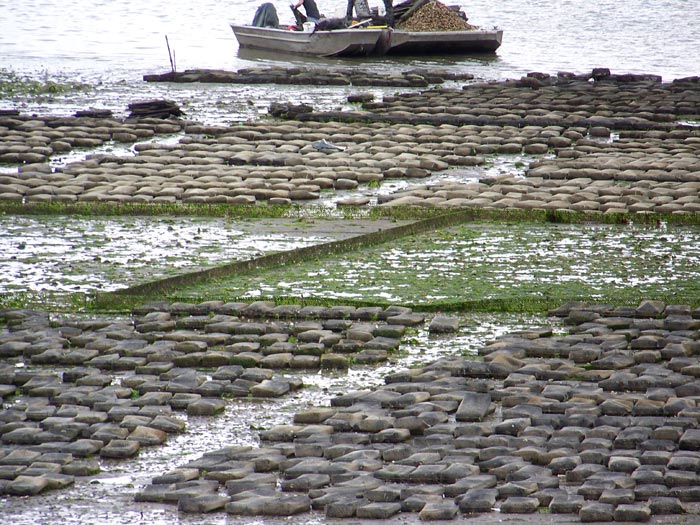
Totten Inlet Non-native Mussel Farm
Slated for Expansion
With Non-native invasive Tunicate Problems


The recently announced initiative does contain important components in the form of restoration of native species; financial assistance for upland owners' failing septic systems; financial assistance for
cattle and dairy farmers; and, increased access to publicly owned shoreline.  But make no mistake:  this effort is primarily an attempt to bypass regulations which have evolved over the past four years which the shellfish industry does not like.

Many citizens have watched the transformation of aquaculture from small mom and pop operations to large corporate entities.  Anyone who cares about Puget Sound should be very concerned about attempts to "streamline" permitting.  If this is allowed to move forward, future generations will only look back on this time and say "What were they thinking?"

You can help by supporting Case Inlet Shoreline Association (http://www.caseinlet.org/) and the Sierra Club (http://washington.sierraclub.org/tatoosh/Aquaculture/index.asp).

Thursday, December 8, 2011

Fudge Point Acquired by The Trust for Public Land

Fudge Point has been acquired by The Trust for Public Land. 
Outlined in red below are the uplands and tidelands (to mean low tide) which were purchased.  Tidelands between mean low tide and extreme low tide were excluded.  The pedestrian easement between extreme low tide and high tide which was established by Ralph Scott in 1991 to benefit the upland owners was extinguished by Taylor Shellfish and Russell and Richard Scott before the sale. 

Fudge Point Acquisition
(lines are approximate)

Tuesday, December 6, 2011

"There isn't any place I'm aware of that the tunicates are causing harm on the shellfish farms,"

Why would Taylor Shellfish state "There isn't any place I'm aware of that the tunicates are causing harm on the shellfish farms,"
http://www.cbsnews.com/8301-501363_162-57331539/environmental-programs-fall-victim-to-budget-cuts
"When Washington's Legislature trimmed $30 million, or 27 percent, from the state Department of Fish and Wildlife's budget, three employees who had been diving in the Puget Sound to hunt down invasive sea squirts lost their jobs.
The gelatinous invaders, known as tunicates, form a goopy mat on the sea floor, raising fears that they will hurt the shellfish industry, as they have in eastern Canada.
"We are basically addressing tunicates on an emergency basis only," said Allen Pleus, Washington state's aquatic invasive species coordinator..."There isn't any place I'm aware of that the tunicates are causing harm on the shellfish farms," said Bill Dewey, of Taylor Shellfish Farms in Shelton, Wash."

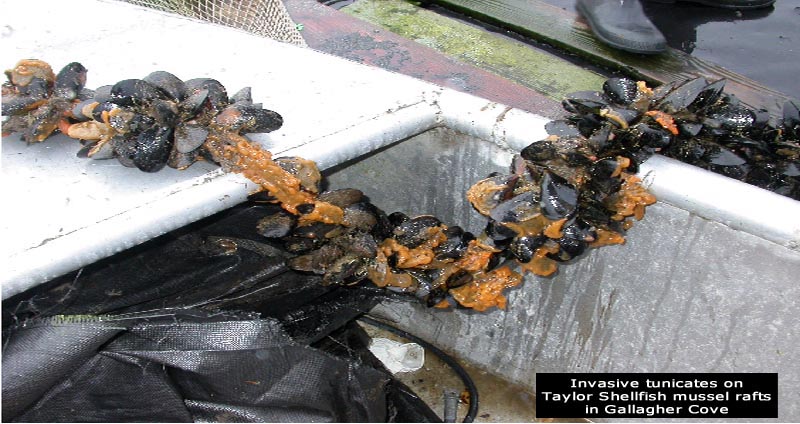
Images from Woodshole seem to clearly show non-native invasive Tunicates causing harm at Taylor Shellfish's mussel rafts in Totten Inlet:
http://woodshole.er.usgs.gov/project-pages/stellwagen/didemnum/images/pdf/wash4b.pdf
The British Columbia Shellfish Growers Association says this on their Aquatic Invasive Species page:
"On Canada’s East coast, invasive tunicates have resulted in significant grow-out, harvesting and processing challenges for the mussel farming industry."
"Tunicates can out compete and suffocate filter feeding bivalves such as mussels and oysters."

Taylor Shellfish has a great deal to loose if their mussel farm is found to be a vector for non-native invasive tunicates.  Taylor Shellfish has a great deal to loose if these tunicates smother their cultured mussels (which the Woodshole images seem to show clearly happening).  Taylor Shellfish has a great deal to loose if what they believe isn't currently causing harm begins to smother oysters which other growers in Totten Inlet and south Puget Sound are culturing.

Sometimes it is better to react to a problem before it becomes an ecological disaster.  Washington State should reconsider its budget cut which eliminated the Washington Department of Fish and Wildlife's program to control invasive tunicates.  Taylor Shellfish should reconsider their statement, for the good of everyone, and work towards helping reinstate funding for WDFW to control this very real threat to Puget Sound's ecosystem.

Tuesday, November 22, 2011

"the ideal Christmas present for your favorite regulator"

Created in part through a $160,000 grant from NOAA, "Shellfish Aquaculture and the Environment" is being promoted by the shellfish industry as "the ideal Christmas present for your favorite regulator."  In response, the Pacific Coast Shellfish Growers Association has ordered 26, presumably to pass out as gifts to their favorite regulator.  If you aren't a "favorite regulator" they are available for $219.95.
http://www.wiley.com/WileyCDA/WileyTitle/productCd-0813814138,descCd-authorInfo.html

The caveat to those regulators fortunate enough to receive one, or with a budget line large enough to order one, is it was created by and for the shellfish industry to promote their business.

Section 5, Science, of Executive Order 13563, relating to "Scientific Integrity" reads: "...each agency shall ensure the objectivity of any scientific and technological information and processes used to support the agency's regulatory actions."   Good words to include in your thank-you card.

Monday, November 14, 2011

Trespass Settlement Terms Disputed

The Squaxin Tribe has challenged 2010 trespass settlement terms.

Should the bigger question be:  Were the 17 treaty Indian tribes aware in 2007 tidelands managed by the State may have Tribal Treaty rights impacted?
 http://nwifc.org/about-us/shellfish/commercial-shellfish-growers-settlement/

In 2010, settlement terms for trespassing may have done so. 

In 2009 Taylor Shellfish, Seattle Shellfish, and Arcadia Point Seafood were all found to be trespassing on State tidelands.  These tidelands were adjacent to private tidelands which had been leased and cultivated, in one case since 1998.  Over this period one, perhaps two harvests occurred with the recent plantings being perhaps a third "crop."  In the 1998 case, settlement terms allowed harvest of the 1/2 acre of planted State lands for a payment of $75,000.

[Our comment:  1/2 acre of geoduck, after expenses, nets up to $500,000 for the grower.  Was a settlement of $75,000 for geoduck worth $500,000 in the best interest of the State and the Tribes?  Were Tribal members notified cultivation and harvesting would occur on State tidelands when letters from the growers were mailed or did those letters only identify the privately held tideland parcels?  Should the growers be allowed to retain ownership of the geoduck planted on State tidelands?]

The Squaxin Tribe does not agree with the settlement terms for reasons outlined in a Magistrate's decision here: 
http://turtletalk.files.wordpress.com/2011/10/dct-order.pdf 

If the Magistrate's decision stands, should the 2007 settlement also be challenged?

Sunday, November 6, 2011

Being Frank: Corps' permit program threatens salmon habitat

http://www.auburn-reporter.com/opinion/133019253.html
Billy Frank writes about the Nationwide Permit program:  
"...There's also little consideration of how multiple projects in a certain area might result in greater habitat damage."
"The Clean Water Act says that the Corps can't authorize the permits if they cause more than minor harm to the marine ecosystem alone, or combined."
"The Corps' nationwide streamlined permit process might make sense in other parts of the country, but not here. This isn't the Mississippi River or Florida. They don't have salmon. We do, and they're in trouble."
"We're not asking the Corps to stop issuing permits for shoreline work nationwide, but rather for the Seattle District Office to switch to an individual permit system that acknowledges the need to protect and restore salmon habitat in Western Washington."

Our comment:  We agree.  We would also add it is time for agencies and the public to turn around and look at what is happening to the intertidal tideland ecosystem through this program and others.  Aquaculture is transforming the most critical habitat area used by salmon into a sea of plastic growout bags, PVC tube structures on the tidelands, and fields of mussel rafts on the water. 

Taylor Shellfish tideland farm in North Bay, Case Inlet.
Plastic grow-out bags

PVC Tubing

Invasive tunicates growing on mussel rafts in Gallagher Cove

Claims of creating "structure" and "biodiversity" are countered with the fact this artificial ecosystem and anything dependent on it is destroyed every time harvesting occurs, as was the original ecosystem in place.  Recovery?  It will never recover as long as "farming" cycles occur.  Biodiversity?  Introduction of non-native species and creating "structure" where invasive species take hold (see tunicates on non-native mussels above) is not healthy for Puget Sound.

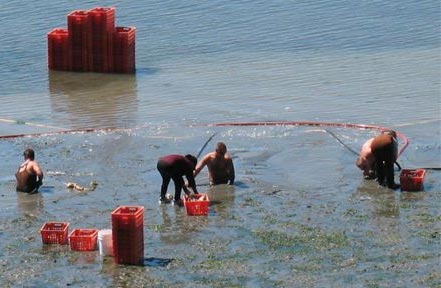
Taylor Shellfish Foss Farm - geoduck harvesters 'in the hole.'
("harvesting" geoduck through injection and liquefication of sediments)
(note sediment plume behind "farmers")

To allow cumulative adverse impacts to occur through the Nationwide Permit program, whether through tideland development or through upland development, together or alone, puts habitat the salmon of Puget Sound rely on at great risk.  We believe the Clean Water Act is clear.

Tuesday, November 1, 2011

Superior Court Transcript Denying Taylor/Arcadia Petition

A transcript detailing why the Thurston County Superior Court denied the petition from Taylor Shellfish and Arcadia Point Seafood is found here:  http://www.caseinlet.org/uploads/taylor_10-21-11.pdf

In clear logic it affirms Thurston County's decision to require a Shoreline Substantial Development Permit for the proposed Thiesen/McClure/Lockhart geoduck farms based on the fact that the PVC tubes and netting are a structure, therefor a development. 

The task of ensuring Puget Sound's most critical habitat - the intertidal tideland area - will be regulated as the Shoreline Management Act intended has taken a great step forward. 

Tuesday, October 25, 2011

Superior Court Agrees: Geoduck Farms Require Shoreline Permits in Thurston County

The Superior Court agrees that Thurston County is able to require Shoreline Substantial Development Permits (SSDP) for geoduck farms.   It has accepted the fact that geoduck farms' use of structures within the tidelands of Puget Sound allow - in fact require - county regulatory oversight to ensure the goals of the Shoreline Management Act are achieved.  In so doing it has rejected the shellfish industry's attempt to create law through an opinion issued by the Attorney General in 2007 which felt a geoduck farm's placement of PVC, netting, bands and rebar within the tidelands was not a structure. 


RCW 90.58.020 clearly defines what the Shoreline Management Act was intended to accomplish.  http://apps.leg.wa.gov/rcw/default.aspx?cite=90.58.020

It states "the shorelines of the state are among the most valuable and fragile of its natural resources and . . . there is great concern throughout the state relating to their utilization, protection, restoration, and preservation." .  It states further that "[i]n the implementation of this policy the public's opportunity to enjoy the physical and aesthetic qualities of natural shorelines of the state shall be preserved to the greatest extent feasible consistent with the overall best interest of the state and the people generally."

It was never intended to give the shellfish industry unregulated rights to develop the tidelands any more than it was intended to give upland shoreline property owners the right to unregulated development.


Wednesday, October 19, 2011

New Burley Lagoon Area Geoduck Operations

A new geoduck farm near the mouth of Burley Lagoon is being proposed.
http://www.nws.usace.army.mil/PublicMenu/documents/REG/NWS-2009-1530-PN.pdf
Comments are due November 16.

Unique to this proposal and what should be of concern to everyone is the expansion from intertidal farming into the nearshore subtidal area, to a depth of 38'.   Nothing like this has been proposed nor been considered by any agency other than DNR who does not allow "harvesting" of subtidal depths between the lowest tide and a depth of 18 feet. 

As proposed the farm will be planted in five annual rotations, the effect of which will be continual impacts to the area from PVC tube insertion/removal; net placement, cleaning and removal; and, sediment plumes from dive harvesting (subtidally) and "dry" harvesting (areas exposed at low tide).

Eel grass beds contained within these tidelands provide critical habitat for Pacific Herring; Steelhead; Cutthroat; and, Chinook.  As seen in Ecology's condition for the Jamestown S'Klallam geoduck farm, impacts to eel grass beds from farm activities are unknown.  Common sense dictates dive harvesting and other activities will spread a plume of sediment far wider than the proposed 10' buffer.  As clearly stated in the July 17, 2009 letter from Pierce County to Mr. DeTienne:

"The range of buffers referenced in literature varies from 10 feet (the standard buffer required in Hydraulic Project Approvals and the distance referenced in the recent U.S. Fish and Wildlife Service and National Marine Fisheries Service biological opinions) to 180 feet (referenced in the 2001 State Final Environmental Impact Statement which pertains to subtidal harvest)."
(It should be noted that an Environmental Impact Statement is far more rigorous than a "biological opinion," which is just that - an opinion.  It is the EIS which requires the 180' buffer.)
The critical habitat provided by Burley Lagoon and the nearshore area at its mouth is already at risk.  Whether from past and current upland activities or proposed future activities related to the expansion of geoduck farming, the specific and cumulative adverse impacts to this critical area - and to Puget Sound in general - need to be fully considered before any expansion of geoduck farming is permitted.

Monday, October 10, 2011

Ecology Issues New 401 Certification


Kilisut Harbor Geoduck Farm
Approved by Ecology

Kilisut Harbor
(From Google Maps)

The Department of Ecology has issued its first Section 401 Water Quality Certification for a new geoduck  farm in Puget Sound, operated by the Jamestown S'Klallam tribe. 

Proposed is a 1.5 acre farm on what is known as Beach 2 on the northeast shore of Naval Magazine Indian Island.  The farm will be planted annually in 12,000 square foot sections, resulting in farming impacts occurring each year over the typical 5 year cycle. 

Since 1939 this island has been used as a Naval weapons station.  In part, runoff from these storage areas has resulted in Beach 2 being closed to shellfish harvesting, with it only recently having been opened (storage bunkers adjacent to this location are seen in the photo above).  Whether these historical contaminants still exist in sediments from which the geoduck are harvested is unknown, but past studies indicate constricted estuaries with historical pollution have contaminants still contained in the deeper sediments.

Kilisut Harbor is also one of the critical habitat areas for the Cherry Point Herring population, currently in decline.  Significant areas of Eel Grass are used for spawning by this population.  As noted in the certification, beds of Eel Grass are adjacent to the proposed farm.  Impacts to these beds from farm activities are currently unknown.

Will sediments disturbed impact this habitat?  Are contaminants still held within the sediments which will be released upon harvesting?  Constricted outlets at both the south and north ends of Kilisut Harbor make flushing of the harbor less than ideal and whatever is disturbed will remain for an unknown period of time.

WAC  173-201A-400(4) states:  No mixing zone shall be granted unless the supporting information clearly indicates the mixing zone would not have a reasonable potential to cause a loss of sensitive or important habitat, substantially interfere with the existing or characteristic uses of the water body, result in damage to the ecosystem, or adversely affect public health as determined by the department.

Has Ecology's allowing a "mixing zone" of 150' met the above?  The proposed Eel Grass study which is part of the 401 Certification clearly indicates impacts from geoduck farming on beds of Eel Grass are unknown.  Are deeper sediments still contaminated, increasing the risk again of exposure to arsenic and BEHP which had kept this beach closed in the past?  Samples of the upper 10cm are not adequate to answer this question. 

WDFW has clearly established Kilisut Harbor as a priority habitat area.  Species of forage fish and critical habitat are well documented.

The Jamestown S'Klallam Tribe notes the following on its web site:
We, the Port Gamble S’Klallam and the Jamestown S’Klallam Tribes, of the Point No Point Treaty Area, recognize the responsibility and need to protect and advance the treaty reserved hunting, fishing and gathering rights of our Tribes.

Contained within the responsibility of protecting reserved hunting, fishing and gathering rights is consideration of whether an intertidal geoduck farm in this critical habitat area meets this stated goal for everyone and everything.